
Pulp Fiction, 1917 · page 42 of 228
Adventure, February 1917 — page 42: what you’re looking at
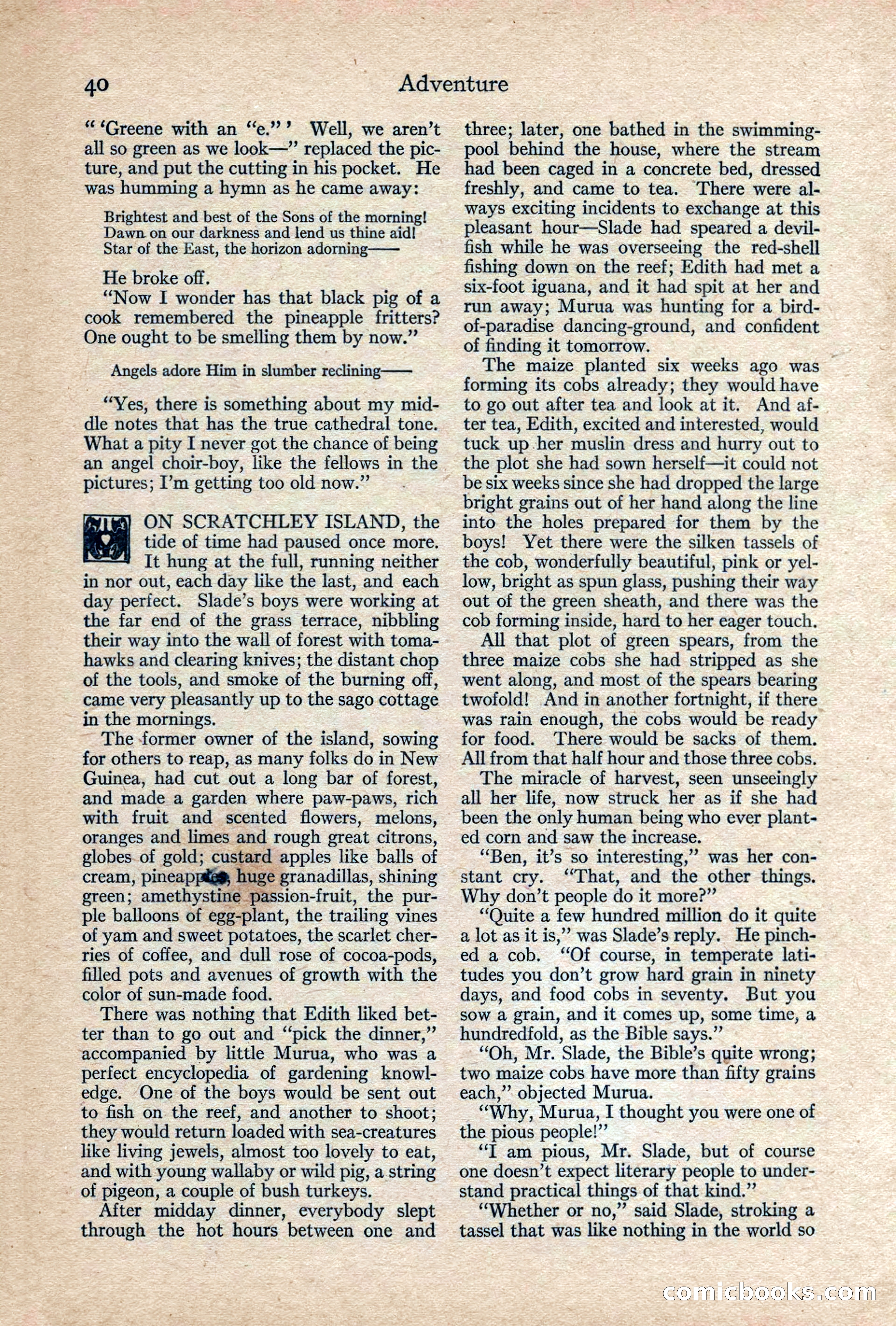
A restored page from Pulp Fiction, 1917. Page through the whole issue in the reader above.
📄 Transcribed text from this page (OCR, searchable)
Machine-transcribed from the original scan — historical spelling and the odd misread are preserved.
40 “ ‘Greene with an ‘“‘e.”’ Well, we aren’t all so green as we look—’” replaced the pic- ture, and put the cutting in his pocket. He was humming a hymn as he came away: Brightest and best of the Sons of the morning! Dawn on our darkness and lend us thine aid! Star of the East, the horizon adorning—— He broke off. “Now I wonder has that black pig of a cook remembered the pineapple fritters? One ought to be smelling them by now.” Angels adore Him in slumber reclining—— | “Ves, there is something about my mid- dle notes that has the true cathedral tone. What a pity I never got the chance of being an angel choir-boy, like the fellows in the. pictures; I’m getting too old now.” ON SCRATCHLEY ISLAND, the tide of time had paused once more. = it hung at the full, running neither in nor out, each day like the last, and each day perfect. Slade’s boys were working at the far end of the grass terrace, nibbling their way into the wall of forest with toma- hawks and clearing knives; the distant chop of the tools, and smoke of the burning off, came very pleasantly up to the sago cottage in the mornings. The former owner of the island, sowing for others to reap, as many folks do in New Guinea, had cut out a long bar of forest, and made a garden where paw-paws, rich with fruit and scented flowers, melons, oranges and limes and rough great citrons, globes. of gold; custard apples like balls of cream, pineapptg® huge granadillas, shining green; amethystine passion-fruit, the pur- ple balloons of egg-plant, the trailing vines of yam and sweet potatoes, the scarlet cher- ries of coffee, and dull rose of cocoa-pods, filled pots and avenues of growth with the color of sun-made food. There was nothing that Edith liked bet- ter than to go out and “pick the dinner,” accompanied by little Murua, who was a perfect encyclopedia of gardening knowl- edge. One of the boys would be sent out to fish on the reef, and another to shoot; they would return loaded with sea-creatures like living jewels, almost too lovely to eat, _ and with young wallaby or wild pig, a string - of pigeon, a couple of bush turkeys. After midday dinner, everybody slept through the hot hours between one and Adventure three; later, one bathed in the swimming- pool behind the house, where the stream had been caged in a concrete bed, dressed freshly, and came to tea. There were al- ways exciting incidents to exchange at this pleasant hour—Slade had speared a devil- fish while he was overseeing the red-shell fishing down on the reef; Edith had met a ~ six-foot iguana, and it had spit at her and run away; Murua was hunting for a bird- of-paradise dancing-ground, and confident of finding it tomorrow. The maize planted six weeks ago was forming its cobs already; they would have to go out after tea and look at it. And af- ter tea, Edith, excited and interested, would tuck up her muslin dress and hurry out to the plot she had sown herself—it could not be six weeks since she had dropped the large bright grains out of her hand along the line into the holes prepared for them by the boys! Yet there were the silken tassels of the cob, wonderfully beautiful, pink or yel- low, bright as spun glass, pushing their way out of the green sheath, and there was the cob forming inside, hard to her eager touch. All that plot of green spears, from the three maize cobs she had stripped as she went along, and most of the spears bearing twofold! And in another fortnight, if there was rain enough, the cobs would be ready for food. There would be sacks of them. All from that half hour and those three cobs. The miracle of harvest, seen unseeingly all her life, now struck her as if she had been the only human being who ever plant- ed corn and saw the increase. “Ben, it’s so interesting,’ was her con- stant cry. “That, and the other things. Why don’t people do it more?” “Quite a few hundred million do it quite a lot as it is,” was Slade’s reply. He pinch- ed a cob. “Of course, in temperate lati- tudes you don’t grow hard grain in ninety days, and food cobs in seventy. But you sow a grain, and it comes up, some time, a hundredfold, as the Bible says.” “Oh, Mr. Slade, the Bible’s quite wrong; two maize cobs have more than fifty grains each,” objected Murua. “Why, Murua, I thought you were one of the pious people!” “T am pious, Mr. Slade, but of course one doesn’t expect literary people to under- stand practical things of that kind.” “Whether or no,” said Slade, stroking a tassel that was like nothing in the world so CEOMMELOOC cS