
Pulp Fiction, 1917 · page 43 of 228
Adventure, February 1917 — page 43: what you’re looking at
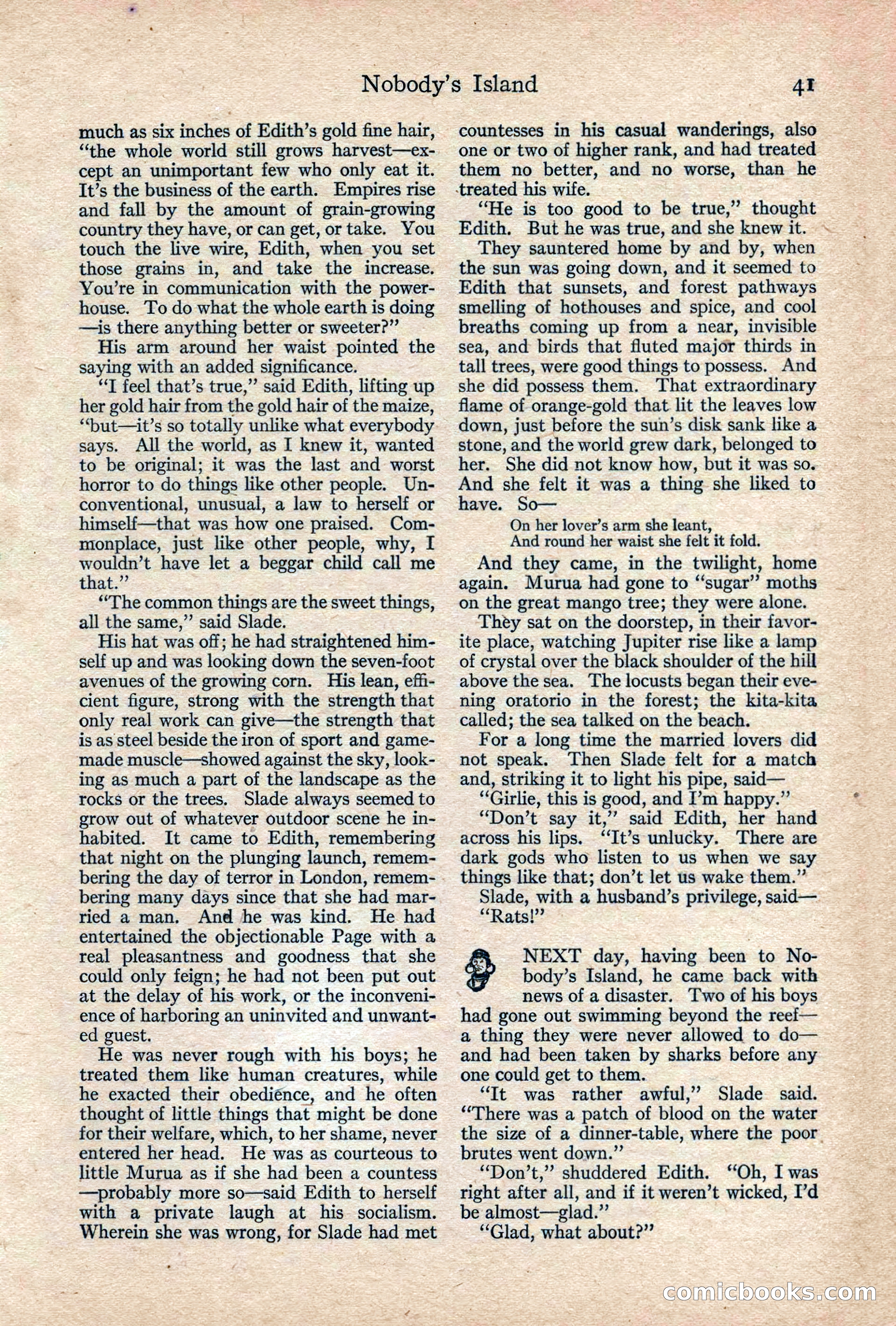
A restored page from Pulp Fiction, 1917. Page through the whole issue in the reader above.
📄 Transcribed text from this page (OCR, searchable)
Machine-transcribed from the original scan — historical spelling and the odd misread are preserved.
Nobody's Island much as six inches of Edith’s gold fine hair, “the whole world still grows harvest—ex- cept an unimportant few who only eat it. It’s the business of the earth. Empires rise and fall by the amount of grain-growing country they have, or can get, or take. You touch the live wire, Edith, when you set those grains in, and take the increase. You’re in communication with the power- house. To do what the whole earth is doing —is there anything better or sweeter?”’ His arm around her waist pointed the saying with an added significance. “T feel that’s true,” said Edith, lifting up her gold hair from the gold hair of the maize, “‘but—it’s so totally unlike what everybody says. All the world, as I knew it, wanted to be original; it was the last and worst horror to do things like other people. Un- conventional, unusual, a law to herself or himself—that was how one praised. Com- mionplace, just like other people, why, I wouldn’t have let a beggar child call me that.” “The common things are the sweet things, all the same,” said Slade. His hat was off; he had straightened him- self up and was looking down the seven-foot avenues of the growing corn. His lean, effi- cient figure, strong with the strength that only real work can give—the strength that is as steel beside the iron of sport and game- made muscle—showed against the sky, look- ing as much a part of the landscape as the rocks or the trees. Slade always seemed to grow out of whatever outdoor scene he in- habited. It came to Edith, remembering that night on the plunging launch, remem- bering the day of terror in London, remem- bering many days since that she had mar- ried a man, And he was kind. He had entertained the objectionable Page with a real pleasantness and goodness that she could only feign; he had not been put out at the delay of his work, or the inconveni- ence of harboring an uninvited and unwant- ed guest. He was never rough with his boys; he treated them like human creatures, while he exacted their obediénce, and he often thought of little things that might be done for their welfare, which, to her shame, never entered her head. He was as courteous to little Murua as if she had been a countess —probably more so—said Edith to herself with a private laugh at his. socialism. Wherein she was wrong, for Slade had met AI countesses in his casual wanderings, also one or two of higher rank, and had treated them no better, and no worse, than he treated his wife. “He is too good to be true,” thought Edith. But he was true, and she knew it. They sauntered home by and by, when the sun was going down, and it seemed to Edith that sunsets, and forest pathways smelling of hothouses and spice, and cool breaths coming up from a near, invisible sea, and birds that fluted major thirds in tall trees, were good things to possess. And she did possess them. That extraordinary flame of orange-gold that lit the leaves low down, just before the sun’s disk sank like a stone, and the world grew dark, belonged to her. She did not know how, but it was so. And she felt it was a thing she liked to _ have. So— On her lover’s arm she lean And round her waist she felt it fold. And they came, in the twilight, home again. Murua had gone to “sugar” moths on the great mango tree; they were alone. They sat on the doorstep, in their favor- ite place, watching Jupiter rise like a lamp of crystal over the black shoulder of the hill above the sea. The locusts began their eve- ning oratorio in the forest; the kita-kita called; the sea talked on the beach. For a long time the married lovers did not speak. Then Slade felt for a match and, striking it to light his pipe, said— “Girlie, this is good, and I’m happy.” “Don’t say it,” said Edith, her hand across his lips. ‘It’s unlucky. There are dark gods who listen to us when we say things like that; don’t let us wake them.” Slade, with a husband’s privilege, said— “Rats!” body’s Island, he came back with news of a disaster. Two of his boys had gone out swimming beyond the reef— a thing they were never allowed to do— and had been taken by sharks before any one could get to them. “It was rather awful,” Slade said. ‘‘There was a patch of blood on the water the size of a dinner-table, where the poor brutes went down.” “Don’t,” shuddered Edith. ‘Oh, I was right after all, and if it weren’t wicked, I'd be almost—glad. 2 “Glad, what about?” EOPMICL OO NEXT day, having been to No- (E@)