
Pulp Fiction, 1917 · page 41 of 228
Adventure, February 1917 — page 41: what you’re looking at
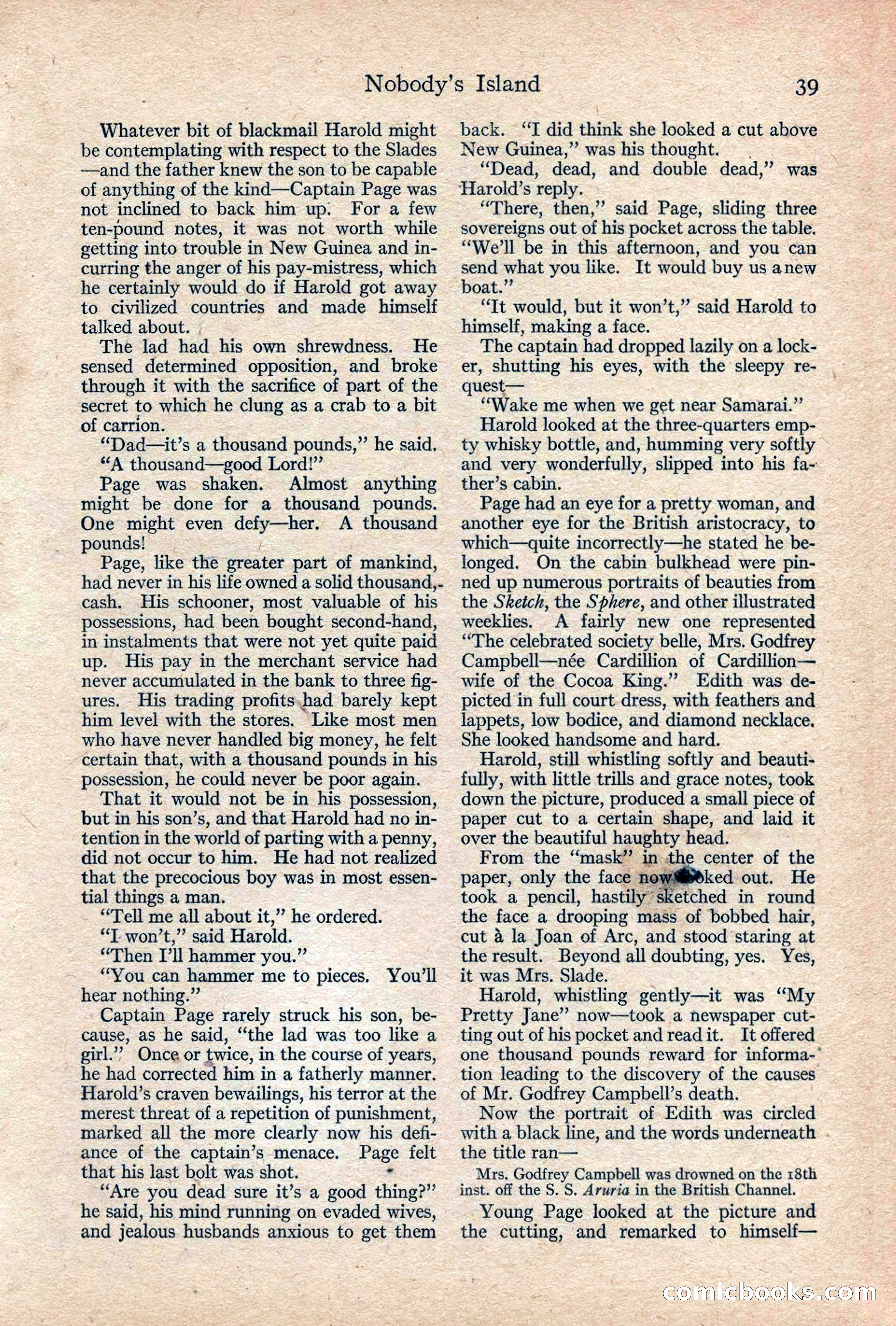
A restored page from Pulp Fiction, 1917. Page through the whole issue in the reader above.
📄 Transcribed text from this page (OCR, searchable)
Machine-transcribed from the original scan — historical spelling and the odd misread are preserved.
Nobody’s Island Whatever bit of blackmail Harold might be contemplating with respect to the Slades —and the father knew the son to be capable of anything of the kind—Captain Page was not inclined to back him up. For a few ten-pound notes, it was not worth while getting into trouble in New Guinea and in- curring the anger of his pay-mistress, which he certainly would do if Harold got away to civilized countries and made himself talked about. | | The lad had his own shrewdness. He sensed determined opposition, and broke through it with the sacrifice of part of the secret to which he clung as a crab to a bit of carrion. “Dad—it’s a thousand pounds,” he said. “A thousand—good Lord!” Page was shaken. Almost anything might be done for a thousand pounds. One might even defy—her. A thousand pounds! Page, like the greater part of mankind, had never in his life owned a solid thousand,. cash. His schooner, most valuable of his possessions, had been bought second-hand, in instalments that were not yet quite paid up. His pay in the merchant service had never accumulated in the bank to three fig- ures. His trading profits.had barely kept him level with the stores. Like most men who have never handled big money, he felt certain that, with a thousand pounds in his possession, he could never be poor again. That it would not be in his possession, but in his son’s, and that Harold had no in- tention in the world of parting with a penny, did not occur to him. He had not realized that the precocious boy was in most essen- tial things a man. “Tell me all about it,’”’ he ordered. “TI. won’t,” said Harold. “Then I'll hammer you.” “You can hammer me to pieces. hear nothing.” -. Captain Page rarely struck his son, be- cause, as he said, ‘“‘the lad was too like a girl.”’? Once or twice, in the course of years, he had corrected him in a fatherly manner. Harold’s craven bewailings, his terror at the merest threat of a repetition of punishment, marked all the more clearly now his defi- ance of the captain’s menace. Page felt that his last bolt was shot. ° “‘Are you dead sure it’s a good thing?”’ he said, his mind running on evaded wives, and jealous husbands anxious to get them You’ll 39 back. ‘‘I did think she looked a cut above New Guinea,” was his thought. “Dead, dead, and double dead, *? was ‘Harold’s reply. “There, then,” said Page, sliding three sovereigns out of his pocket across the table. “We'll be in this afternoon, and you can send what you like. It would buy us anew boat.” “Tt would, but it won’t,” said Harold to himself, making a face. The captain had dropped lazily on a lock- er, shutting his eyes, with the sleepy re- quest— ‘‘Wake me when we get near Samarai.”’ Harold looked at the three-quarters emp- ty whisky bottle, and, humming very softly and very wonderfully, slipped into his fa- ther’s cabin. Page had an eye for a pretty woman, and another eye for the British aristocracy, to which—quite incorrectly—he stated he be- longed. On the cabin bulkhead were pin- ned up numerous portraits of beauties from the Skeich, the Sphere, and other illustrated weeklies. A fairly new one represented “‘The celebrated society belle, Mrs. Godfrey | Campbell—née Cardillion of Cardillion— — wife of the Cocoa King.” Edith was de- picted in full court dress, with feathers and lappets, low bodice, and diamond necklace. She looked handsome and hard. Harold, still whistling softly and beauti- fully, with little trills and grace notes, took down the picture, produced a small piece of paper cut to a certain shape, and laid it over the beautiful egtenty head. / From the “mask” in paper, only the face be yn took a pencil, hastily ’s the face a drooping mass of bobbed hair, cut & la Joan of Arc, and stood staring at the result. Beyond all doubting, yes. Yes, it was Mrs. Slade. | Harold, whistling gently—it was “My Pretty Jane” now—took a newspaper cut- ting out of his pocket and readit. It offered one thousand pounds reward for informa-’ tion leading to the discovery of the causes of Mr. Godfrey Campbell’s death. Now the portrait of Edith was circled with a black line, and the words underneath . the title ran— Mrs. Godfrey Campbell was drowned on the 18th inst. off the S. S. Aruria in the British Channel. Young Page looked at the picture and the cutting, and remarked to himself— 0)(0)(6) S COME (E©)