
Pulp Fiction, 1917 · page 11 of 228
Adventure, February 1917 — page 11: what you’re looking at
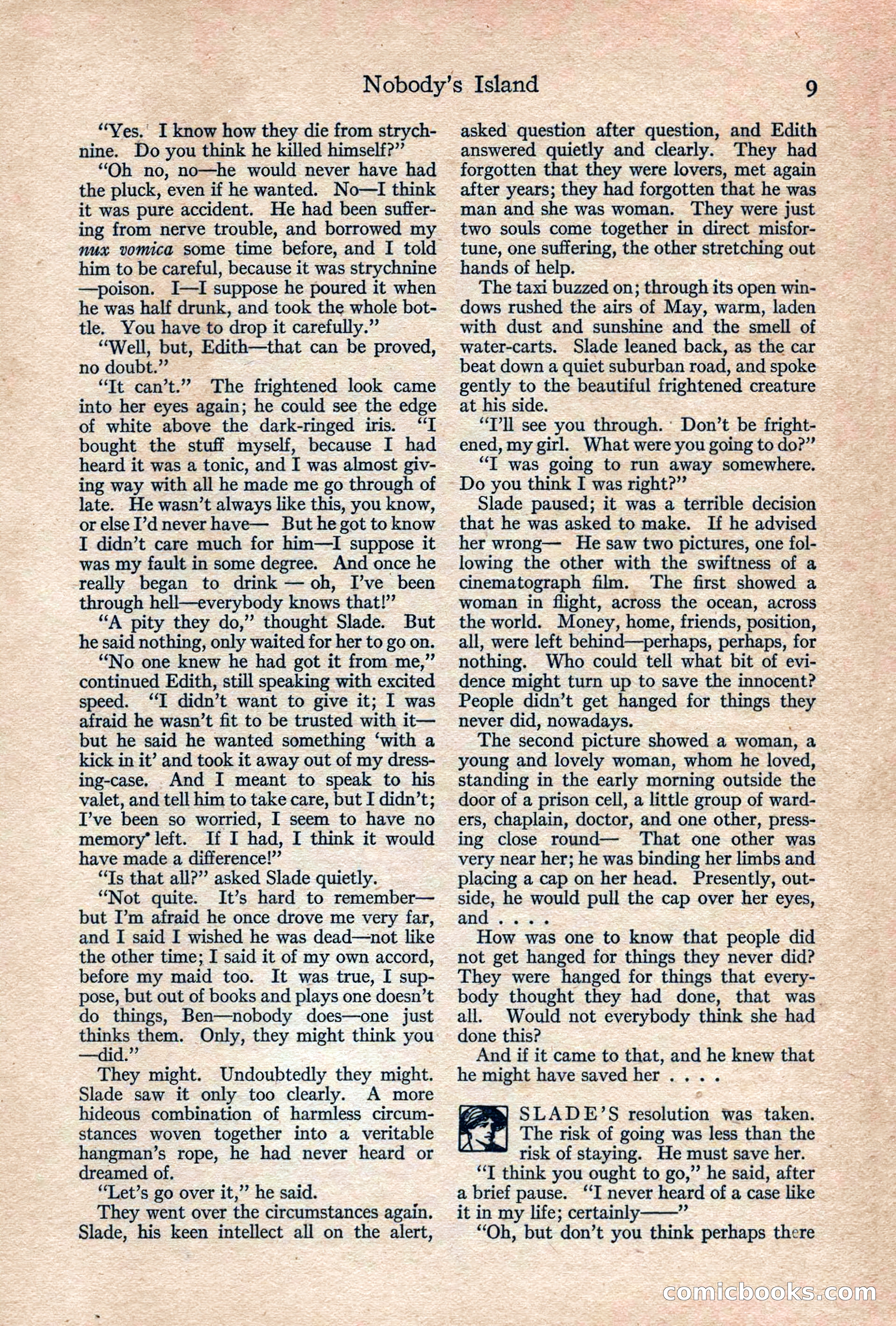
A restored page from Pulp Fiction, 1917. Page through the whole issue in the reader above.
📄 Transcribed text from this page (OCR, searchable)
Machine-transcribed from the original scan — historical spelling and the odd misread are preserved.
Nobody’s Island “Yes. I know how they die from strych- nine. Do you think he killed himself?” “Oh no, no—he would never have had the pluck, even if he wanted. No—I think it was pure accident. He had been suffer- ing from nerve trouble, and borrowed my nux vomica some time before, and I told him to be careful, because it was strychnine —poison. I—I suppose he poured it when he was half drunk, and took the whole bot- tle. You have to drop it carefully.” “Well, but, Edith—that can be proved, no doubt.” “Tt can’t.” The frightened look came into her eyes again; he could see the edge of white above the dark-ringed iris. “I bought the stuff myself, because I had heard it was a tonic, and I was almost giv- ing way with all he made me go through of late. He wasn’t always like this, you know, or else I’d never have— But he got to know I didn’t care much for him—lI suppose it was my fault in some degree. And once he really began to drink — oh, I’ve been through hell—everybody knows that!” “A pity they do,” thought Slade. But he said nothing, only waited for her to go on. “No one knew he had got it from me,”’ continued Edith, still speaking with excited speed. “I didn’t want to give it; I was afraid he wasn’t fit to be trusted with it— but he said he wanted something ‘with a kick in it’ and took it away out of my dress- ing-case. And I meant to speak to his valet, and tell him to take care, but I didn’t; I’ve been so worried, I seem to have no memory’ left. If I had, I think it would have made a difference!” “Ts that all?” asked Slade quietly. “Not quite. It’s hard to remember— but I’m afraid he once drove me very far, and I said I wished he was dead—not like the other time; I said it of my own accord, before my maid too. It was true, I sup- pose, but out of books and plays one doesn’t do things, Ben—nobody does—one just thinks them. Only, they might think you —did.” They might. Undoubtedly they might. Slade saw it only too clearly. A more hideous combination of harmless circum- stances woven together into a veritable hangman’s rope, he had never heard or dreamed of. “Let’s go over it,” he said. They went over the circumstances again. Slade, his keen intellect all on the alert, 9 asked question after question, and Edith ~ answered quietly and clearly. They had forgotten that they were lovers, met again after years; they had forgotten that he was man and she was woman. They were just two souls come together in direct misfor- tune, one suffering, the other stretching out hands of help. The taxi buzzed on; through its open win- dows rushed the airs ‘of May, warm, laden with dust and sunshine and the smell of water-carts. Slade leaned back, as the car beat down a quiet suburban road, and spoke gently to the beautiful frightened creature at his side. “T’ll see you through. ' Don’t be fright- ened, my girl. What were you going to do?” “IT was going to run away somewhere. Do you think I was right?” Slade paused; it was a terrible decision that he was asked to make. If he advised her wrong— He saw two pictures, one fol- lowing the other with the swiftness of a cinematograph film. The first showed a woman in flight, across the ocean, across the world. Money, home, friends, position, all, were left behind—perhaps, perhaps, for nothing. Who could tell what bit of evi- dence might turn up to save the innocent? People didn’t get hanged for things they never did, nowadays. The second picture showed a woman, a young and lovely woman, whom he loved, standing in the early morning outside the door of a prison cell, a little group of ward- ers, chaplain, doctor, and one other, press- ing close round— That one other was very near her; he was binding her limbs and placing a cap on her head. Presently, out- side, he would pull the cap over her eyes, and . How was one to know that people did not get hanged for things they never did? They were hanged for things that every- body thought they had done, that was. all. Would not everybody think she had done this? And if it came to that, and he knew that he might have saved her .... The risk of going was less than the © SLADE’S resolution was taken. A risk of staying. He must save her. “T think you ought to go,” he said, after a brief pause. “TI never heard of a case like it in my life; certainly——” “Oh, but don’t you think perhaps there Gomichbooks ico