
Pulp Fiction, 1917 · page 10 of 228
Adventure, February 1917 — page 10: what you’re looking at
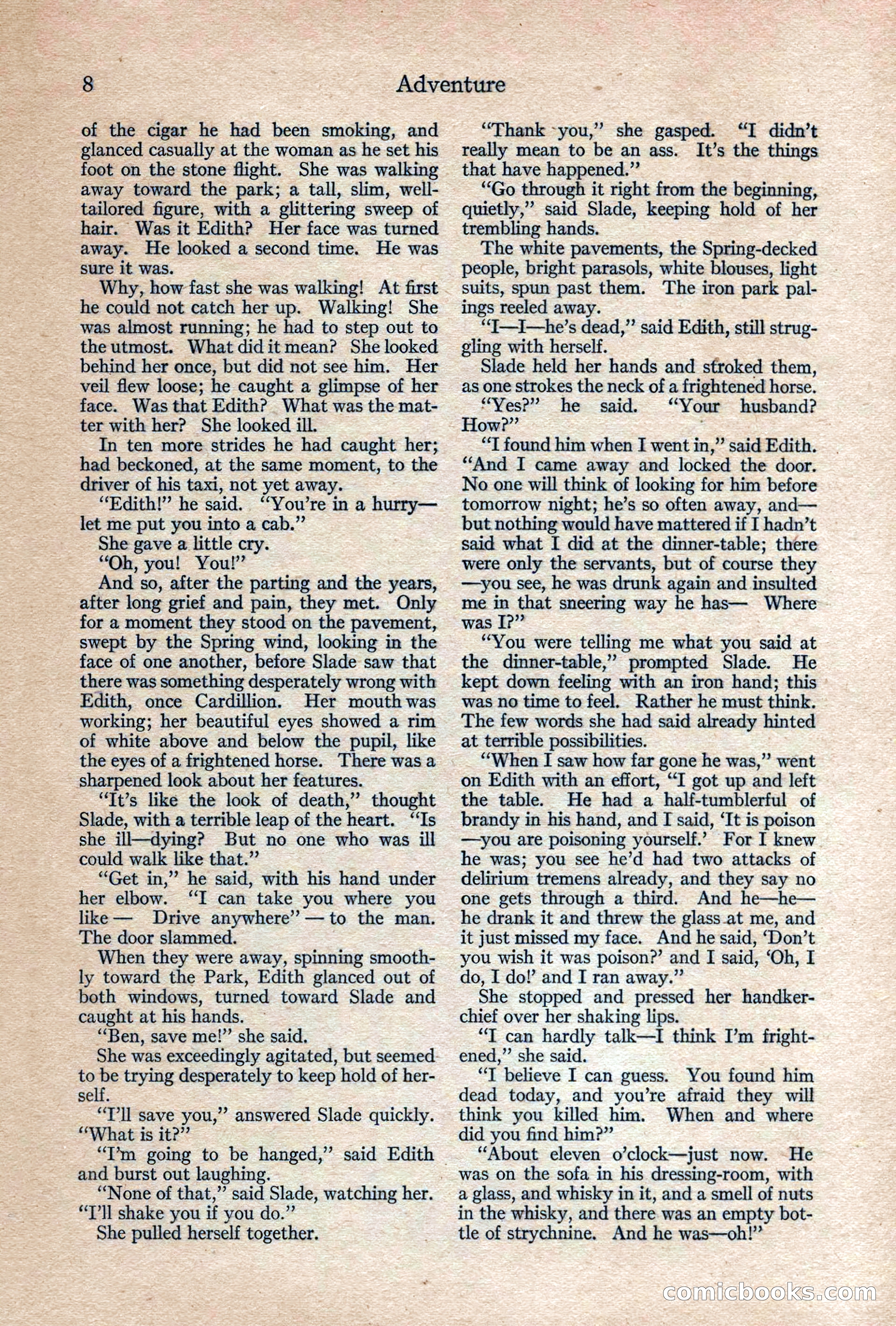
A restored page from Pulp Fiction, 1917. Page through the whole issue in the reader above.
📄 Transcribed text from this page (OCR, searchable)
Machine-transcribed from the original scan — historical spelling and the odd misread are preserved.
8 Adventure : of the cigar he had been smoking, and glanced casually at the woman as he set his foot on the stone flight. She was walking away toward the park; a tall, slim, well- tailored figure, with a glittering sweep of hair. Was it Edith? Her face was turned away. He looked a second time. He was sure it was. Why, how fast she was walking! At first - he could not catch her up. Walking! She was almost running; he had to step out to the utmost. What diditmean? She looked behind her once, but did not see him. Her veil flew loose; he caught a glimpse of her face. Was that Edith? What was the mat- ter with her? She looked ill. In ten more strides he had caught her; had beckoned, at the same moment, to the driver of his taxi, not yet away. “Edith!” he said. “You' re in a hurry— let me put you into a ca She gave a little cry. “Oh, you! You!” And so, after the parting and the years, after long grief and pain, they met. Only for a moment they stood on the pavement, swept by the Spring wind, looking in the face of one another, before Slade saw that there was something desperately wrong with Edith, once Cardillion. Her mouth was working; her beautiful eyes showed a rim of white above and below the pupil, like the eyes of a frightened horse. There was a sharpened look about her features. “Tt’s like the look of death,” thought Slade, with a terrible leap of the heart. “Is she ill—dying? But no one who was ill could walk like that.” “Get in,” he said, with his hand under her elbow. “I can take you where you like — Drive anywhere’ —to the man. The door slammed. When they were away, spinning smooth- ly toward the Park, Edith glanced out of both windows, turned toward Slade and caught at his hands. “Ben, save me!” she said, She was exceedingly agitated, but seemed. to be trying desperately to keep hold of her- self. “T’ll save you,” answered Slade quickly. “What is it?” “T’m going to be hanged,” said Edith © and burst out laughing. “None of that,” said Slade, watching her. “T’ll shake you if you do.” She pulled herself together. “Thank ~you,” she gasped. “I didn’t really mean to be an ass. It’s the things that have happened.” “Go through it right from the beginning, quietly,” said Slade, keeping hold of her trembling hands. The white pavements, the Spring-decked people, bright parasols, white blouses, light suits, spun past them. The iron park pal- ings reeled away “T—JI—he’s iead. ” said Edith, still strug- gling with herself. Slade held her hands and stroked them, as one strokes the neck of a frightened horse. “Yes?” he said. “Your husband? How?” : “T found him when I went in,” said Edith. “And I came away and locked the door. No one will think of looking for him before tomorrow night; he’s so often away, and— but nothing would have mattered if I hadn’t said what I did at the dinner-table; there were only the servants, but of course they —you see, he was drunk again and insulted me in that sneering way he has— Where was I?” “You were telling me what you said at the dinner-table,” prompted Slade. He kept down feeling with an iron hand; this was no time to feel. Rather he must think. The few words she had said already hinted at terrible possibilities. “When I saw how far gone he was,” went on Edith with an effort, “I got up and left the table. He had a half-tumblerful of brandy in his hand, and [I said, ‘It is poison —you are poisoning yourself.’ For I knew he was; you see he’d had two attacks of delirium tremens already, and they say no one gets through a third. And he—he— he drank it and threw the glass at me, and it just missed my face. And he said, ‘Don’t you wish it was poison?’ and I said, ‘Oh, I do, I do! and I ran away.” She stopped and pressed her handker- chief over her shaking lips. “T can hardly talk—I think I’m fright- ened,” she said. “T believe I can guess. You found him dead today, and you’re afraid they will think you killed him. When and where did you find him?” “About eleven o’clock—just now. ~He was on the sofa in his dressing-room, with a glass, and whisky in it, and a smell of nuts in the whisky, and there was an empty bot- tle of strychnine. And he was—oh!” Gomichbook (E@