
Pulp Fiction, 1917 · page 12 of 228
Adventure, February 1917 — page 12: what you’re looking at
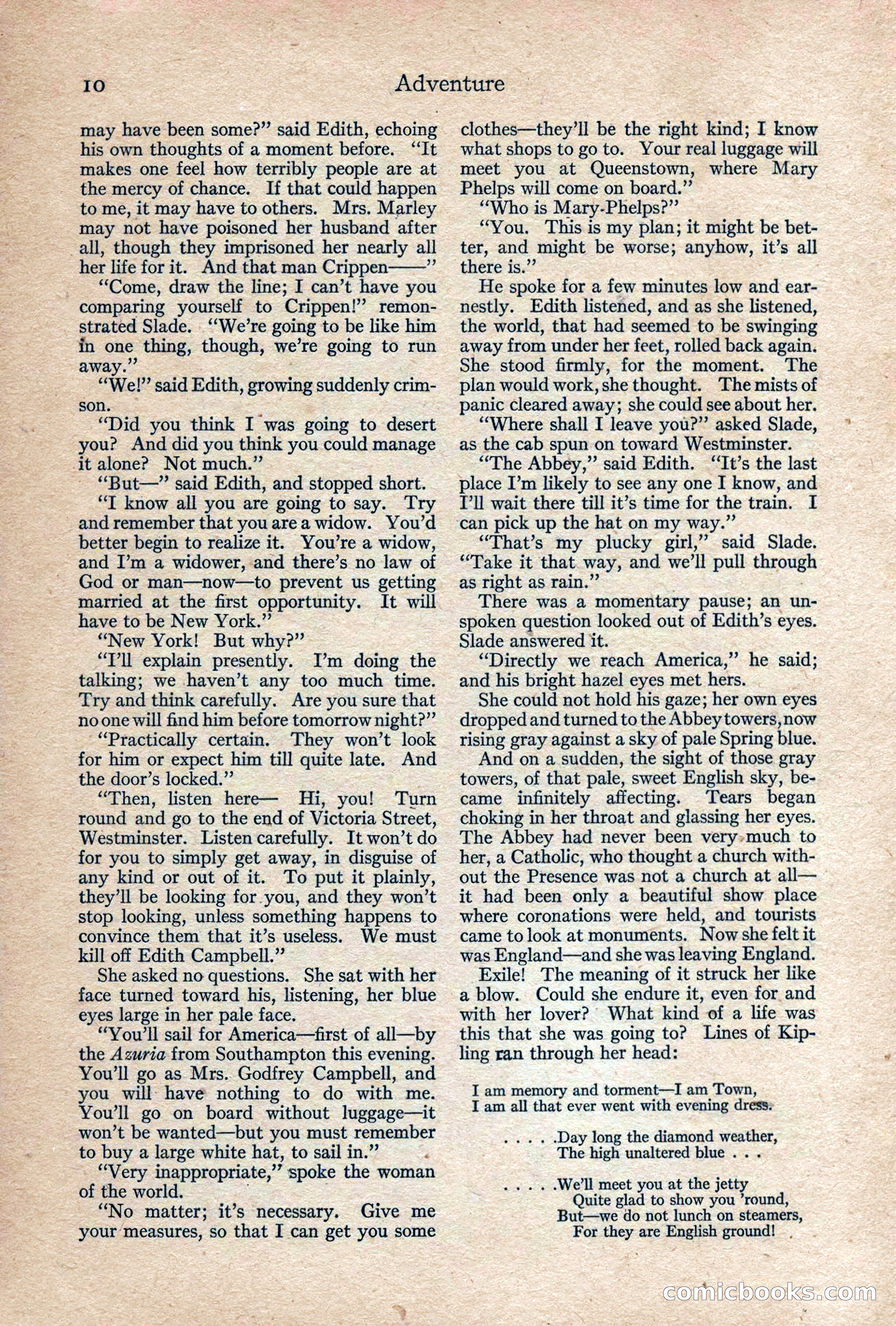
A restored page from Pulp Fiction, 1917. Page through the whole issue in the reader above.
📄 Transcribed text from this page (OCR, searchable)
Machine-transcribed from the original scan — historical spelling and the odd misread are preserved.
Io may have been some?” said Edith, echoing his own thoughts of a moment before. “It makes one feel how terribly people are at the mercy of chance. If that could happen to me, it may have to others. Mrs. Marley may not have poisoned her husband after all, though they imprisoned her nearly all her life for it. And that man Crippen——”’ “Come, draw the line; I can’t have you comparing yourself to Crippen!” remon- strated Slade. ‘‘We’re going to be like him in one thing, though, we’re going to run away Wel !’’ said Edith, growing suddenly crim- son. ‘Did you think I was going to desert you? And did you think you could manage it alone? Not much.” “But—” said Edith, and stopped short. “T know all you are going to say. Try and remember that you area widow. You’d better begin to realize it. You’re a widow, and I’m a widower, and there’s no law of God or man—now—to prevent us getting married at the first opportunity. It will have to be New York.” “New York! But why?” “T’ll explain presently. I’m doing the talking; we haven’t any too much time. Try and think carefully. Are you sure that noone will find him before tomorrow night?” “Practically certain. They won’t look for him or expect him till quite late. And the door’s locked.” “Then, listen here— Hi, you! Turn round and go to the end of Victoria Street, Westminster. Listen carefully. It won’t do for you to simply get away, in disguise of any kind or out of it. To put it plainly, they’ll be looking for.you, and they won’t stop looking, unless something happens to convince them that it’s useless. We must kill off Edith Campbell.” She asked no questions. She sat with her face turned toward his, listening, her blue eyes large in her pale face. “You'll sail for America—first of all—by the Azuria from Southampton this evening. You'll go as Mrs. Godfrey Campbell, and you will have nothing to do with me. You'll go on board without luggage—it won’t be wanted—but you must remember to buy a large white hat, to sail in.’ _ “Very inappropriate,’ , spoke the woman of the world. “No matter; it’s necessary. Give me your measures, so that I can get you some Adventure — clothes—they’ll be the right kind; I know what shops to go to. Your real luggage will meet you at Queenstown, where Mary Phelps will come on board.” “Who is Mary-Phelps?”’ “You. This is my plan; it might be bet- ter, and might be worse; anyhow, it’s all there is.’ | He spoke for a few minutes low and ear- nestly. Edith listened, and as she listened, the world, that had seemed to be swinging away from under her feet, rolled back again. She stood firmly, for the moment. The plan would work,she thought. The mists of panic cleared away; she could see about her. “Where shall I leave you?” asked Slade, as the cab spun on toward Westminster. “The Abbey,” said Edith. place I’m likely to see any one I know, and I’ll wait there till it’s time for the train. I can pick up the hat on my way.” “That’s my plucky girl,” said Slade. “Take it that. way, and we’ll pull Laroueh as right as rain.’ There was a momentary pause; an un- spoken question looked out of Edith’s eyes. Slade answered it. “Directly we reach America,” he said; and his bright hazel eyes met hers. She could not hold his gaze; her own eyes dropped and turned to the Abbey towers, now rising gray against a sky of pale Spring blue. And on a sudden, the sight of those gray towers, of that pale, sweet English sky, be- came infinitely affecting. Tears began choking in her throat and glassing her eyes. The Abbey had never been very»much to her, a Catholic, who thought a church with- out the Presence was not a church at all— it had been only a beautiful show place where coronations were held, and tourists came to look at monuments. Now she felt it was England—and she was leaving England. Exile! The meaning of it struck her like a blow. Could she endure it, even for and with her lover? What kind of a life was this that she was going to? Lines of Kip- ling ran through her head: I am memory and torment—I am Town, I am all that ever went with evening dress: SG taRe eek Day long the diamond weather, The high unaltered blue .. . ean We'll meet you at the jetty Quite glad to show you ’round, But—we do not lunch on steamers, For they are English ground! , Gomichbook “Tt’s the last © (E@) S|