
Pulp Fiction, 1915 · page 207 of 228
Adventure, November 1915 — page 207: what you’re looking at
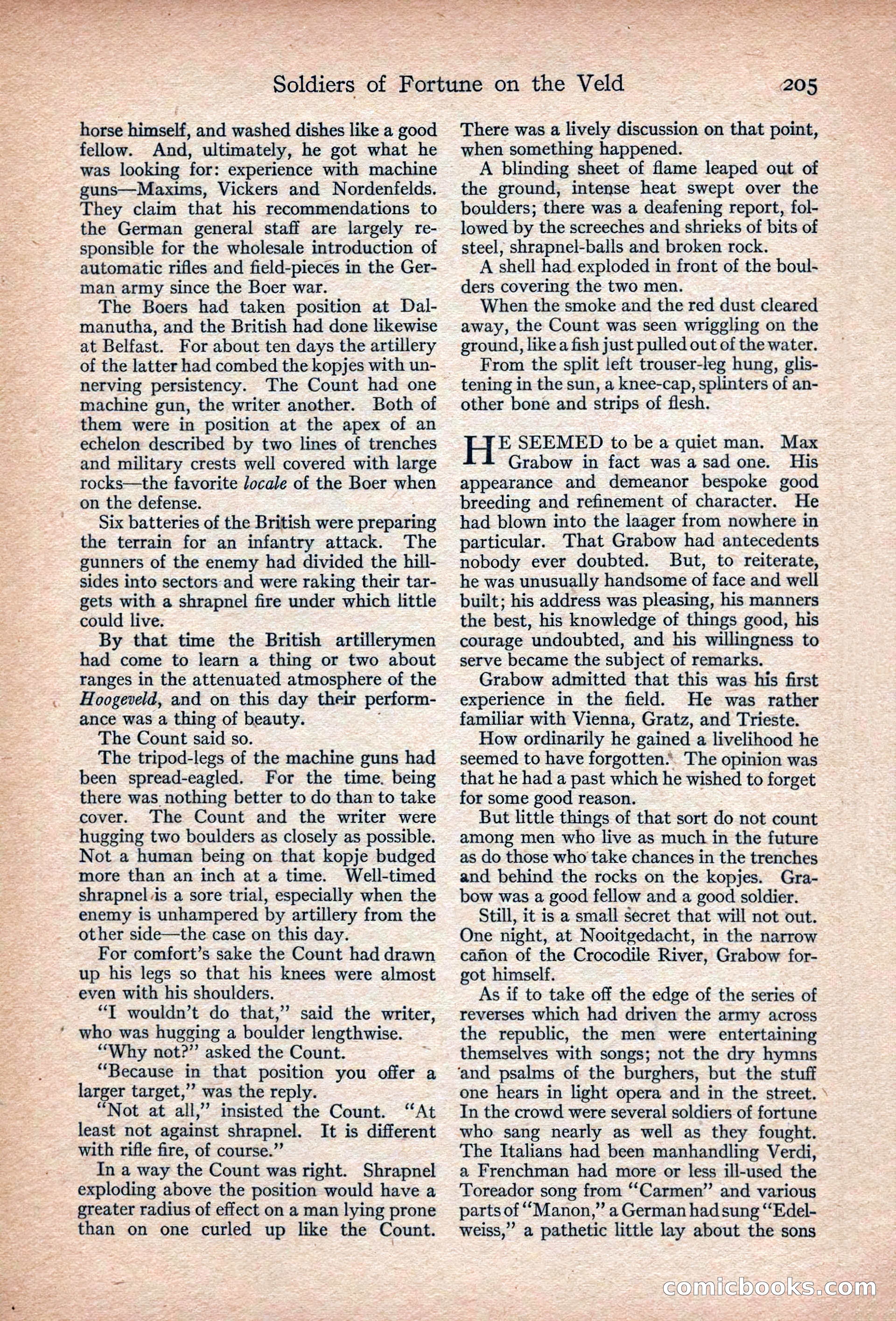
A restored page from Pulp Fiction, 1915. Page through the whole issue in the reader above.
📄 Transcribed text from this page (OCR, searchable)
Machine-transcribed from the original scan — historical spelling and the odd misread are preserved.
Soldiers of Fortune on the Veld horse himself, and washed dishes like a good fellow. And, ultimately, he got what he was looking for: experience with machine guns—Maxims, Vickers and Nordenfelds. They claim that his recommendations to the German general staff are largely re- sponsible for the wholesale introduction of automatic rifles and field-pieces in the Ger- man army since the Boer war. The Boers had taken position at Dal- manutha, and the British had done likewise at Belfast. For about ten days the artillery of the latter had combed the kopjes with un- nerving persistency. The Count had one machine gun, the writer another. Both of them were in position at the apex of an echelon described by two lines of trenches and military crests well covered with large rocks—the favorite locale of the Boer when on the defense. Six batteries of the British were preparing the terrain for an infantry attack. The gunners of the enemy had divided the hill- sides into sectors and were raking their tar- gets with a shrapnel fire under which little could live. By that time the British artillerymen had come to learn a thing or two about ranges in the attenuated atmosphere of the Hoogeveld, and on this day their perform- ance was a thing of beauty. The Count said so. The tripod-legs of the machine guns had been spread-eagled. For the time. being there was nothing better to do than to take cover. The Count and the writer were hugging two boulders as closely as possible. Not a human being on that kopje budged more than an inch at a time. Well-timed shrapnelis a sore trial, especially when the enemy is unhampered by artillery from the other side—the case on this day. For comfort’s sake the Count had drawn up his legs so that his knees were almost - even with his shoulders. “T wouldn’t do that,’”’ said the writer, who was hugging a boulder lengthwise. “Why not?” asked the Count. “Because in that position you offer a larger target,’ was the reply. “Not at all,” insisted the Count. “At least not against shrapnel. It is different with rifle fire, of course.” In a way the Count was right. Shrapnel exploding above the position would have a greater radius of effect on a man lying prone than on one curled up like the Count. 205 There was a lively discussion on that point, when something happened. A blinding sheet of flame leaped out of the ground, intense heat swept over the boulders; there was a deafening report, fol- lowed by the screeches and shrieks of bits of steel, shrapnel-balls and broken rock. A shell had exploded in front of the boul- ders covering the two men. When the smoke and the red dust cleared away, the Count was seen wriggling on the ground, like a fish just pulled out of the water. From the split left trouser-leg hung, glis- tening in the sun, a knee-cap, splinters of an- other bone and strips of flesh. H® SEEMED to be a quiet man. Max Grabow in fact was asad one. His appearance and demeanor bespoke good breeding and refinement of character. He had blown into the laager from nowhere in particular. That Grabow had antecedents nobody ever doubted. But, to reiterate, he was unusually handsome of face and well built; his address was pleasing, his manners the best, his knowledge of things good, his courage undoubted, and his willingness to serve became the subject of remarks. Grabow admitted that this was his first experience in the field. He was rather familiar with Vienna, Gratz, and Trieste. How ordinarily he gained a livelihood he seemed to have forgotten’ The opinion was that he had a past which he wished to forget for some good reason. But little things of that sort do not count among men who live as much in the future as do those who take chances in the trenches and behind the rocks on the kopjes. Gra- bow was a good fellow and a good soldier. Still, it is a small secret that will not out. One night, at Nooitgedacht, in the narrow cafion of the Crocodile River, Grabow for- got himself. As if to take off the edge of the series of reverses which had driven the army across the republic, the men were entertaining themselves with songs; not the dry hymns ‘and psalms of the burghers, but the stuff one hears in light opera and in the street. ° In the crowd were several soldiers of fortune who sang nearly as well as they fought. The Italians had been manhandling Verdi, a Frenchman had more or less ill-used the Toreador song from “Carmen” and various parts of “Manon,” a German had sung “Edel- weiss,” a pathetic little lay about the sons Eomichbooks