
Pulp Fiction, 1915 · page 206 of 228
Adventure, November 1915 — page 206: what you’re looking at
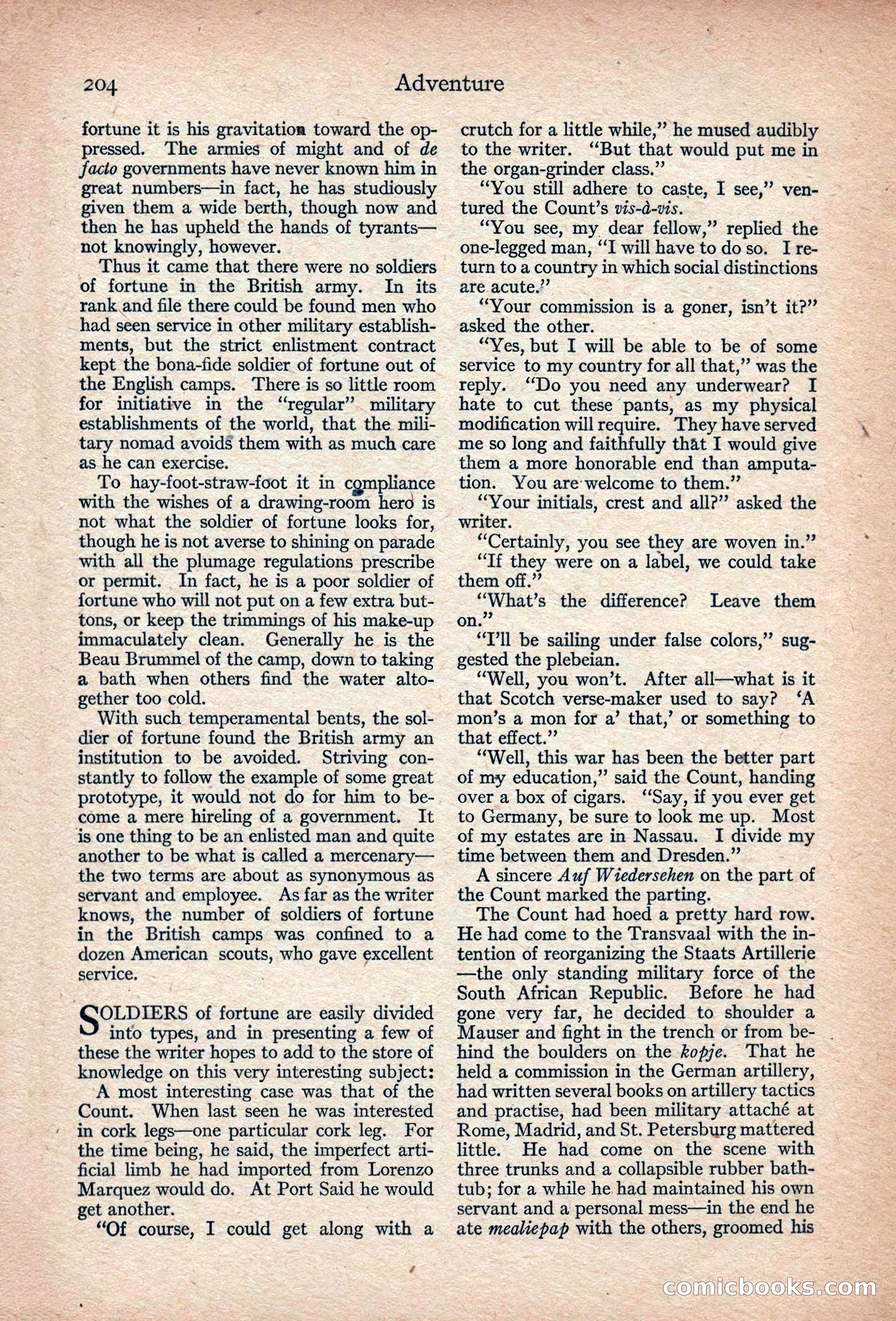
A restored page from Pulp Fiction, 1915. Page through the whole issue in the reader above.
📄 Transcribed text from this page (OCR, searchable)
Machine-transcribed from the original scan — historical spelling and the odd misread are preserved.
204 fortune it is his gravitation toward the op- pressed. The armies of might and of de _ facto governments have never known him in great numbers—in fact, he has studiously given them a wide berth, though now and then he has upheld the hands of tyrants— not knowingly, however. Thus it came that there were no soldiers of fortune in the British army. In its rank and file there could be found men who had seen service in other military establish- ments, but the strict enlistment contract kept the bona-fide soldier of fortune out of the English camps. There is so little room for initiative in the “regular” military establishments of the world, that the mili- tary nomad avoids them with as much care as he can exercise. To hay-foot-straw-foot it in cgmpliance with the wishes of a drawing-room hero is not what the soldier of fortune looks for, though he is not averse to shining on parade with all the plumage regulations prescribe or permit. In fact, he is a poor soldier of fortune who will not put on a few extra but- tons, or keep the trimmings of his make-up immaculately clean. Generally he is the Beau Brummel of the camp, down to taking a bath when others find the water alto- gether too cold. With such temperamental bents, the sol- dier of fortune found the British army an institution to be avoided. Striving con- stantly to follow the example of some great prototype, it would not do for him to be- come a mere hireling of a government. It is one thing to be an enlisted man and quite another to be what is called a mercenary— the two terms are about as synonymous as servant and employee. As far as the writer knows, the number of soldiers of fortune in the British camps was confined to a dozen American scouts, who gave excellent service. | | SOLDIERS of fortune are easily divided into types, and in presenting a few of these the writer hopes to add to the store of knowledge on this very interesting subject: A most interesting case was that of the Count. When last seen he was interested in cork legs—one particular cork leg. For the time being, he said, the imperfect arti- ficial limb he had imported from Lorenzo Marquez would do. At Port Said he would get another. “Of course, I could get along with a é Adventure crutch for a little while,” he mused audibly to the writer. “But that would put me in the organ-grinder class.”’ “You still adhere to caste, I see,” tured the Count’s vis-d-vis. “You see, my dear fellow,” replied the one-legged man, “I will have todoso. I re- turn toa country in which social distinctions are.acute,”’ “Your commission is a goner, isn’t it?” asked the other. “Yes, but I will be able to be of some service to my country for all that,’’ was the reply. “Do you need any underwear? I hate to cut these pants, as my physical modification will require. They have served me so long and faithfully that I would give them a more honorable end than amputa- tion. You are welcome to them.” “Your initials, crest and all?” asked the writer. “Certainly, you see they are woven in.’ “If they were on a label, we could xi them off.” “What’s the difference? on.” “T’ll be sailing under false colors,” sug- gested the plebeian. “Well, you won’t. After all—what is it that Scotch verse-maker used to say? ‘A mon’s a mon for a’ that,’ or something to that effect.” “Well, this war has been the better part of my education,” said the Count, handing over a box of cigars. “Say, if you ever get to Germany, be sure to look me up. Most of my estates are in Nassau. I divide my time between them and Dresden.” A sincere Auf Wiedersehen on the part of the Count marked the parting. The Count had hoed a pretty hard row. He had come to the Transvaal with the in- tention of reorganizing the Staats Artillerie —the only standing military force of the South African Republic. Before he had gone very far, he decided to shoulder a ven- Leave them Mauser and fight in the trench or from be- . hind the boulders on the kofje. That he held a commission in the German artillery, had written several books on artillery tactics and practise, had been military attaché at Rome, Madrid, and St. Petersburg mattered little. He had come on the scene with three trunks and a collapsible rubber bath- tub; for a while he had maintained his own servant and a personal mess—in the end he ate mealiepap with the others, groomed his Gomichooks (Q) (EO) ae