
Pulp Fiction, 1915 · page 208 of 228
Adventure, November 1915 — page 208: what you’re looking at
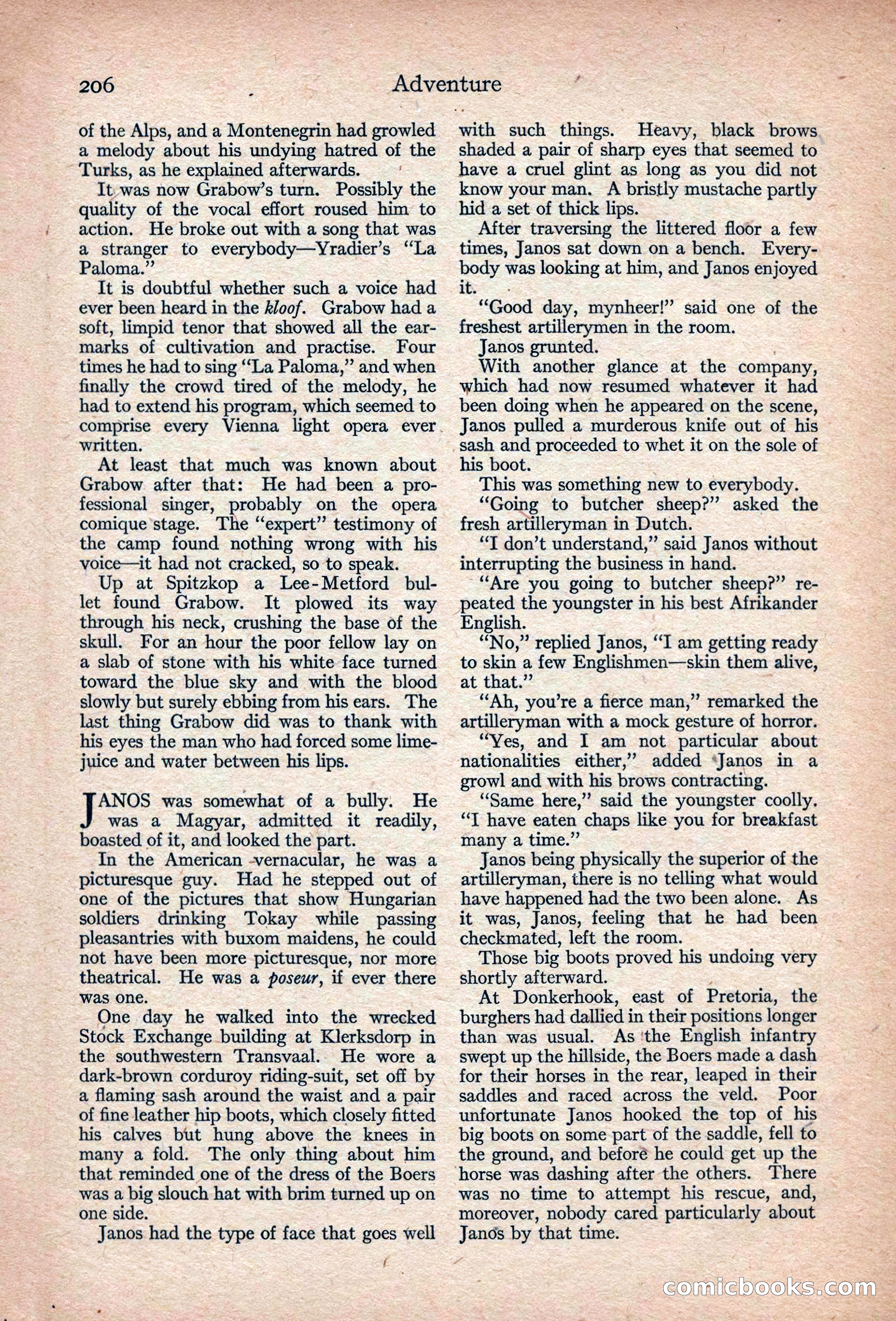
A restored page from Pulp Fiction, 1915. Page through the whole issue in the reader above.
📄 Transcribed text from this page (OCR, searchable)
Machine-transcribed from the original scan — historical spelling and the odd misread are preserved.
206 of the Alps, and a Montenegrin had growled a melody about his undying hatred of the Turks, as he explained afterwards. It. was now Grabow’s turn. Possibly the quality of the vocal effort roused him to action. He broke out with a song that was a stranger to everybody—Yradier’s “La Paloma.” It is doubtful whether such a voice had ever been heard in the kloof. Grabow had a soft, limpid tenor that showed all the ear- marks of cultivation and practise. Four times he had to sing “‘La Paloma,” and when finally the crowd tired of the melody, he had to extend his program, which seemed to comprise every Vienna light opera ever. written. At least that much was known about Grabow after that: He had been a pro- fessional singer, probably on the opera comique stage. The “expert” testimony of the camp found nothing wrong with his voice—it had not cracked, so to speak. Up at Spitzkop a Lee-Metford bul- let found Grabow. It plowed its way through his neck, crushing the base of the skull. For an hour the poor fellow lay on a slab of stone with his white face turned toward the blue sky and with the blood slowly but surely ebbing from his ears. The last thing Grabow did was to thank with his eyes the man who had forced some lime- juice and water between his lips. ANOS was somewhat of a bully. He was a Magyar, admitted it readily, boasted of it, and looked the part. In the American -vernacular, he was a picturesque guy. Had he stepped out of one of the pictures that show Hungarian soldiers drinking Tokay while passing pleasantries with buxom maidens, he could not have been more picturesque, nor more theatrical. He was a poseur, if ever there was one. One day he walked into the wrecked Stock Exchange building at Klerksdorp in the southwestern Transvaal. He wore a dark-brown corduroy riding-suit, set off by a flaming sash around the waist and a pair of fine leather hip boots, which closely fitted his calves but hung above the knees in many a fold. The only thing about him that reminded one of the dress of the Boers was a big slouch hat with brim turned up on one side. Janos had the type of face that goes well f with such things. horse was dashing after the others. Adventure Heavy, black brows shaded a pair of sharp eyes that seemed to have a cruel glint as long as you did not know your man. A bristly mustache partly hid a set of thick lips. After traversing the littered floor a few times, Janos sat down on a bench. Every- body was looking at him, and Janos enjoyed | “Good day, mynheer!”’ said one of the freshest artillerymen in the room. Janos grunted. With another glance at the company, which had now resumed whatever it had been doing when he appeared on the scene, Janos pulled a murderous knife out of his sash and proceeded to whet it on the sole of his boot. This was something new to everybody. “Going to butcher sheep?” asked the fresh artilleryman in Dutch. “T don’t understand,” said Janos without interrupting the business in hand. “Are you going to butcher sheep?” re- peated the youngster in his best Afrikander English. “No,” replied Janos, “I am getting ready to skin a few Englishmen—skin them alive, at that.” “Ah, you’re a fierce man,” remarked the artilleryman with a mock gesture of horror. “Yes, and I am not particular about nationalities either,” added ‘Janos in a growl and with his brows contracting. “Same here,” said the youngster coolly. “T have eaten chaps like you for breakfast many a time.” Janos being physically the superior of the artilleryman, there is no telling what would have happened had the two been alone. As it was, Janos, feeling that he had been checkmated, left the room. Those big boots proved his undoing very shortly afterward. At Donkerhook, east of Pretoria, the burghers had dallied i in their positions longer than was usual. As ‘the English infantry swept up the hillside, the Boers made a dash for their horses in the rear, leaped in their saddles and raced across the veld. Poor unfortunate Janos hooked the top of his big boots on some part of the saddle, fell to the ground, and beforé he could get up the There was no time to attempt his rescue, and, moreover, nobody cared particularly about Janos by that time. Eomichoo (CO)