
Pulp Fiction, 1919 · page 135 of 204
Adventure, August 3, 1919 — page 135: what you’re looking at
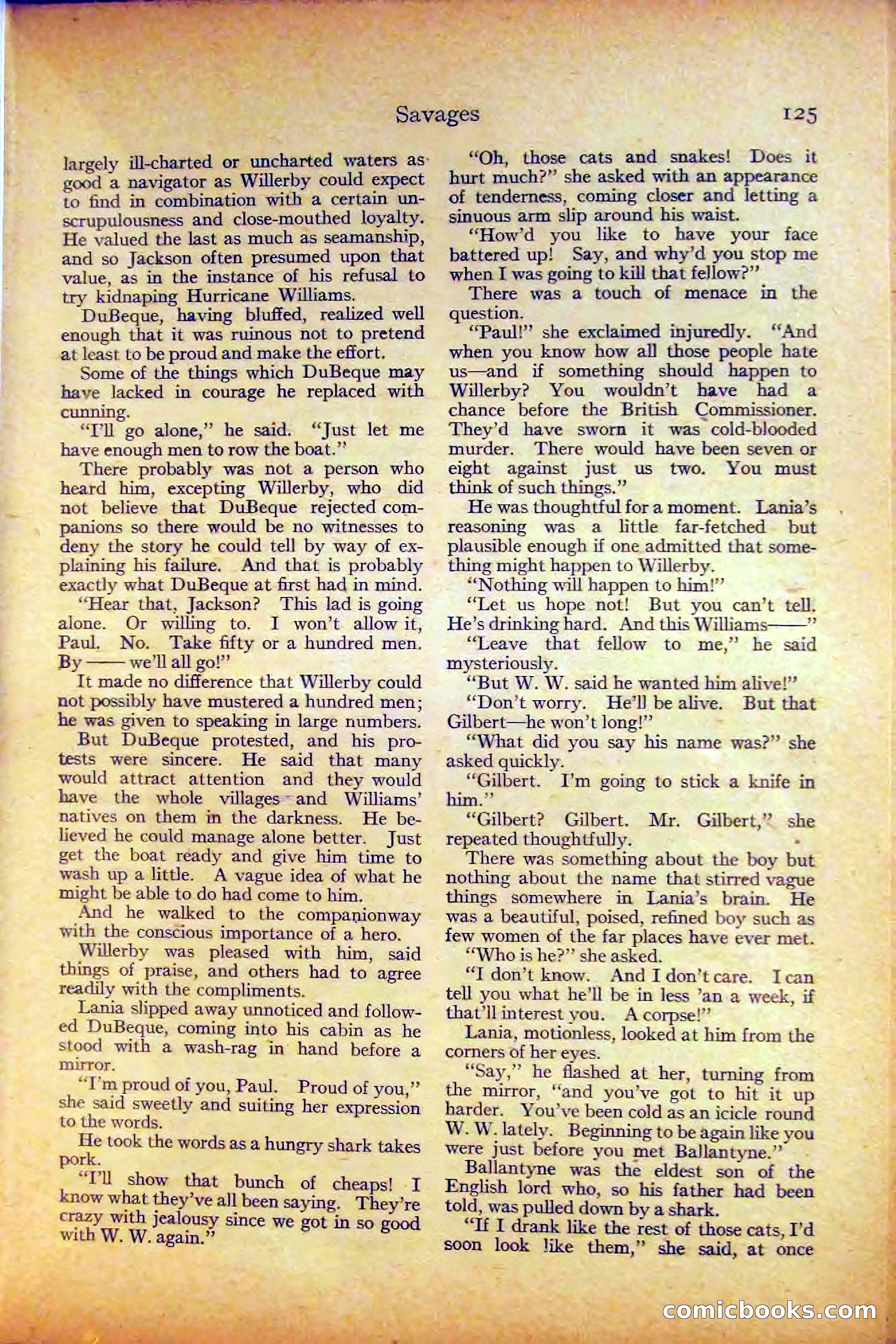
A restored page from Pulp Fiction, 1919. Page through the whole issue in the reader above.
📄 Transcribed text from this page (OCR, searchable)
Machine-transcribed from the original scan — historical spelling and the odd misread are preserved.
largely ill-charted or uncharted waters as: good a navigator as Willerby could expect to find in combination with a certain un- scrupulousness and close-mouthed loyalty. He valued the last as much as seamanship, and so Jackson often presumed upon that value, as in the instance of his refusal to try kidnaping Hurricane Williams. DuBeque, having bluffed, realized well enough that it was ruinous not to pretend at least to be proud and make the effort. Some of the things which DuBeque may have lacked in courage he replaced with cunning. “T’ll go alone,” he said. “Just let me have enough men to row the boat.”’ There probably was not a person who heard him, excepting Willerby, who did not believe that DuBeque rejected com- panions so there would be no witnesses to deny the story he could tell by way of ex- plaining his failure. And that is probably exactly what DuBeque at first had in mind. “Hear that, Jackson? This lad is going alone. Or willing to. I won’t. allow it, Paul, No. Take fifty or a hundred men. By we'll all go!” It made no difference that Willerby could not possibly have mustered a hundred men; he was given to speaking in large numbers. But DuBeque protested, and his pro- tests were sincere. He said that many would attract attention and they would have the whole villages-and Williams’ natives on them in the darkness. He be- lieved he could manage alone better. Just get the boat ready and give him time to wash up a little. A vague idea of what he might be able to do had come to him. And he walked to the companionway with the conscious importance of a hero. Willerby was pleased with him, said things of praise, and others had to agree readily with the compliments. Lania slipped away unnoticed and follow- ed DuBeque, coming into his cabin as he stood with a wash-rag in hand before a mirror. “I’m proud of you, Paul. Proud of you,” she said sweetly and suiting her expression to the words. took the words as a hungry shark takes pork. “Pi show that bunch of cheaps! I know what they’ve all been saying. They’re | ctaay with jealousy since we got in so good ith W. W. again. Savages 125 “Qh, those cats and snakes! Does it hurt much?” she asked with an appearance of tenderness, coming closer and letting a sinuous arm slip around his waist. “How'd you like to have your face battered up! Say, and why’d you stop me when I was going to kill that fellow?” There was a touch of menace in the question. “Paul!” she exclaimed injuredly. “And when you know how all those people hate us—and if something should happen to Willerby? You wouldn’t have had a chance before the British Commissioner. They’d have sworn it was cold-blooded murder. There would have been seven or eight against just us two. You must think of such things.” He was thoughtful fora moment. Lania’s reasoning was a little far-fetched but plausible enough if one admitted that some- thing might happen to Willerby. *“‘Nothing will happen to him!” “Let us hope not! But you can’t tell. He’s drinking hard. And this Williams a “Leave that fellow to me,” he said mysteriously. “But W. W. said he wanted him alive!” “Don’t worry. He'll be alive. But that Gilbert—he won't long!” . “What did you say his name was?” she asked quickly. “Gilbert. I’m going to stick a knife in him.”’ “Gilbert? Gilbert. Mr. Gilbert,” she repeated thoughtfully. . There was something about the boy but nothing about the name that stirred vague things somewhere in Lania’s brain. He was a beautiful, poised, refined boy such as few women of the far places have ever met. “Who is he?” she asked. “I don’t know. AndIdon’tcare. Ican tell you what he'll be in less ’an a week, if that’ll interest you. A corpse!” Lania, motionless, looked at him from the corners of her eyes. “Say,” he flashed at her, turning from the mirror, “and you've got to hit it up harder. You've been cold as an icicle round W.W. lately. Beginning to be again like you were just before you met Ballantyne.” Ballantyne was the eldest son of the English lord who, so his father had been told, was pulled down by a shark. “Tf I drank like the rest of those cats, I’d soon look like them,” she said, at once ~ : “ “~~ s 7 4 7% « a * - mM 4 . ? ‘