
Pulp Fiction, 1919 · page 136 of 204
Adventure, August 3, 1919 — page 136: what you’re looking at
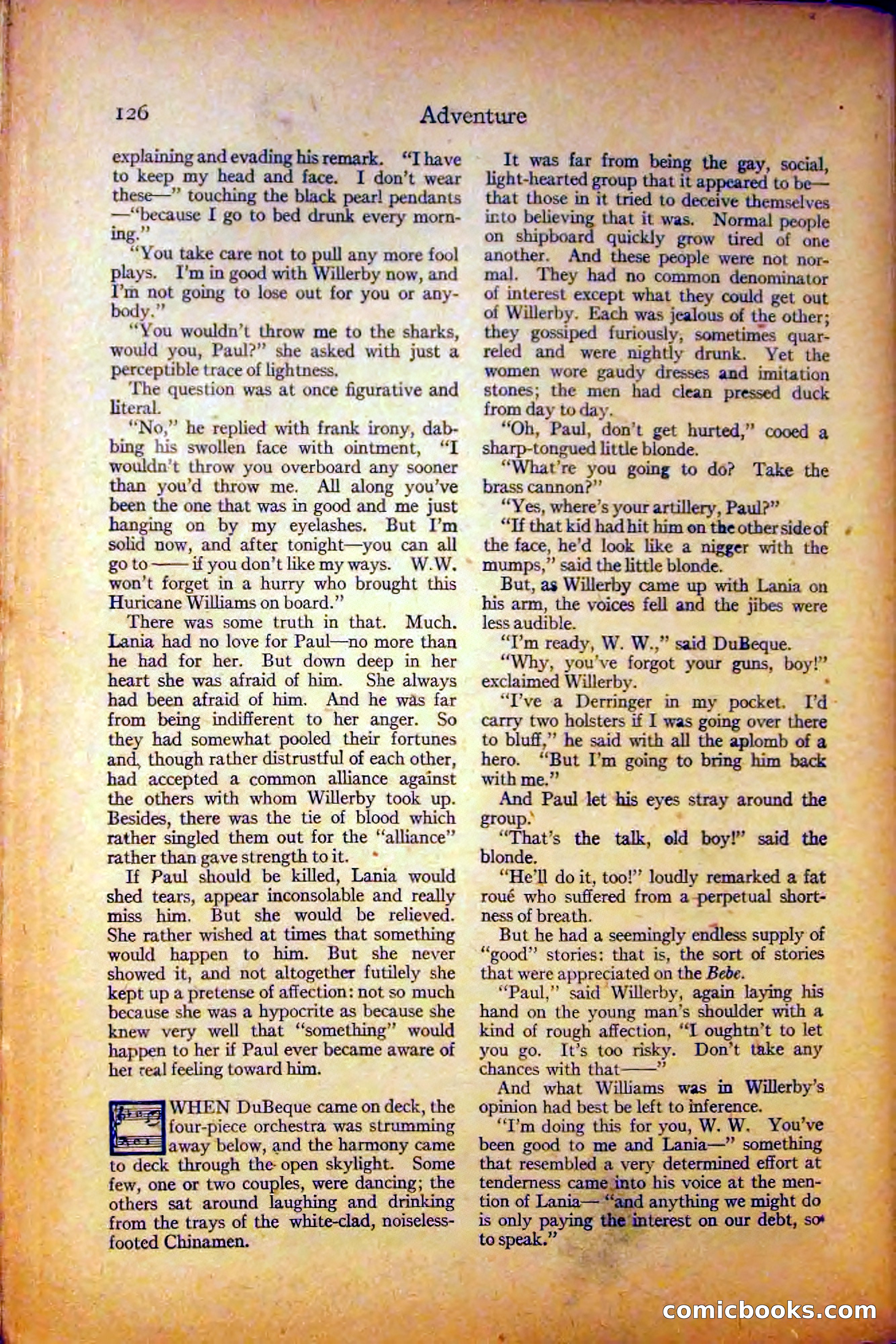
A restored page from Pulp Fiction, 1919. Page through the whole issue in the reader above.
📄 Transcribed text from this page (OCR, searchable)
Machine-transcribed from the original scan — historical spelling and the odd misread are preserved.
% # a ree TOE”! j 126 explaining and evading hisremark. “Ihave to keep my head and face. I don’t wear these—” touching the black pear! pendants —“because I go to bed drunk every morn- £. “You take care not to pull any more fool plays. I’m in good with Willerby now, and I’m not going to lose out for you or any- body.”” “You wouldn’t throw me to the sharks, would you, Paul?” she asked with just a perceptible trace of lightness, ‘The question was at once figurative and literal. “No,” he replied with frank irony, dab- bing his swollen face with ointment, “I wouldn't throw you overboard any sooner than you’d throw me. All along you’ve been the one that was in good and me just hanging on by my eyelashes. But I’m solid now, and after tonight—you can all go to—— if you don’t likemy ways. W.W. won’t forget in a hurry who brought this Huricane Williams on board.” There was some truth in that. Much. Lania had no love for Paul—no more than he had for her. But down deep in her heart she was afraid of him. She always had been afraid of him. And he was far from being indifferent to her anger. So they had somewhat pooled their fortunes and, though rather distrustful of each other, had accepted a common alliance against the others with whom Willerby took up. Besides, there was the tie of blood which rather singled them out for the “alliance” rather than gave strength toit. If Paul should be killed, Lania would shed tears, appear inconsolable and really miss him, But she would be relieved. She rather wished at times that something would happen to him. But she never showed it, and not altogether futilely she kept up a pretense of affection: not so much because she was a hypocrite as because she knew very well that “something” would happen to her if Paul ever became aware of her teal feeling toward him. el WHEN DuBeque came on deck, the Y {four-piece orchestra was strumming == away below, and the harmony came to deck through the open skylight. Some few, one or two couples, were dancing; the others sat around laughing and drinking from the trays of the white-clad, noiseless- footed Chinamen. He Adventure It was far from being the gay, social, light-hearted that i appored tates that those in it tried to deceive themselves into believing that it was. Normal people on shipboard quickly grow tired of one another. And these people were not nor- pees Asem, had pg denominator interest except t could get out of Willerby. Each was jealous of ponte they gossiped furiously, sometimes quar- reled and were nightly drunk. Yet the women wore gaudy dresses and imitation stones; the men had clean pressed duck from day to day. “Oh, Paul, don’t get hurted,” cooed a sharp-tongued little blonde. “What're you going to do? Take the brass cannon?” “Yes, where’s your artillery, Paul?” “Tf that kid had hit him on the otherside of the face, he’d look like a nigger with the mumps,” said the little blonde. But, as Willerby came up with Lania on his arm, the voices fell and the jibes were less audible. “T’m ready, W. W.,” said DuBeque. “Why, you've forgot your guns, boy!” exclaimed Willerby. : “I’ve a Derringer in my pocket. I'd- carry two holsters if I was going over there to bluff,” he said with all the aplomb of a hero. “But I’m going to bring him back with me.” And Paul let his eyes stray around the group. “That’s the talk, eld boy!” said the blonde. “He'll do it, too!” loudly remarked a fat roué who suffered from a-perpetual short- ness of breath. But he had a seemingly endless supply of “good” stories: that is, the sort of stories that were appreciated on the Bede. “Paul,” said Willerby, again laying his hand on the young man’s shoulder with a kind of rough affection, ““L oughtn’t to let you go, It’s too risky. Don’t take any chances with that——’” And what Williams was in Willerby’s opinion had best be left to inference. “T’'m doing this for you, W. W. You've been good to me and Lania—” something that resembled a very determined effort at tendermess 2 into his voice at the men- Ame Into tion of Lania— “and anything we might do is only paying the interest on our debt, sot , i) ae ¥ to speak.’ ey oh