
Pulp Fiction, 1919 · page 134 of 204
Adventure, August 3, 1919 — page 134: what you’re looking at
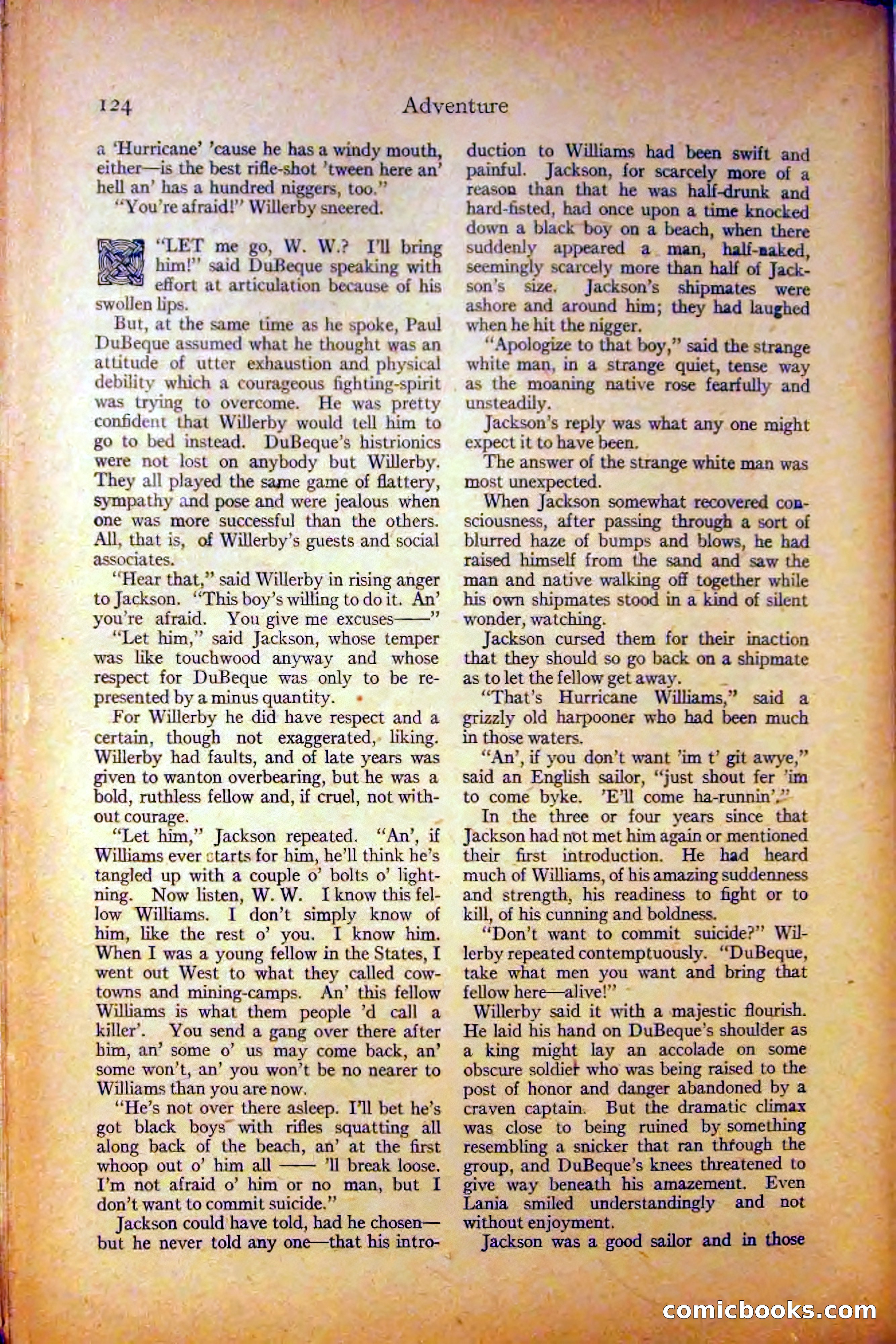
A restored page from Pulp Fiction, 1919. Page through the whole issue in the reader above.
📄 Transcribed text from this page (OCR, searchable)
Machine-transcribed from the original scan — historical spelling and the odd misread are preserved.
a ‘Hurricane’ ’cause he has a windy mouth, either—is the best rifle-shot ’tween here an’ hell an’ has a hundred niggers, too.” “You're afraid!” Willerby sneered. hy “LET me go, W. W.? I'll bring pes him!’ said DuBeque speaking with =“ effort at articulation because of his swollen lips. But, at the same time as he spoke, Paul DuBeque assumed what he thought was an attitude of utter exhaustion and physical debility which a courageous fighting-spirit was trying to overcome. He was pretty confident that Willerby would tell him to go to bed instead. DuBeque’s histrionics were not lost on anybody but Willerby. They all played the same game of flattery, sympathy and pose and were jealous when one was more successful than the others. All, that is, of Willerby’s guests and social associates. “Hear that,” said Willerby in rising anger to Jackson. “This boy’s willing to doit. An’ you're afraid. You give me excuses——” “Let him,” said Jackson, whose temper was like touchwood anyway and whose respect for DuBeque was only to be re- presented by a minus quantity. « For Willerby he did have respect and a certain, though not exaggerated,. liking. Willerby had faults, and of late years was given to wanton overbearing, but he was a bold, ruthless fellow and, if cruel, not with- out courage. “Let him,” Jackson repeated. “‘An’, if Williams ever ctarts for him, he’ll think he’s tangled up with a couple o’ bolts o’ light- ning. Now listen, W.W. I know this fel- low Williams. I don’t simply know of him, like the rest o’ you. I know him. When I was a young fellow in the States, I went out West to what they called cow- towns and mining-camps. An’ this fellow Williams is what them people ’d call a killer’. You send a gang over there after him, an’ some o’ us may come back, an’ some won't, an’ you won’t be no nearer to Williams than you are now. “He’s not over there asleep. I'll bet he’s got black boys with rifles squatting all along back of the beach, an’ at the first whoop out o’ him all —— ’ll break loose. I’m not afraid o’ him or no man, but I don’t want to commit suicide.” Jackson could have told, had he chosen— but he never told any one—that his intro- ; Adventure son's size, Jackson’s shipmates were ashore and around him; they had laughed when he hit the nigger, “Apologize to that boy,” said the strange white man, in a strange quiet, tense way as the moaning native rose fearfully and unsteadily. Jackson's reply was what any one might expect it to have been. ‘ The answer of the strange white man was most unexpected. When Jackson somewhat recovered con- sciousness, after passing through a sort of blurred haze of bumps and blows, he had raised himself from the sand and saw the man and native walking off together while his own shipmates stood in a kind of silent wonder, watching. Jackson cursed them for their inaction that they should so go back on a shipmate as to let the fellow get away. : “That’s Hurricane Williams,” said a grizzly old harpooner who had been much in those waters. “An’, if you don’t want ‘im t’ git awye,” said an English sailor, “just shout fer ‘im to come byke. ’E’ll come ha-runnin’,” In the three or four years since that Jackson had not met him again or mentioned their first introduction. He had heard much of Williams, of his amazing suddenness and strength, his readiness to fight or to kill, of his cunning and boldness. “Don’t want to commit suicide?” Wil- lerby repeated contemptuously. “DuBeque, take what men you want and bring that - fellow here—alive!” { Willerby said it with a majestic flourish. | He laid his hand on DuBeque’s shoulder as 7 a king might lay an accolade on some . obscure soldiet who was being raised to the post of honor and danger abandoned by a craven captain. But the dramatic climax was close to being ruined by something resembling a snicker that ran thfough the - group, and DuBeque’s knees threatened to | give way bene his amazement. Even Lania smiled understandingly and not Jackson was a good sailor and in those — = - gf ee ; . ~~ _ icbooks.com =; y