
Pulp Fiction · page 38 of 68
Aboriginal Science Fiction, Issues 57–58 — page 38: what you’re looking at
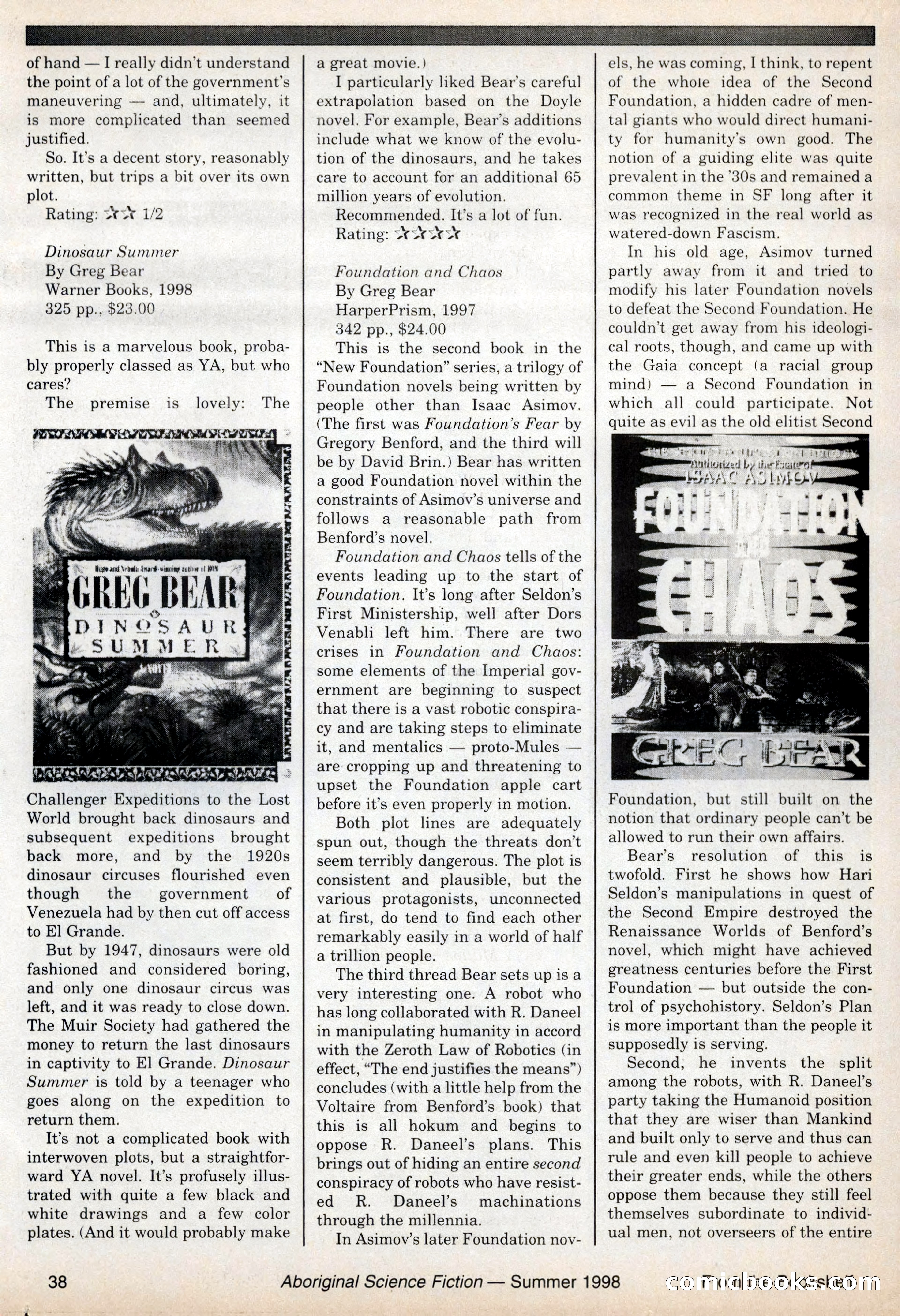
A restored page from Pulp Fiction. Page through the whole issue in the reader above.
📄 Transcribed text from this page (OCR, searchable)
Machine-transcribed from the original scan — historical spelling and the odd misread are preserved.
of hand — I really didn’t understand the point of a lot of the government’s maneuvering — and, ultimately, it is more complicated than seemed justified. So. It’s a decent story, reasonably written, but trips a bit over its own plot. Rating: 2¢vx 1/2 Dinosaur Summer By Greg Bear Warner Books, 1998 325 pp., $23.00 This is a marvelous book, proba- bly properly classed as YA, but who cares? The premise is_ lovely: A luge and 14 1 eine 7 el WiN | x Challenger Expaditions to the Lost World brought back dinosaurs and subsequent expeditions brought back more, and by the 1920s dinosaur circuses flourished even though the government’ of Venezuela had by then cut off access to El Grande. But by 1947, dinosaurs were old fashioned and considered boring, and only one dinosaur circus was left, and it was ready to close down. The Muir Society had gathered the money to return the last dinosaurs in captivity to El Grande. Dinosaur Summer is told by a teenager who goes along on the expedition to return them. It’s not a complicated book with interwoven plots, but a straightfor- ward YA novel. It’s profusely illus- trated with quite a few black and white drawings and a few color plates. (And it would probably make 38 Aboriginal Science Fiction — Summer 1998 a great movie.) I particularly liked Bear’s careful extrapolation based on the Doyle novel. For example, Bear’s additions include what we know of the evolu- tion of the dinosaurs, and he takes care to account for an additional 65 million years of evolution. Recommended. It’s a lot of fun. Rating: oesrvesr Foundation and Chaos By Greg Bear HarperPrism, 1997 342 pp., $24.00 This is the second book in the “New Foundation” series, a trilogy of Foundation novels being written by people other than Isaac Asimov. (The first was Foundation’s Fear by Gregory Benford, and the third will be by David Brin.) Bear has written a good Foundation novel within the constraints of Asimov’s universe and follows a reasonable path from Benford’s novel. Foundation and Chaos tells of the events leading up to the start of Foundation. It’s long after Seldon’s First Ministership, well after Dors Venabli left him. There are two crises in Foundation and Chaos: some elements of the Imperial gov- ernment are beginning to suspect that there is a vast robotic conspira- cy and are taking steps to eliminate it, and mentalics — proto-Mules — are cropping up and threatening to upset the Foundation apple cart before it’s even properly in motion. Both plot lines are adequately spun out, though the threats don’t seem terribly dangerous. The plot is consistent and plausible, but the various protagonists, unconnected at first, do tend to find each other remarkably easily in a world of half a trillion people. The third thread Bear sets up is a very interesting one. A robot who has long collaborated with R. Daneel in manipulating humanity in accord with the Zeroth Law of Robotics (in effect, “The end justifies the means”) concludes (with a little help from the Voltaire from Benford’s book) that this is all hokum and begins to oppose R. Daneel’s plans. This brings out of hiding an entire second conspiracy of robots who have resist- ed R. Daneel’s' machinations through the millennia. In Asimov’s later Foundation nov- els, he was coming, I think, to repent of the whole idea of the Second Foundation, a hidden cadre of men- tal giants who would direct humani- ty for humanity’s own good. The notion of a guiding elite was quite prevalent in the 30s and remained a common theme in SF long after it was recognized in the real world as watered-down Fascism. In his old age, Asimov turned partly away from it and tried to modify his later Foundation novels to defeat the Second Foundation. He couldn’t get away from his ideologi- cal roots, though, and came up with the Gaia concept (a racial group mind) — a Second Foundation in which all could participate. Not quite as evil as the old elitist Second ntntivosize ad by deeFicaeros berth e\ ( Seraeagy so 4 Foundation, but still built on the notion that ordinary people can’t be allowed to run their own affairs. Bear’s resolution of this is twofold. First he shows how Hari Seldon’s manipulations in quest of the Second Empire destroyed the Renaissance Worlds of Benford’s novel, which might have achieved greatness centuries before the First Foundation — but outside the con- trol of psychohistory. Seldon’s Plan is more important than the people it supposedly is serving. Second, he invents the split among the robots, with R. Daneel’s party taking the Humanoid position that they are wiser than Mankind and built only to serve and thus can rule and even kill people to achieve their greater ends, while the others oppose them because they still feel themselves subordinate to individ- ual men, not overseers of the entire Gomichbooks: com