
Pulp Fiction · page 37 of 68
Aboriginal Science Fiction, Issues 57–58 — page 37: what you’re looking at
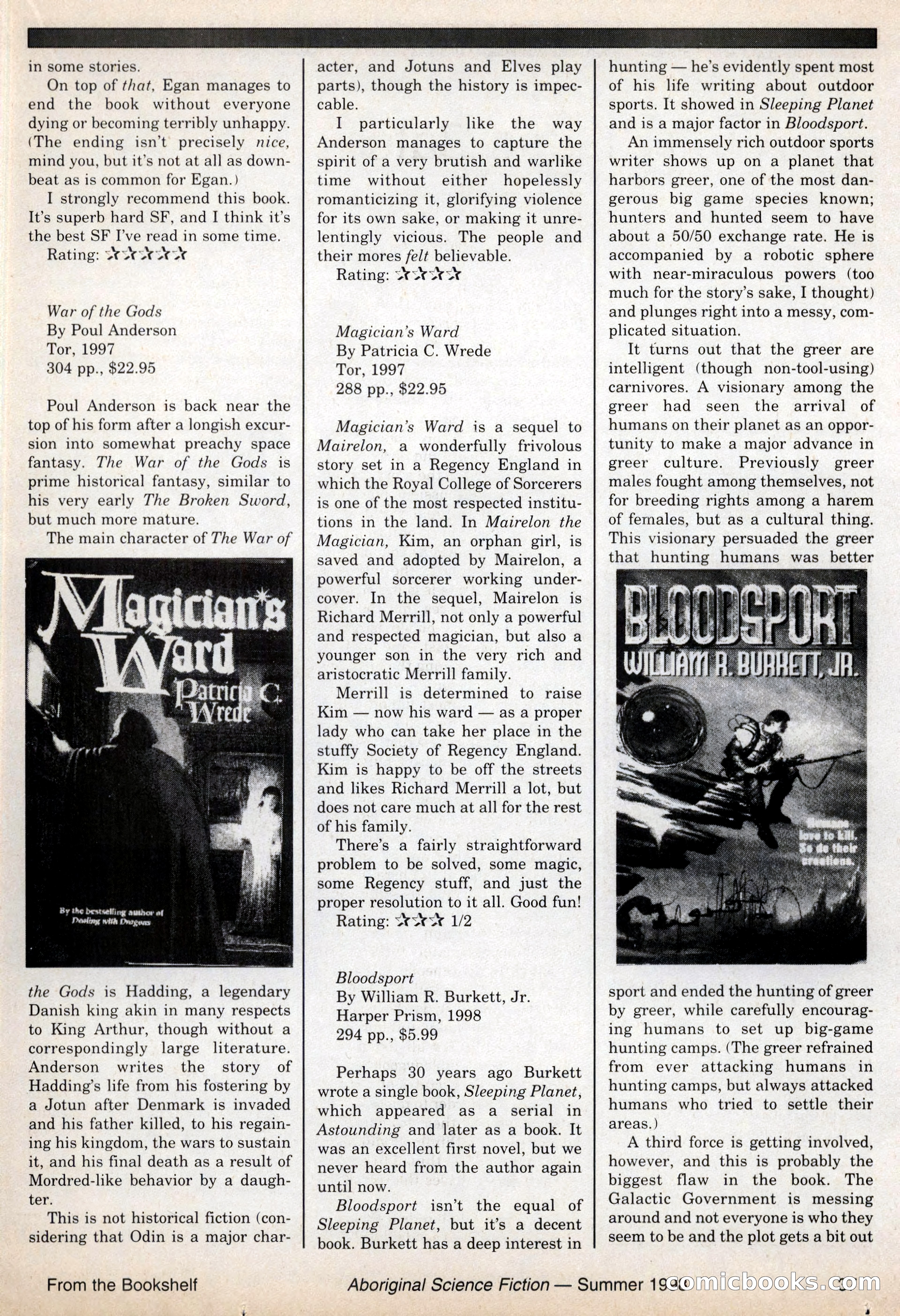
A restored page from Pulp Fiction. Page through the whole issue in the reader above.
📄 Transcribed text from this page (OCR, searchable)
Machine-transcribed from the original scan — historical spelling and the odd misread are preserved.
in some stories. On top of that, Egan manages to end the book without everyone dying or becoming terribly unhappy. (The ending isn’t precisely nice, mind you, but it’s not at all as down- beat as is common for Egan.) I strongly recommend this book. It’s superb hard SF, and I think it’s the best SF I’ve read in some time. Rating: evrveve ve War of the Gods By Poul Anderson Tor, 1997 304 pp., $22.95 Poul Anderson is back near the top of his form after a longish excur- sion into somewhat preachy space fantasy. The War of the Gods is prime historical fantasy, similar to his very early The Broken Sword, but much more mature. The main character of The War of By the bestselling author of Dessling with Drag ens the Gods is Hadding, a legendary Danish king akin in many respects to King Arthur, though without a correspondingly large literature. Anderson writes the story of Hadding’s life from his fostering by a Jotun after Denmark is invaded and his father killed, to his regain- ing his kingdom, the wars to sustain it, and his final death as a result of Mordred-like behavior by a daugh- ter. This is not historical fiction (con- sidering that Odin is a major char- From the Bookshelf acter, and Jotuns and Elves play parts), though the history is impec- cable. I particularly like the way Anderson manages to capture the spirit of a very brutish and warlike time without either hopelessly romanticizing it, glorifying violence for its own sake, or making it unre- lentingly vicious. The people and their mores felt believable. Rating: “orl Magician’s Ward By Patricia C. Wrede Tor, 1997 288 pp., $22.95 Magician’s Ward is a sequel to Mairelon, a wonderfully frivolous story set in a Regency England in which the Royal College of Sorcerers is one of the most respected institu- tions in the land. In Mairelon the Magician, Kim, an orphan girl, is saved and adopted by Mairelon, a powerful sorcerer working under- cover. In the sequel, Mairelon is Richard Merrill, not only a powerful and respected magician, but also a younger son in the very rich and aristocratic Merrill family. Merrill is determined to raise Kim — now his ward — as a proper lady who can take her place in the stuffy Society of Regency England. Kim is happy to be off the streets and likes Richard Merrill a lot, but does not care much at all for the rest of his family. There’s a fairly straightforward problem to be solved, some magic, some Regency stuff, and just the proper resolution to it all. Good fun! Rating: veux 1/2 Bloodsport By William R. Burkett, Jr. Harper Prism, 1998 294 pp., $5.99 Perhaps 30 years ago Burkett wrote a single book, Sleeping Planet, which appeared as a serial in Astounding and later as a book. It was an excellent first novel, but we never heard from the author again until now. Bloodsport isn’t the equal of Sleeping Planet, but it’s a decent book. Burkett has a deep interest in Aboriginal Science Fiction — Summer 192@1i)_\C_DOOKS.Goiw hunting — he’s evidently spent most of his life writing about outdoor sports. It showed in Sleeping Planet and is a major factor in Bloodsport. An immensely rich outdoor sports writer shows up on a planet that harbors greer, one of the most dan- gerous big game species known; hunters and hunted seem to have about a 50/50 exchange rate. He is accompanied by a robotic sphere with near-miraculous powers (too much for the story’s sake, I thought) and plunges right into a messy, com- plicated situation. It turns out that the greer are intelligent (though non-tool-using) carnivores. A visionary among the greer had seen the arrival of humans on their planet as an oppor- tunity to make a major advance in greer culture. Previously greer males fought among themselves, not for breeding rights among a harem of females, but as a cultural thing. This visionary persuaded the greer that hunting humans was better sport and ended the hunting of greer by greer, while carefully encourag- ing humans to set up big-game hunting camps. (The greer refrained from ever attacking humans in hunting camps, but always attacked humans who tried to settle their areas.) A third force is getting involved, however, and this is probably the biggest flaw in the book. The Galactic Government is messing around and not everyone is who they seem to be and the plot gets a bit out