
Pulp Fiction · page 39 of 68
Aboriginal Science Fiction, Issues 57–58 — page 39: what you’re looking at
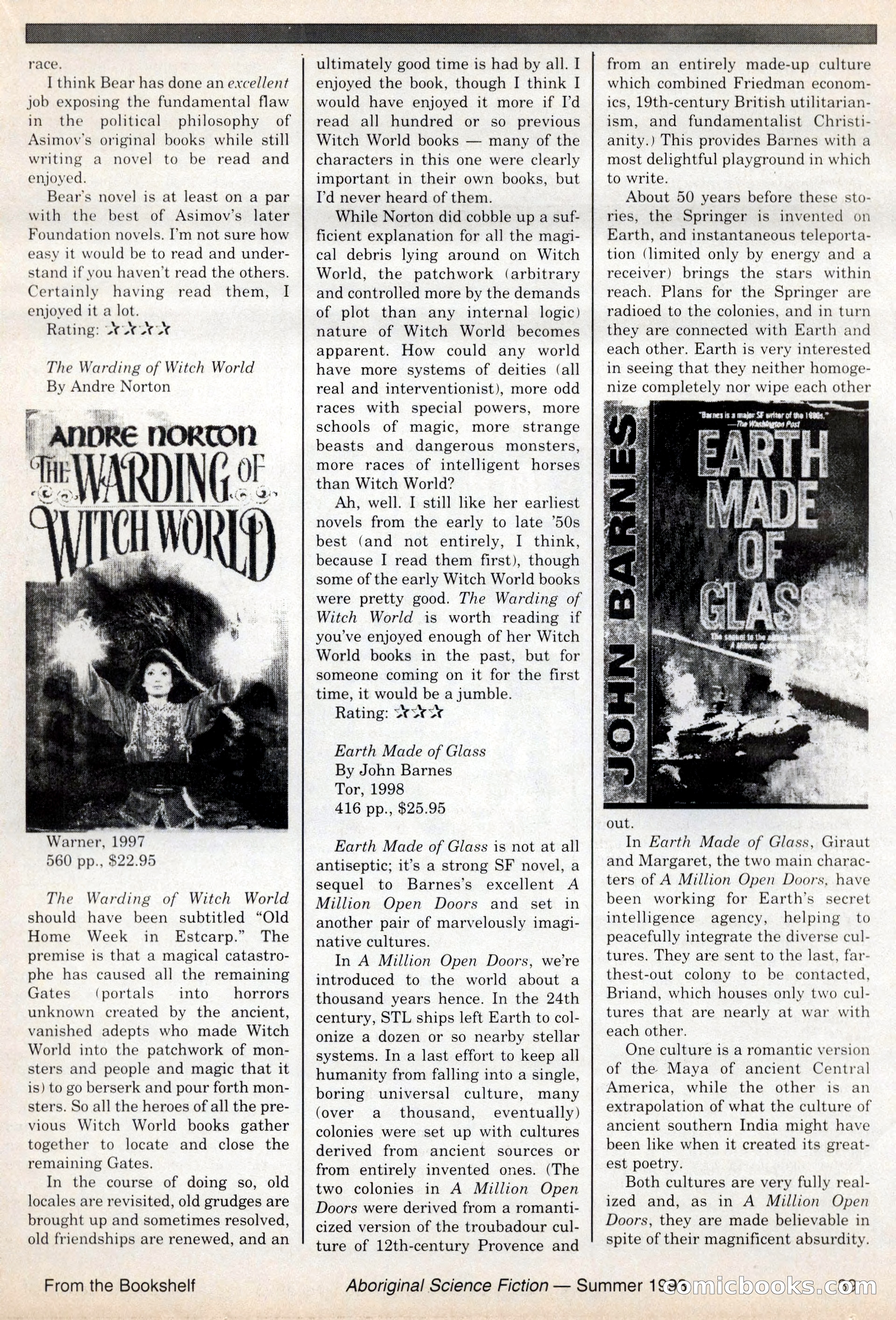
A restored page from Pulp Fiction. Page through the whole issue in the reader above.
📄 Transcribed text from this page (OCR, searchable)
Machine-transcribed from the original scan — historical spelling and the odd misread are preserved.
race. I think Bear has done an excellent job exposing the fundamental flaw in the political philosophy of Asimov's original books while still writing a novel to be read and enjoyed. Bear's novel is at least on a par with the best of Asimov’s later Foundation novels. I’m not sure how easy it would be to read and under- stand if you haven't read the others. Certainly having read them, I enjoved it a lot. Rating: er The Warding of Witch World By Andre Norton 1997 060 pp., $22.95 Warner, The Warding of Witch World should have been subtitled “Old Home Week in Estcarp.” The premise is that a magical catastro- phe has caused all the remaining Gates (portals into horrors unknown created by the ancient, vanished adepts who made Witch World into the patchwork of mon- sters and people and magic that it is) to go berserk and pour forth mon- sters. So all the heroes of all the pre- vious Witch World books gather together to locate and close the remaining Gates. In the course of doing so, old locales are revisited, old grudges are brought up and sometimes resolved, old friendships are renewed, and an From the Bookshelf ultimately good time is had by all. I enjoyed the book, though I think I would have enjoyed it more if I’d read all hundred or so previous Witch World books — many of the characters in this one were clearly important in their own books, but I'd never heard of them. While Norton did cobble up a suf- ficient explanation for all the magi- cal debris lying around on Witch World, the patchwork (arbitrary and controlled more by the demands of plot than any internal logic) nature of Witch World becomes apparent. How could any world have more systems of deities (all real and interventionist), more odd races with special powers, more schools of magic, more strange beasts and dangerous monsters, more races of intelligent horses than Witch World? Ah, well. I still like her earliest novels from the early to late 50s best (and not entirely, I think, because I read them first), though some of the early Witch World books were pretty good. The Warding of Witch World is worth reading if you've enjoyed enough of her Witch World books in the past, but for someone coming on it for the first time, it would be a jumble. Rating: v«vxrve Earth Made of Glass By John Barnes Tor, 1998 416 pp., $25.95 Earth Made of Glass is not at all antiseptic; it’s a strong SF novel, a sequel to Barnes’s excellent A Million Open Doors and set in another pair of marvelously imagi- native cultures. In A Million Open Doors, we're introduced to the world about a thousand years hence. In the 24th century, STL ships left Earth to col- onize a dozen or so nearby stellar systems. In a last effort to keep all humanity from falling into a single, boring universal culture, many (over a thousand, eventually) colonies were set up with cultures derived from ancient sources or from entirely invented ones. (The two colonies in A Million Open Doors were derived from a romanti- cized version of the troubadour cul- ture of 12th-century Provence and from an entirely made-up culture which combined Friedman econom- ics, 19th-century British utilitarian- ism, and fundamentalist Christi- anity.) This provides Barnes with a most delightful playground i in which to write. About 50 years before these sto- ries, the Springer is invented on Earth, and instantaneous teleporta- tion (limited only by energy and a receiver) brings the stars within reach. Plans for the Springer are radioed to the colonies, and in turn they are connected with Earth and each other. Earth is very interested in seeing that they neither homoge- nize completely nor wipe each other ws —— ‘Sane bee ree —The Wastington Post out. In Earth Made of Glass, Giraut and Margaret, the two main charac- ters of A Million Open Doors, have been working for Earth’s secret intelligence agency, helping to peacefully integrate the diverse cul- tures. They are sent to the last, far- thest-out colony to be contacted, Briand, which houses only two cul- tures that are nearly at war with each other. One culture is a romantic version of the Maya of ancient Central America, while the other is an extrapolation of what the culture of ancient southern India might have been like when it created its great- est poetry. Both cultures are very fully real- ized and, as in A Million Open Doors, they are made believable in spite of their magnificent absurdity. Aboriginal Science Fiction — Summer 1£9%3)/71)/\C DOO) KS ,CoIn