
Pulp Fiction · page 27 of 68
Aboriginal Science Fiction, Issues 57–58 — page 27: what you’re looking at
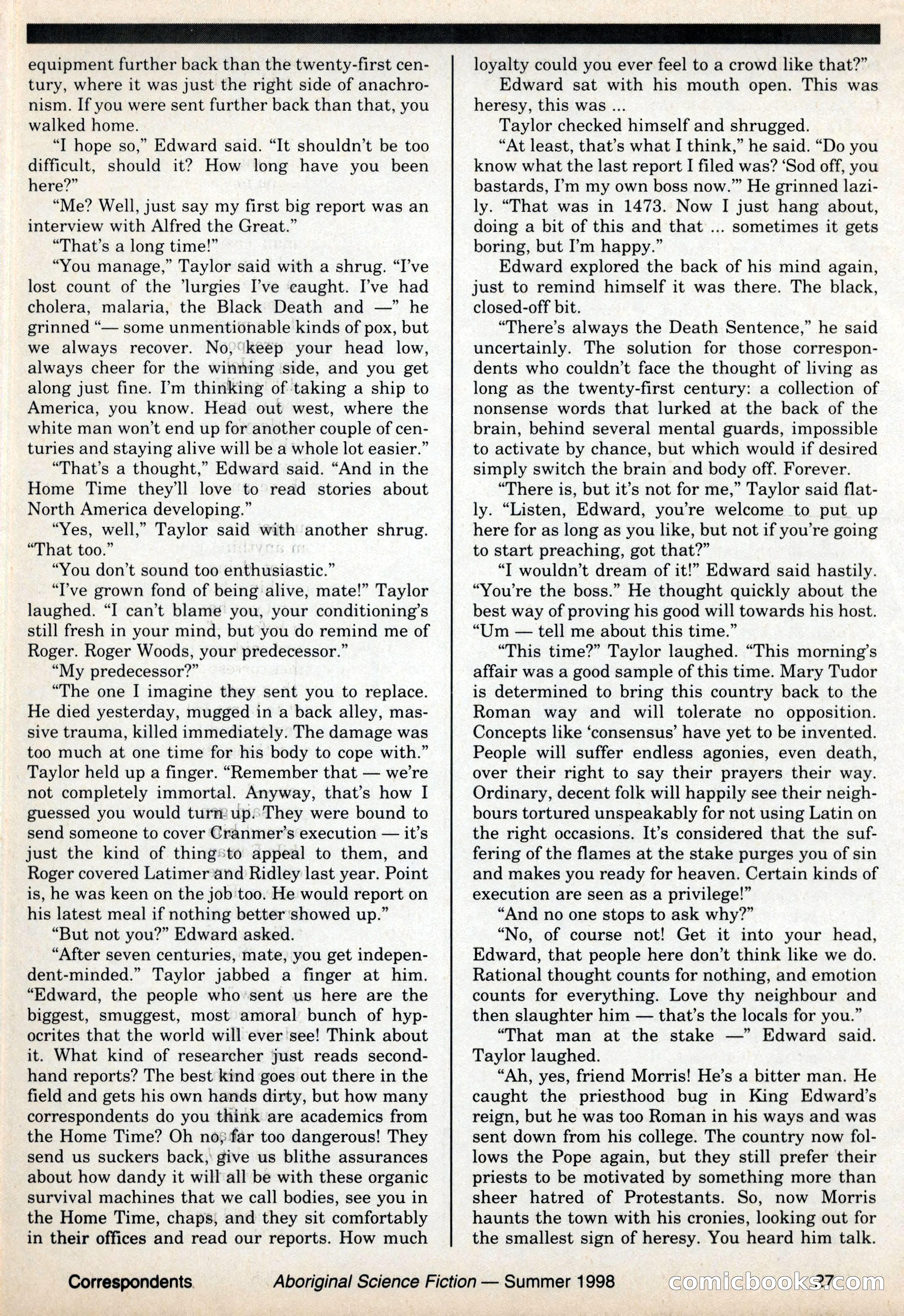
A restored page from Pulp Fiction. Page through the whole issue in the reader above.
📄 Transcribed text from this page (OCR, searchable)
Machine-transcribed from the original scan — historical spelling and the odd misread are preserved.
equipment further back than the twenty-first cen- tury, where it was just the right side of anachro- nism. If you were sent further back than that, you walked home. “I hope so,” Edward said. “It shouldn’t be too difficult, should it? How long have you been here?” “Me? Well, just say my first big report was an interview with Alfred the Great.” “That’s a long time!” “You manage,” Taylor said with a shrug. “I’ve lost count of the ‘lurgies I’ve caught. I’ve had cholera, malaria, the Black Death and —” he grinned “— some unmentionable kinds of pox, but we always recover. No, ‘keep your head low, always cheer for the winning side, and you get along just fine. ’'m thinking of taking a ship to America, you know. Head out west, where the white man won't end up for another couple of cen- turies and staying alive will be a whole lot easier.” “That’s a thought,” Edward said. “And in the Home Time they'll love to read stories about North America developing.” “Yes, well,” Taylor said with another shrug. “That too.” “You don’t sound too enthusiastic.” “I’ve grown fond of being alive, mate!” Taylor laughed. “I can’t blame you, your conditioning’s still fresh in your mind, but you do remind me of Roger. Roger Woods, your predecessor.” “My predecessor?” “The one I imagine they sent you to replace. He died yesterday, mugged in a back alley, mas- sive trauma, killed immediately. The damage was too much at one time for his body to cope with.” Taylor held up a finger. “Remember that — we’re not completely immortal. Anyway, that’s how I guessed you would turn: up. They were bound to send someone to cover Cranmer’s execution — it’s just the kind of thingsto appeal to them, and Roger covered Latimer and Ridley last year. Point is, he was keen on the job too. He would report on his latest meal if nothing better showed up.” “But not you?” Edward asked. “After seven centuries, mate, you get indepen- dent-minded.” Taylor jabbed a finger at him. “Edward, the people who sent us here are the biggest, smuggest, most amoral bunch of hyp- ocrites that the world will ever see! Think about it. What kind of researcher just reads second- hand reports? The best kind goes out there in the field and gets his own hands dirty, but how many correspondents do you think are academics from the Home Time? Oh no; far too dangerous! They send us suckers back, give us blithe assurances about how dandy it will all be with these organic survival machines that we call bodies, see you in the Home Time, chaps, and they sit comfortably in their offices and read our reports. How much Correspondents. loyalty could you ever feel to a crowd like that?” Edward sat with his mouth open. This was heresy, this was ... Taylor checked himself and shrugged. “At least, that’s what I think,” he said. “Do you know what the last report I filed was? ‘Sod off, you bastards, I’m my own boss now.” He grinned lazi- ly. “That was in 1473. Now I just hang about, doing a bit of this and that ... sometimes it gets boring, but I’m happy.” Edward explored the back of his mind again, just to remind himself it was there. The black, closed-off bit. “There’s always the Death Sentence,” he said uncertainly. The solution for those correspon- dents who couldn’t face the thought of living as long as the twenty-first century: a collection of nonsense words that lurked at the back of the brain, behind several mental guards, impossible to activate by chance, but which would if desired simply switch the brain and body off. Forever. “There is, but it’s not for me,” Taylor said flat- ly. “Listen, Edward, you’re welcome to put up here for as long as you like, but not if you're going to start preaching, got that?” “I wouldn’t dream of it!” Edward said hastily. “You're the boss.” He thought quickly about the best way of proving his good will towards his host. “Um — tell me about this time.” “This time?” Taylor laughed. “This morning’s affair was a good sample of this time. Mary Tudor is determined to bring this country back to the Roman way and will tolerate no opposition. Concepts like ‘consensus’ have yet to be invented. People will suffer endless agonies, even death, over their right to say their prayers their way. Ordinary, decent folk will happily see their neigh- bours tortured unspeakably for not using Latin on the right occasions. It’s considered that the suf- fering of the flames at the stake purges you of sin and makes you ready for heaven. Certain kinds of execution are seen as a privilege!” “And no one stops to ask why?” “No, of course not! Get it into your head, Edward, that people here don’t think like we do. Rational thought counts for nothing, and emotion counts for everything. Love thy neighbour and then slaughter him — that’s the locals for you.” “That man at the stake —” Edward said. Taylor laughed. “Ah, yes, friend Morris! He’s a bitter man. He caught the priesthood bug in King Edward’s reign, but he was too Roman in his ways and was sent down from his college. The country now fol- lows the Pope again, but they still prefer their priests to be motivated by something more than sheer hatred of Protestants. So, now Morris haunts the town with his cronies, looking out for the smallest sign of heresy. You heard him talk. Aboriginal Science Fiction — Summer 1998 COMME OOKSKeomnn