
Pulp Fiction · page 26 of 68
Aboriginal Science Fiction, Issues 57–58 — page 26: what you’re looking at
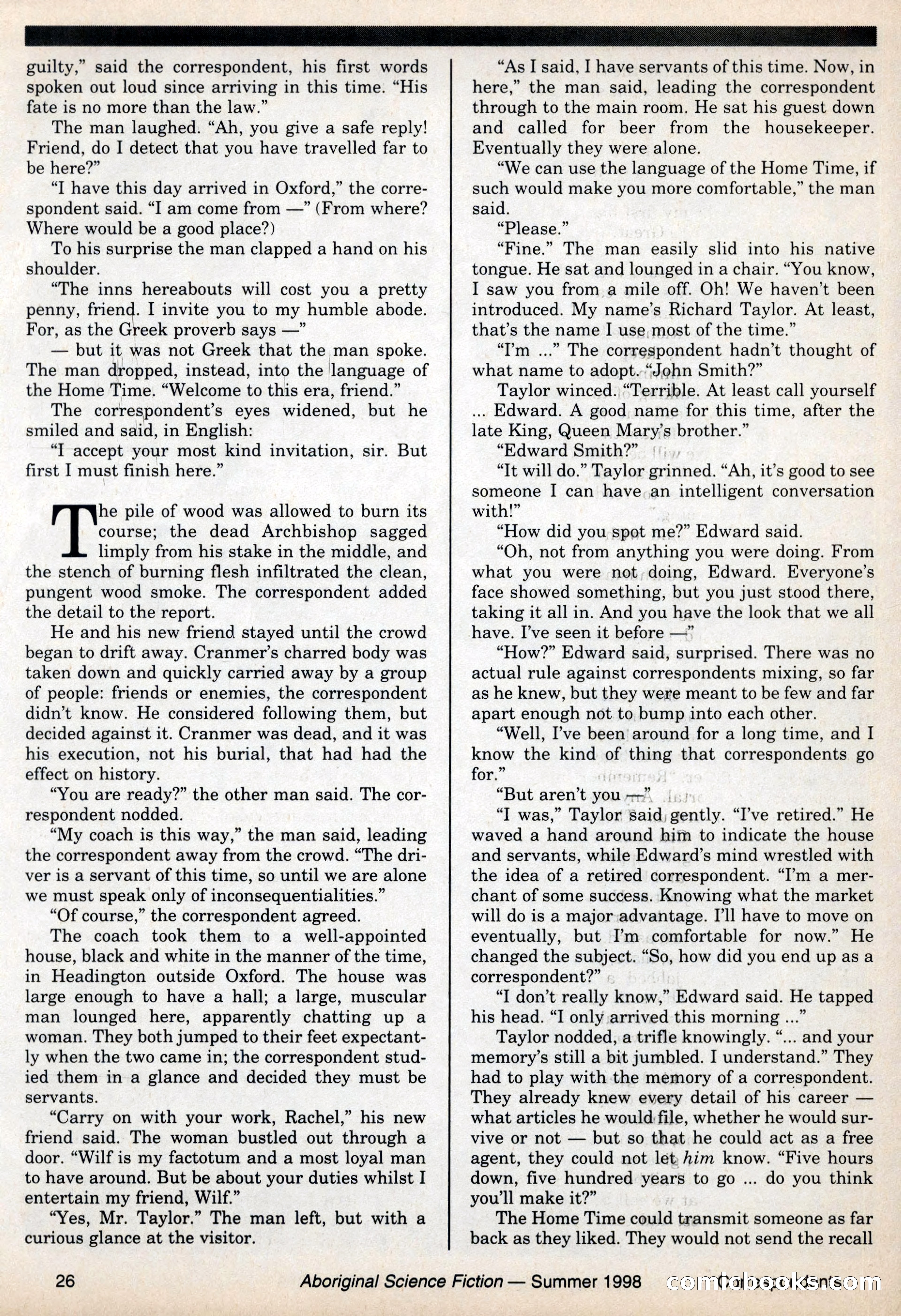
A restored page from Pulp Fiction. Page through the whole issue in the reader above.
📄 Transcribed text from this page (OCR, searchable)
Machine-transcribed from the original scan — historical spelling and the odd misread are preserved.
guilty,” said the correspondent, his first words spoken out loud since arriving in this time. “His fate is no more than the law.” The man laughed. “Ah, you give a safe reply! Friend, do I detect that you have travelled far to be here?” “I have this day arrived in Oxford,” the corre- spondent said. “I am come from —” (From where? Where would be a good place?) To his surprise the man clapped a hand on his shoulder. “The inns hereabouts will cost you a pretty penny, friend. I invite you to my humble abode. For, as the Greek proverb says —” — but it was not Greek that the man spoke. The man dropped, instead, into the language of the Home Time. “Welcome to this era, friend.” The correspondent’s eyes widened, but he smiled and said, in English: “I accept your most kind invitation, sir. But first I must finish here.” course; the dead Archbishop sagged limply from his stake in the middle, and the stench of burning flesh infiltrated the clean, pungent wood smoke. The correspondent added the detail to the report. He and his new friend stayed until the crowd began to drift away. Cranmer’s charred body was taken down and quickly carried away by a group of people: friends or enemies, the correspondent didn’t know. He considered following them, but decided against it. Cranmer was dead, and it was his execution, not his burial, that had had the effect on history. “You are ready?” the other man said. The cor- respondent nodded. “My coach is this way,” the man said, leading the correspondent away from the crowd. “The dri- ver is a servant of this time, so until we are alone we must speak only of inconsequentialities.” “Of course,” the correspondent agreed. The coach took them to a well-appointed house, black and white in the manner of the time, in Headington outside Oxford. The house was large enough to have a hall; a large, muscular man lounged here, apparently chatting up a woman. They both jumped to their feet expectant- ly when the two came in; the correspondent stud- ied them in a glance and decided they must be servants. “Carry on with your work, Rachel,” his new friend said. The woman bustled out through a door. “Wilf is my factotum and a most loyal man to have around. But be about your duties whilst I entertain my friend, Wilf.” “Yes, Mr. Taylor.” The man left, but with a curious glance at the visitor. IT": pile of wood was allowed to burn its “As I said, I have servants of this time. Now, in here,” the man said, leading the correspondent through to the main room. He sat his guest down and called for beer from the housekeeper. Eventually they were alone. “We can use the language of the Home Time, if such would make you more comfortable,” the man said. “Please.” “Fine.” The man easily slid into his native tongue. He sat and lounged in a chair. “You know, I saw you from a mile off. Oh! We haven’t been introduced. My name’s Richard Taylor. At least, that’s the name I use, most of the time.” “Tm ...” The correspondent hadn’t thought of what name to adopt. “John Smith?” Taylor winced. “Terrible. At least call yourself .. Edward. A good name for this time, after the late King, Queen Mary’s brother.” “Edward Smith?” “It will do.” Taylor grinned. “Ah, it’s good to see someone I can have.an intelligent conversation with!” “How did you spot me?” Edward said. “Oh, not from anything you were doing. From what you were not, doing, Edward. Everyone’s face showed something, but you just stood there, taking it all in. And you have the look that we all have. I’ve seen it before —” “How?” Edward said, surprised. There was no actual rule against correspondents mixing, so far as he knew, but they were meant to be few and far apart enough not to bump into each other. “Well, I’ve been around for a long time, and I know the kind of thing that correspondents go for.” “But aren’t you” | ,.: “I was,” Taylor Said; gently. “I’ve retired.” He waved a hand around him to indicate the house and servants, while Edward’s mind wrestled with the idea of a retired correspondent. “I’m a mer- chant of some success. Knowing what the market will do is a major advantage. I’ll have to move on eventually, but I’m comfortable for now.” He changed the subject. “So, how did you end up as a correspondent?” “T don’t really know,” Edward said. He tapped his head. “I only arrived this morning ...” Taylor nodded, a trifle knowingly. “... and your memory’s still a bit jumbled. I understand.” They had to play with the memory of a correspondent. They already knew every detail of his career — what articles he would file, whether he would sur- vive or not — but so that he could act as a free agent, they could not let: him know. “Five hours down, five hundred years to go ... do you think you'll make it?” The Home Time could transmit someone as far back as they liked. They would not send the recall 26 Aboriginal Science Fiction — Summer 1998 c@/iitkatoxsrordsn’sO/i))