
Pulp Fiction · page 28 of 68
Aboriginal Science Fiction, Issues 57–58 — page 28: what you’re looking at
A restored page from Pulp Fiction. Page through the whole issue in the reader above.
📄 Transcribed text from this page (OCR, searchable)
Machine-transcribed from the original scan — historical spelling and the odd misread are preserved.
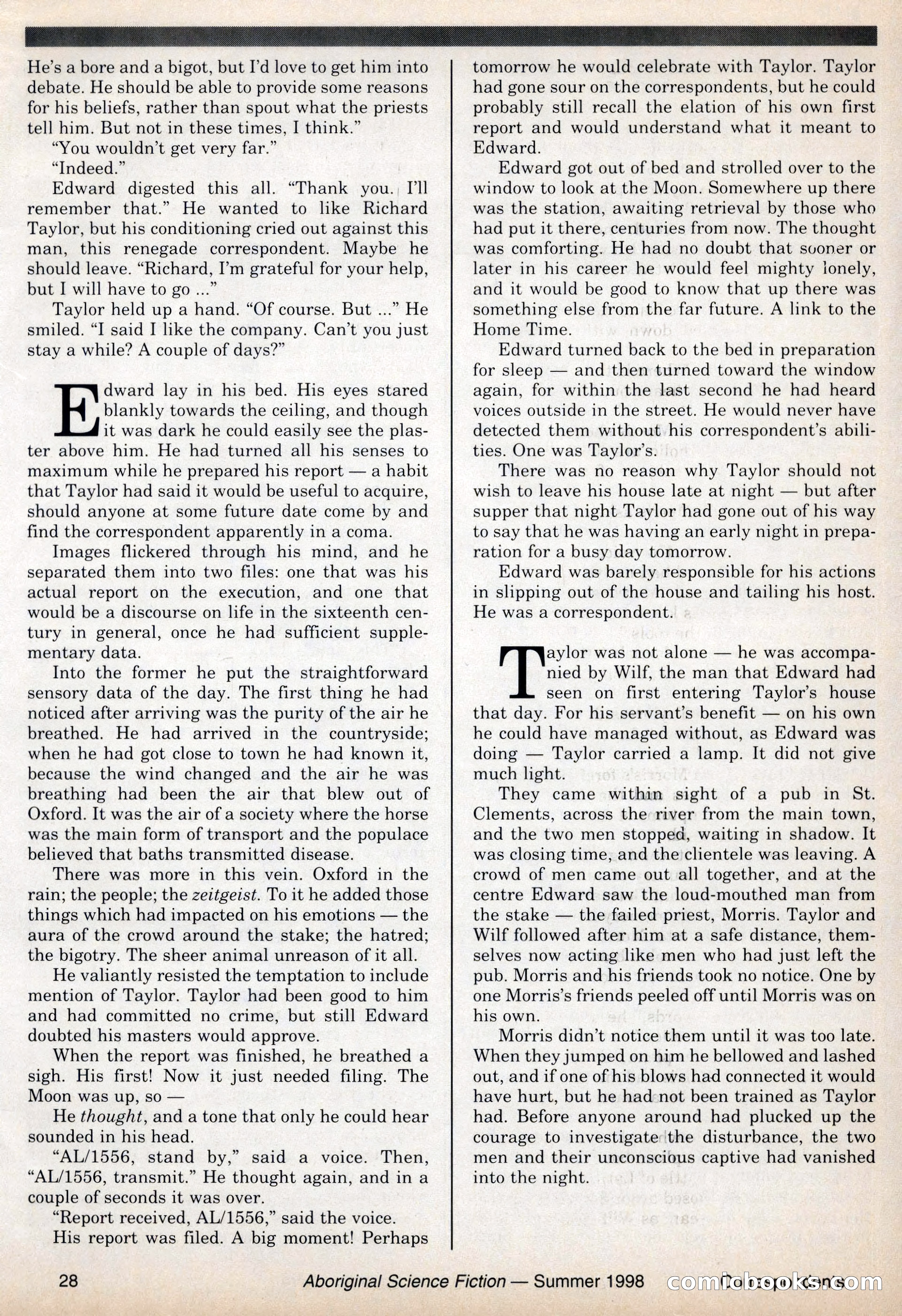
He’s a bore and a bigot, but I’d love to get him into debate. He should be able to provide some reasons for his beliefs, rather than spout what the priests tell him. But not in these times, I think.” “You wouldn’t get very far.” “Indeed.” Edward digested this all. “Thank you., [ll remember that.” He wanted to like Richard Taylor, but his conditioning cried out against this man, this renegade correspondent. Maybe he should leave. “Richard, I’m grateful for your help, but I will have to go ...” Taylor held up a hand. “Of course. But ...” He smiled. “I said I like the company. Can’t you just stay a while? A couple of days?” dward lay in his bed. His eyes stared BK blankly towards the ceiling, and though it was dark he could easily see the plas- ter above him. He had turned all his senses to maximum while he prepared his report — a habit that Taylor had said it would be useful to acquire, should anyone at some future date come by and find the correspondent apparently in a coma. Images flickered through his mind, and he separated them into two files: one that was his actual report on the execution, and one that would be a discourse on life in the sixteenth cen- tury in general, once he had sufficient supple- mentary data. Into the former he put the straightforward sensory data of the day. The first thing he had noticed after arriving was the purity of the air he breathed. He had arrived in the countryside; when he had got close to town he had known it, because the wind changed and the air he was breathing had been the air that blew out of Oxford. It was the air of a society where the horse was the main form of transport and the populace believed that baths transmitted disease. There was more in this vein. Oxford in the rain; the people; the zeitgeist. To it he added those things which had impacted on his emotions — the aura of the crowd around the stake; the hatred; the bigotry. The sheer animal unreason of it all. He valiantly resisted the temptation to include mention of Taylor. Taylor had been good to him and had committed no crime, but still Edward doubted his masters would approve. When the report was finished, he breathed a sigh. His first! Now it just needed filing. The Moon was up, so — He thought, and a tone that only he could hear sounded in his head. “AL/1556, stand by,” said a voice. Then, “AL/1556, transmit.” He thought again, and in a couple of seconds it was over. “Report received, AL/1556,” said the voice. His report was filed. A big moment! Perhaps 28 Aboriginal Science Fiction — Summer 1998 (coyiTalsrsyo) *CSNSO/ Hh) tomorrow he would celebrate with Taylor. Taylor had gone sour on the correspondents, but he could probably still recall the elation of his own first report and would understand what it meant to Edward. Edward got out of bed and strolled over to the window to look at the Moon. Somewhere up there was the station, awaiting retrieval by those who had put it there, centuries from now. The thought was comforting. He had no doubt that svoner or later in his career he would feel mighty lonely, and it would be good to know that up there was something else from the far future. A link to the Home Time. Edward turned back to the bed in preparation for sleep — and then turned toward the window again, for within the last second he had heard voices outside in the street. He would never have detected them without his correspondent’s abili- ties. One was Taylor's. There was no reason why Taylor should not wish to leave his house late at night — but after supper that night Taylor had gone out of his way to say that he was having an early night in prepa- ration for a busy day tomorrow. Edward was barely responsible for his actions in slipping out of the house and tailing his host. He was a correspondent. aylor was not alone — he was accompa- ; nied by Wilf, the man that Edward had seen on first entering Taylor’s house that day. For his servant’s benefit — on his own he could have managed without, as Edward was doing — Taylor carried a lamp. It did not give much light. They came within sight of a pub in St. Clements, across the river from the main town, and the two men stopped, waiting in shadow. It was closing time, and the clientele was leaving. A crowd of men came out all together, and at the centre Edward saw the loud-mouthed man from the stake — the failed priest, Morris. Taylor and Wilf followed after him at a safe distance, them- selves now acting like men who had just left the pub. Morris and his friends took no notice. One by one Morris’s friends peeled off until Morris was on his own. Morris didn’t notice them until it was too late. When they jumped on him he bellowed and lashed out, and if one of his blows had connected it would have hurt, but he had not been trained as Taylor had. Before anyone around had plucked up the courage to investigate the disturbance, the two men and their unconscious captive had vanished into the night.