
Pulp Fiction, 1950 · page 56 of 135
A. Merritt's Fantasy Magazine, October 1950 — page 56: what you’re looking at
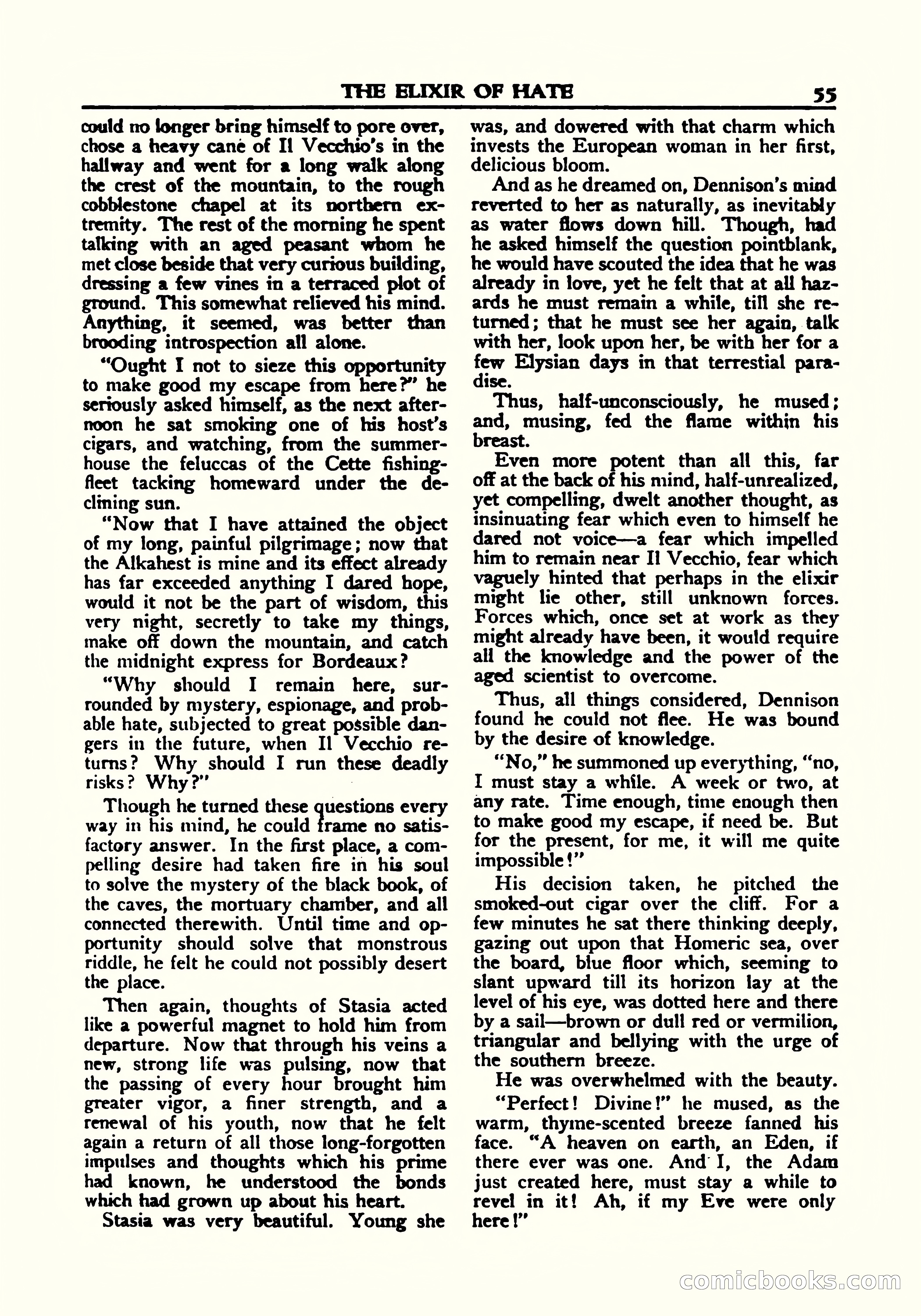
A restored page from Pulp Fiction, 1950. Page through the whole issue in the reader above.
📄 Transcribed text from this page (OCR, searchable)
Machine-transcribed from the original scan — historical spelling and the odd misread are preserved.
THE ELIXIR OF HATE 35 could no longer bring himself to pore over, chose a heavy cane of I! Vecchio’s in the hallway and went for a long walk along the crest of the mountain, to the rough cobblestone chapel at its northern ex- tremity. The rest of the morning he spent talking with an aged peasant whom he met close beside that very curious building, dressing a few vines in a terraced plot of ground. This somewhat relieved his mind. Anything, it seemed, was better than brooding introspection all alone. “Ought I not to sieze this opportunity to make good my escape from here?” he seriously asked himself, as the next after- noon he sat smoking one of his host’s cigars, and watching, from the summer- house the feluccas of the Cette fishing- fleet tacking homeward under the de- clming sun. “Now that I have attained the object of my long, painful pilgrimage; now that the Alkahest is mine and its effect already has far exceeded anything I dared hope, would it not be the part of wisdom, this very night, secretly to take my things, make off down the mountain, and catch the midnight express for Bordeaux? “Why should I remain here, sur- rounded by mystery, espionage, and prob- able hate, subjected to great possible dan- gers in the future, when II Vecchio re- turns? Why should I run these deadly risks? Why?” Though he turned these questions every way in his mind, he could trame no satis- factory answer. ‘In the first place, a com- pelling desire had taken fire in his soul to solve the mystery of the black book, of the caves, the mortuary chamber, and all connected therewith. Until time and op- portunity should solve that monstrous riddle, he felt he could not possibly desert the place. Then again, thoughts of Stasia acted like a powerful magnet to hold him from departure. Now that through his veins a new, strong life was pulsing, now that the passing of every hour brought him greater vigor, a finer strength, and a renewal of his youth, now that he felt again a return of all those long-forgotten impulses and thoughts which his prime had known, he understood the bonds which had grown up about his heart. Stasia was very beautiful. Young she was, and dowered with that charm which invests the European woman in her first, delicious bloom. And as he dreamed on, Dennison’s mind reverted to her as naturally, as inevitably as water flows down hill. Though, had he asked himself the question pointblank, he would have scouted the idea that he was already in love, yet he felt that at all haz- ards he must remain a while, till she re- turned; that he must see her again, talk with her, look upon her, be with her for a had Elysian days in that terrestial para- ise. Thus, half-unconsciously, he mused; and, musing, fed the flame within his breast. Even more potent than all this, far off at the back of his mind, half-unrealized, yet compelling, dwelt another thought, as insinuating fear which even to himself he dared not voice—a fear which impelled him to remain near I] Vecchio, fear which vaguely hinted that perhaps in the elixir might lie other, still unknown forces. Forces which, once set at work as they might already have been, it would require all the knowledge and the power of the aged scientist to overcome. Thus, all things considered, Dennison found he could not flee. He was bound by the desire of knowledge. “No,” he summoned up everything, “‘no, I must stay a while. A week or two, at any rate. Time enough, time enough then to make good my escape, if need be. But for the present, for me, it will me quite impossible !’”’ His decision taken, he pitched the smoked-out cigar over the cliff. For a few minutes he sat there thinking deeply, gazing out upon that Homeric sea, over the board, blue floor which, seeming to slant upward till its horizon fay at the level of his eye, was dotted here and there by a sail—brown or dull red or vermilion, triangular and bellying with the urge of the southern breeze. He was overwhelmed with the beauty. “Perfect! Divine!” he mused, as the warm, thyme-scented breeze fanned his face. “A heaven on earth, an Eden, if there ever was one. And I, the Adam Just created here, must stay a while to revel in it! Ah, if my Eve were only here [’’ 6)(0)©) (C(O)