
Pulp Fiction, 1950 · page 55 of 135
A. Merritt's Fantasy Magazine, October 1950 — page 55: what you’re looking at
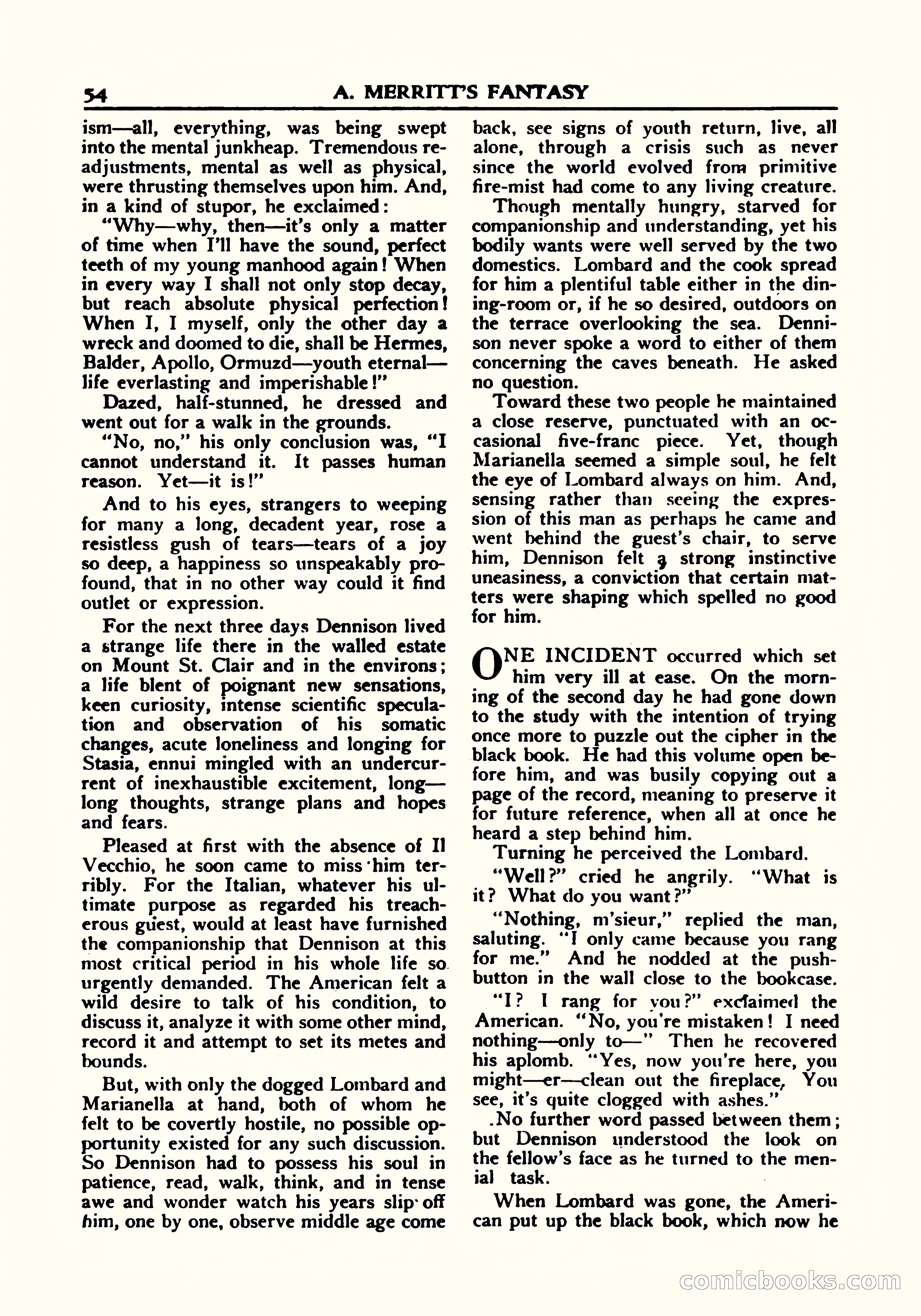
A restored page from Pulp Fiction, 1950. Page through the whole issue in the reader above.
📄 Transcribed text from this page (OCR, searchable)
Machine-transcribed from the original scan — historical spelling and the odd misread are preserved.
54 A. MERRITT’S FANTASY ism—all, everything, was being swept into the mental junkheap. Tremendous re- adjustments, mental as well as physical, were thrusting themselves upon him. And, in a kind of stupor, he exclaimed: “Why—why, then—it’s only a matter of time when I’ll have the sound, perfect teeth of my young manhood again! When in every way I shall not only stop decay, but reach absolute physical perfection! When I, I myself, only the other day a wreck and doomed to die, shall be Hermes, Balder, Apollo, Ormuzd—youth eternal— life everlasting and imperishable!’ Dazed, half-stunned, he dressed and went out for a walk in the grounds. “No, no,” his only conclusion was, “I cannot understand it. It passes human reason. Yet—it is! And to his eyes, strangers to weeping for many a long, decadent year, rose a resistless gush of tears—tears of a joy so deep, a happiness so unspeakably pro- found, that in no other way could it find outlet or expression. For the next three days Dennison lived a strange life there in the walled estate on Mount St. Clair and in the environs; a life blent of poignant new sensations, keen curiosity, intense scientific specula- tion and observation of his somatic changes, acute loneliness and longing for Stasia, ennui mingled with an undercur- rent of inexhaustible excitement, long— long thoughts, strange plans and hopes and fears. Pleased at first with the absence of II Vecchio, he soon came to miss ‘him ter- ribly. For the Italian, whatever his ul- timate purpose as regarded his treach- erous guest, would at least have furnished the companionship that Dennison at this most critical period in his whole life so. urgently demanded. The American felt a wild desire to talk of his condition, to discuss it, analyze it with some other mind, record it and attempt to set its metes and bounds. But, with only the dogged Lombard and Marianella at hand, both of whom he felt to be covertly hostile, no possible op- portunity existed for any such discussion. So Dennison had to possess his soul in patience, read, walk, think, and in tense awe and wonder watch his years slip: off him, one by one, observe middle age come back, see signs of youth return, live, all alone, through a crisis such as never since the world evolved from primitive fire-mist had come to any living creature. Though mentally hungry, starved for companionship and understanding, yet his bodily wants were well served by the two domestics. Lombard and the cook spread for him a plentiful table either in the din- ing-room or, if he so desired, outdoors on the terrace overlooking the sea. Denni- son never spoke a word to either of them concerning the caves beneath. He asked no question. Toward these two people he maintained a close reserve, punctuated with an oc- casional five-franc piece. Yet, though Marianella seemed a simple soul, he felt the eye of Lombard always on him. And, sensing rather than seeing the expres- sion of this man as perhaps he came and went behind the guest’s chair, to serve him, Dennison felt 3 strong instinctive uneasiness, a conviction that certain mat- ters were shaping which spelled no good for him. NE INCIDENT occurred which set him very ill at ease. On the morn- ing of the second day he had gone down to the study with the intention of trying once more to puzzle out the cipher in the black book. He had this volume open be- fore him, and was busily copying out a page of the record, meaning to preserve it for future reference, when all at once he heard a step behind him. Turning he perceived the Lombard. “Well?” cried he angrily. ‘What is it? What do you want?” “Nothing, m’sieur,” replied the man, saluting. “I only came because you rang for me.” And he nodded at the push- button in the wall close to the bookcase. “IT? IT rang for vou?” exclaimed the American. “No, you're mistaken! I need nothing—only to—”’ Then he recovered his aplomb. ‘Yes, now you're here, you might—er—clean out the fireplace, You see, it’s quite clogged with ashes.” .No further word passed between them; but Dennison understood the look on the fellow’s face as he turned to ec men- ial task. When Lombard was gone, the Ameri- can put up the black book, which now he COMICOC|S (C(O)