
Pulp Fiction, 1950 · page 57 of 135
A. Merritt's Fantasy Magazine, October 1950 — page 57: what you’re looking at
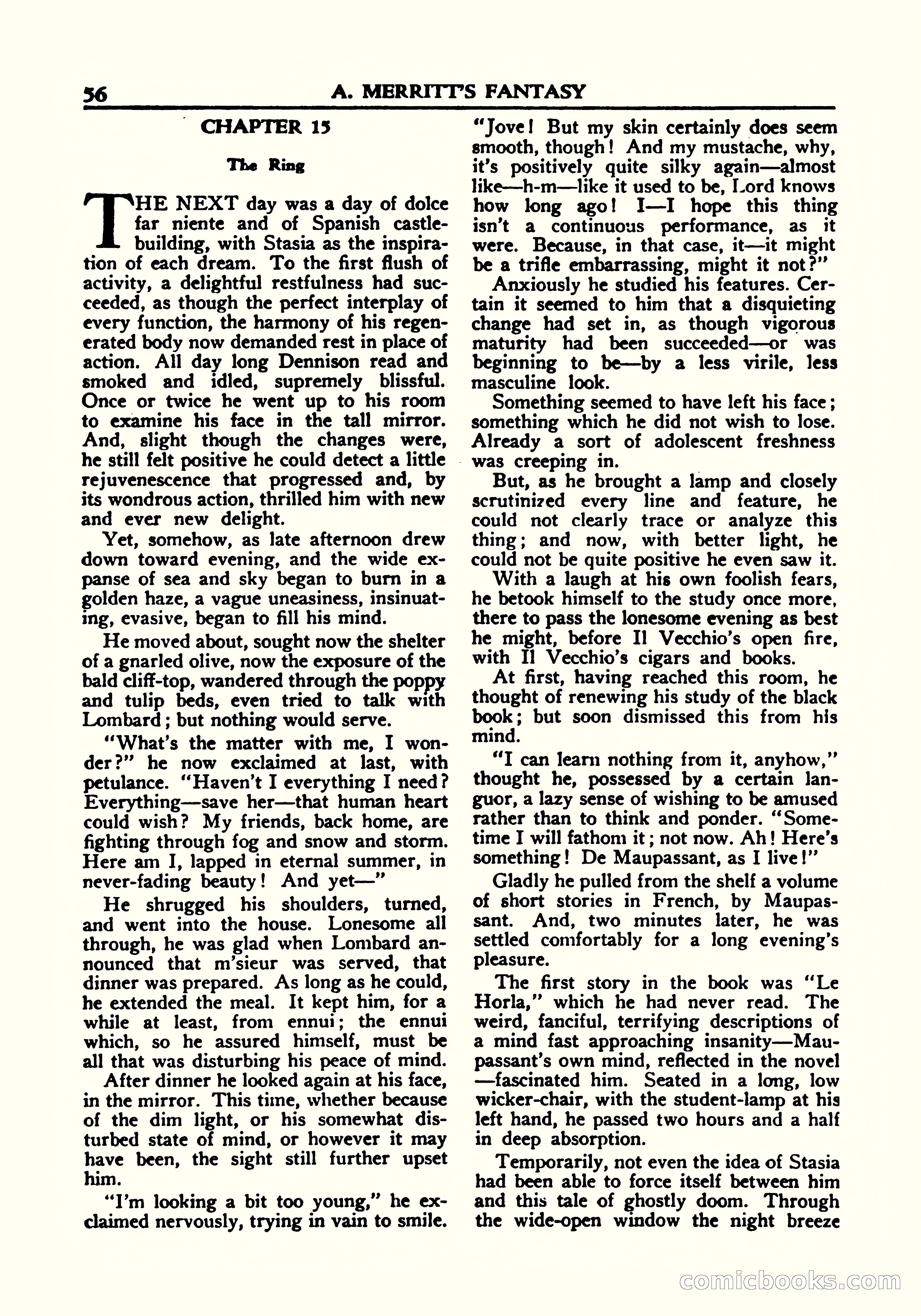
A restored page from Pulp Fiction, 1950. Page through the whole issue in the reader above.
📄 Transcribed text from this page (OCR, searchable)
Machine-transcribed from the original scan — historical spelling and the odd misread are preserved.
A. MERRITT’S FANTASY _ CHAPTER 15 The Ring HE NEXT day was a day of dolce far niente and of Spanish castle- building, with Stasia as the inspira- tion of each dream. To the first flush of activity, a delightful restfulness had suc- ceeded, as though the perfect interplay of every function, the harmony of his regen- erated body now demanded rest in place of action. All day long Dennison read and smoked and idled, supremely blissful. Once or twice he went up to his room to examine his face in the tall mirror. And, slight though the changes were, he still felt positive he could detect a little rejuvenescence that progressed and, by its wondrous action, thrilled him with new and ever new delight. Yet, somehow, as late afternoon drew down toward evening, and the wide ex- panse of sea and sky began to burn in a golden haze, a vague uneasiness, insinuat- ing, evasive, began to fill his mind. He moved about, sought now the shelter of a gnarled olive, now the exposure of the bald cliff-top, wandered through the poppy and tulip beds, even tried to talk with Lombard ; but nothing would serve. ‘‘What’s the matter with me, I won- der?” he now exclaimed at last, with petulance. “Haven't I everything I need? Everything—save her—that human heart could wish? My friends, back home, are fighting through fog and snow and storm. Here am I, lapped in eternal summer, in never-fading beauty! And yet—” He shrugged his shoulders, turned, and went into the house. Lonesome all through, he was glad when Lombard an- nounced that m’sieur was served, that dinner was prepared. As long as he could, he extended the meal. It kept him, for a while at least, from ennui; the ennui which, so he assured himself, must be all that was disturbing his peace of mind. After dinner he looked again at his face, in the mirror. This time, whether because of the dim light, or his somewhat dis- turbed state of mind, or however it may have been, the sight still further upset him. “I’m looking a bit too young,” he ex- claimed nervously, trying in vain to smile. “Jove! But my skin certainly does seem smooth, though! And my mustache, why, it’s positively quite silky again—almost like—h-m—like it used to be, Lord knows how long ago! I—I hope this thing isn’t a continuous performance, as it were. Because, in that case, it—it might be a trifle embarrassing, might it not?” Anxiously he studied his features. Cer- tain it seemed to him that a disquieting change had set in, as though vigorous maturity had been succeeded—or was beginning to be—by a less virile, less masculine look. Something seemed to have left his face ; something which he did not wish to lose. Already a sort of adolescent freshness - ‘was creeping in. But, as he brought a lamp and closely Scrutinized every line and feature, he could not clearly trace or analyze this thing; and now, with better light, he could not be quite positive he even saw it. With a laugh at his own foolish fears, he betook himself to the study once more, there to pass the lonesome evening as best he might, before I! Vecchio’s open fire, with Il Vecchio’s cigars and books. At first, having reached this room, he thought of renewing his study of the black pari but soon dismissed this from his mind. “T can learn nothing from it, anyhow,” thought he, possessed by a certain Jan- guor, a lazy sense of wishing to be amused rather than to think and ponder. “‘Some- time I will fathom it ; not now. Ah! Here’s something! De Maupassant, as I live!” Gladly he pulled from the shelf a volume of short stories in French, by Maupas- sant. And, two minutes later, he was settled comfortably for a long evening’s pleasure. The first story in the book was “Le Horla,”’ which he had never read. The weird, fanciful, terrifying descriptions of a mind fast approaching insanity—Mau- passant’s own mind, reflected in the novel —fascinated him. Seated in a long, low wicker-chair, with the student-lamp at his left hand, he passed two hours and a half in deep absorption. Temporarily, not even the idea of Stasia had been able to force itself between him and this tale of ghostly doom. Through the wide-open window the night breeze nn) (C 6)(0)©) <S (C(O)