
Pulp Fiction, 1957 · page 37 of 101
2 Gun Western, May 1957 — page 37: what you’re looking at
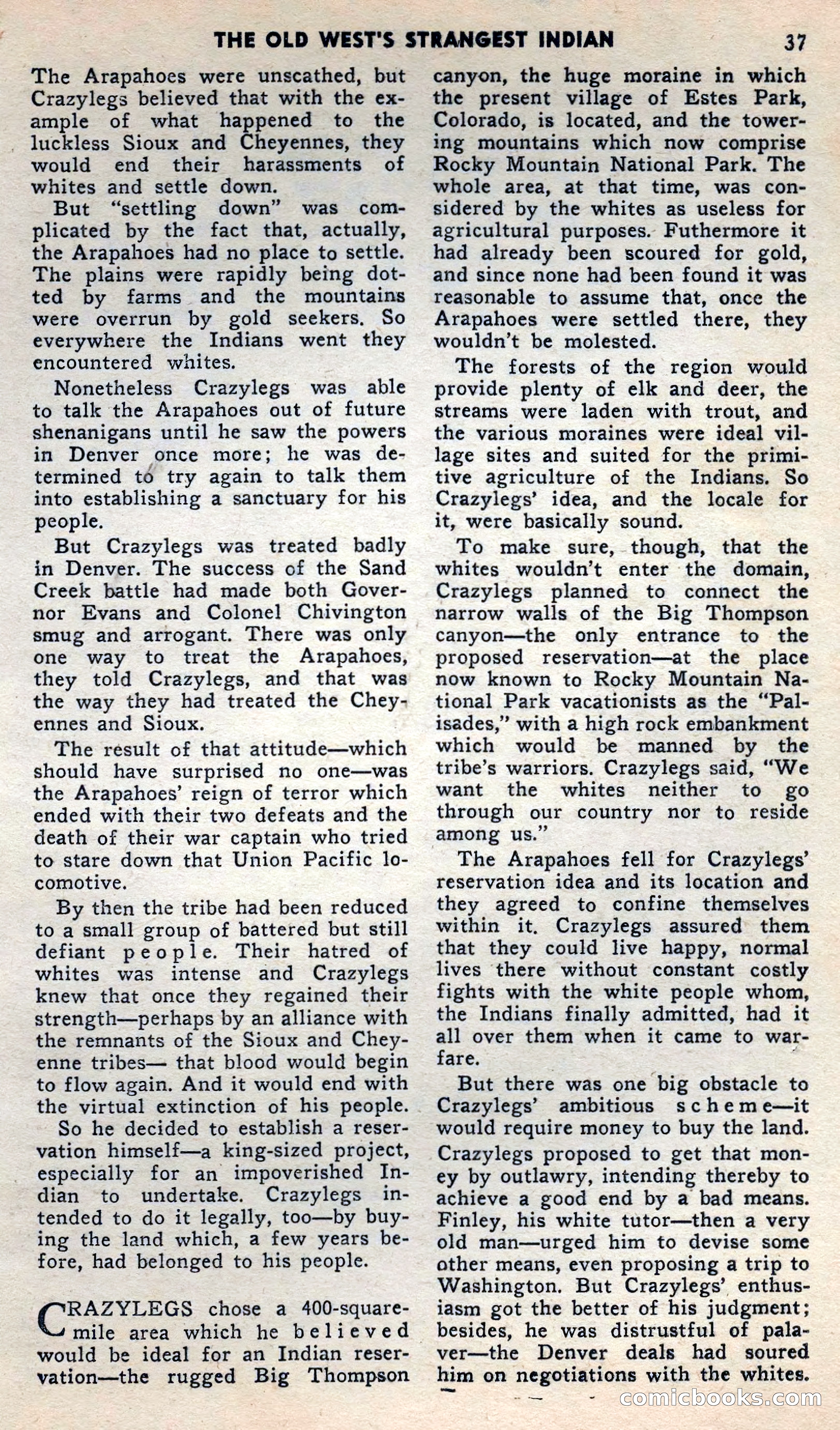
A restored page from Pulp Fiction, 1957. Page through the whole issue in the reader above.
📄 Transcribed text from this page (OCR, searchable)
Machine-transcribed from the original scan — historical spelling and the odd misread are preserved.
THE OLD WEST'S STRANGEST INDIAN 37 The Arapahoes were unscathed, but Crazylegs believed that with the ex- ample of what happened to the _ luckless Sioux and Cheyennes, they would end their harassments of whites and settle down. But “settling down” was com- plicated by the fact that, actually, the Arapahoes had no place to settle. The plains were rapidly being dot- ted by farms and the mountains were overrun by gold seekers. So everywhere the Indians went they encountered wiites. Nonetheless Crazylegs was able to talk the Arapahoes out of future shenanigans until he saw the powers in Denver once more; he was de- termined t6 try again to talk them into establishing a sanctuary for his people. But Crazylegs was treated badly in Denver. The success of the Sand Creek battle had made both Gover- nor Evans and Colonel Chivington smug and arrogant. There was only one way to treat the Arapahoes, they told Crazylegs, and that was the way they had treated the Chey- ennes and Sioux. The result of that attitude—which should have surprised no one—was the Arapahoes’ reign of terror which ended with their two defeats and the death of their war captain who tried to stare down that Union Pacific lo- comotive. By then the tribe had been reduced to a small group of battered but still defiant people. Their hatred of whites was intense and Crazylegs knew that once they regained their strength—perhaps by an alliance with the remnants of the Sioux and Chey- enne tribes— that blood would begin to flow again. And it would end with the virtual extinction of his people. So he decided to establish a reser- vation himself—a king-sized project, especially for an impoverished In- dian to undertake. Crazylegs in- tended to do it legally, too—by buy- ing the land which, a few years be- fore, had belonged to his people. RAZYLEGS chose a 400-square- mile area which he believed would be ideal for an Indian reser- vation—the rugged Big Thompson canyon, the huge moraine in which the present village of Estes Park, Colorado, is located, and the tower- ing mountains which now comprise Rocky Mountain National Park. The whole area, at that time, was con- sidered by the whites as useless for agricultural purposes. Futhermore it had already been scoured for gold, and since none had been found it was reasonable to assume that, once the Arapahoes were settled there, they wouldn’t be molested. The forests of the region would provide plenty of elk and deer, the streams were laden with trout, and the various moraines were ideal vil- lage sites and suited for the primi- tive agriculture of the Indians. So Crazylegs’ idea, and the locale for it, were basically sound. To make sure, though, that the whites wouldn’t enter the domain, Crazylegs planned to connect the narrow walls of the Big Thompson canyon—the only entrance to the proposed reservation—at the place now known to Rocky Mountain Na- tional Park vacationists as the “Pal- isades,” with a high rock embankment which would be manned by the tribe’s warriors. Crazylegs said, “We want the whites neither to go through our country nor to reside among us.” The Arapahoes fell for Crazylegs’ reservation idea and its location and they agreed to confine themselves within it. Crazylegs assured them that they could live happy, normal lives there without constant costly fights with the white people whom, the Indians finally admitted, had it all over them when it came to war- fare. | ; But there was one big obstacle to Crazylegs’ ambitious scheme—it would require money to buy the land. Crazylegs proposed to get that mon- ey by outlawry, intending thereby to achieve a good end by a bad means. Finley, his white tutor—then a very old man—urged him to devise some other means, even proposing a trip to Washington. But Crazylegs’ enthus- iasm got the better of his judgment; besides, he was distrustful of pala- ver—the Denver deals had soured him on negotiations with the whites. Ba COMmichboOokxs.Coh - mee =