
Pulp Fiction, 1957 · page 36 of 101
2 Gun Western, May 1957 — page 36: what you’re looking at
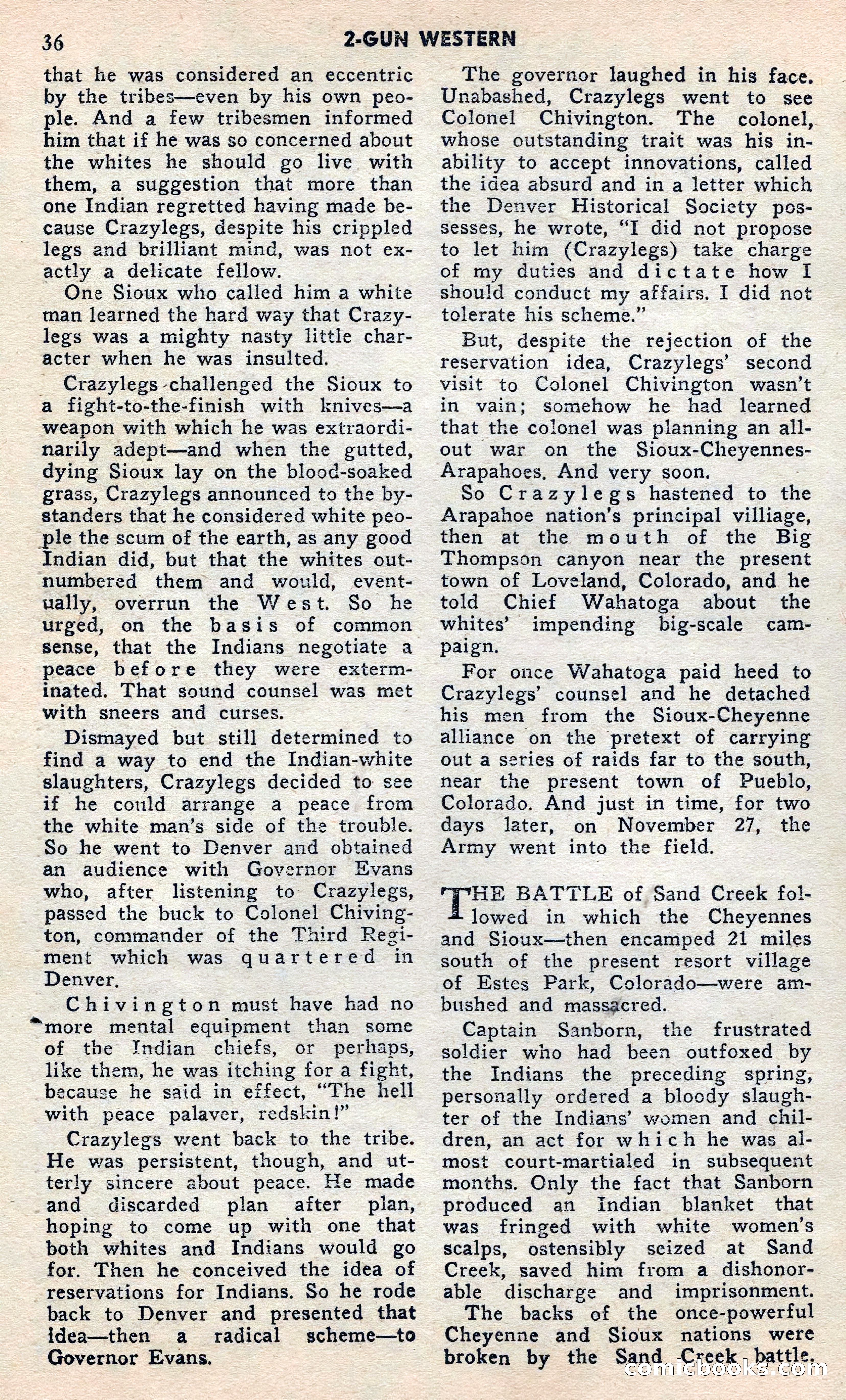
A restored page from Pulp Fiction, 1957. Page through the whole issue in the reader above.
📄 Transcribed text from this page (OCR, searchable)
Machine-transcribed from the original scan — historical spelling and the odd misread are preserved.
36 2-GUN WESTERN that he was considered an eccentric by the tribes—even by his own peo- ple. And a few tribesmen informed him that if he was so concerned about the whites he should go live with them, a suggestion that more than one Indian regretted having made be- cause Crazylegs, despite his crippled legs and brilliant mind, was not ex- actly a delicate fellow. One Sioux who called him a white man learned the hard way that Crazy- legs was a mighty nasty little char- acter when he was insulted. Crazylegs challenged the Sioux to a fight-to-the- finish with knives—a weapon with which he was extraordi- narily adept—and when the gutted, dying Sioux lay on the blood-soaked grass, Crazylegs announced to the by- standers that he considered white peo- ple the scum of the earth, as any good Indian did, but that the whites out- numbered them and would, event- ually, overrun the West. So he urged, on the basis of common sense, that the Indians negotiate a peace before they were exterm- inated. That sound counsel was met with sneers and curses. Dismayed but still determined to find a way to end the Indian-white slaughters, Crazylegs decided to see if he could arrange a peace from the white man’s side of the trouble. So he went to Denver and obtained an audience with Governor Evans who, after listening to Crazylegs, passed the buck to Colonel Chiving- ton, commander of the Third Regi- ment which was quartered in Denver, Chivington must have had no “more mental equipment than some of the Indian chiefs, or perhaps, like them, he was itching for a fight, ecause he said in effect, “The hell with peace palaver, redskin!” Crazylegs went back to the tribe. He was persistent, though, and ut- terly sincere about peace. He made and discarded plan after plan, hoping to come up with one that both whites and Indians would go for. Then he conceived the idea of reservations for Indians. So he rode back to Denver and presented that idea—then a radical Governor Evans. scheme—to The governor laughed in his face. Unabashed, Crazylegs went to see Colonel Chivington. The colonel, whose outstanding trait was his in- ability to accept innovations, called the idea absurd and in a letter which the Denver Historical Society pos- sesses, he wrote, “I did not propose to let him (Crazylegs) take charge of my duties and dictate how I should conduct my affairs. I did not tolerate his scheme.” But, despite the rejection of the reservation idea, Crazylegs’ second visit to Colonel Chivington wasn’t in vain; somehow he had learned that the colonel was planning an all- out war on the Sioux- ee Arapahoes, And very soon. so Crazylegs hastened to the Arapahoe nation’s principal villiage, then at the mouth of the Big Thompson canyon near the present town of Loveland, Colorado, and he told Chief Wahatoga about the whites’ impending big-scale cam- — paign. For once Wahatoga paid heed to Crazylegs’ counsel and he detached his men from the Sioux-Cheyenne alliance on the pretext of carrying out a series of raids far to the south, near the present town of Pueblo, Colorado. And just in time, for two days later, on November 27, the Army went into the field. HE BATTLE of Sand Creek fol- lowed in which the Cheyennes and Sioux—then encamped 21 miles south of the present resort village of Estes Park, Colorado—were am- bushed and massacred. Captain Sanborn, the frustrated soldier who had been outfoxed by the Indians the preceding spring, personally ordered a bloody slaugh- ter of the Indians’ women and chil- dren, an act for which he was al- most court-martialed in subsequent months. Only the fact that Sanborn produced an indian blanket that was fringed with white women’s scalps, ostensibly seized at Sand Creek, saved him from a dishonor- able ‘discharge and imprisonment. The backs of the once-powerful Cheyenne and Sioux nations were broken by the Sand eis Patels im