
Pulp Fiction, 1957 · page 30 of 101
2 Gun Western, May 1957 — page 30: what you’re looking at
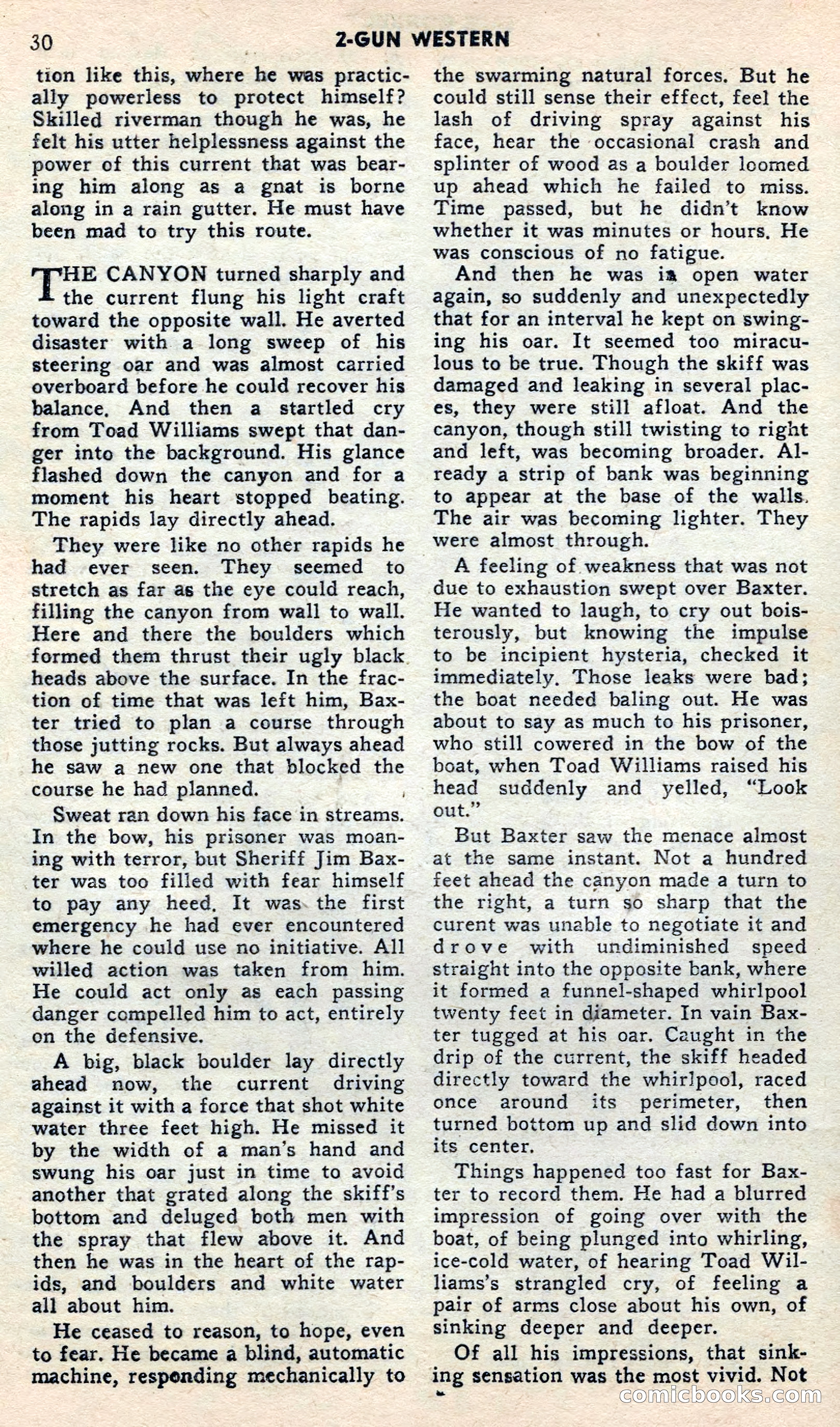
A restored page from Pulp Fiction, 1957. Page through the whole issue in the reader above.
📄 Transcribed text from this page (OCR, searchable)
Machine-transcribed from the original scan — historical spelling and the odd misread are preserved.
30 Z-GUN WESTERN tion like this, where he was practic- ally powerless to protect himself? Skilled riverman though he was, he felt his utter helplessness against the power of this current that was bear- ing him along as a gnat is borne along in a rain gutter. He must have been mad to try this route. cba CANYON turned sharply and the current flung his light craft toward the opposite wall. He averted disaster with a long sweep of his steering oar and was almost carried overboard before he could recover his balance, And then a startled cry from Toad Williams swept that dan- ger into the background. His glance flashed down the canyon and for a moment his heart stopped beating. The rapids lay directly ahead. They were like no other rapids he had ever seen. They seemed to stretch as far as the eye could reach, filling the canyon from wall to wall. Here and there the boulders which formed them thrust their ugly black. heads above the surface. In the frac- tion of time that was left him, Bax- ter tried to plan a course through those jutting rocks. But always ahead he saw a new one that blocked the course he had planned. Sweat ran down his face in streams. In the bow, his prisoner was moan- ing with terror, but Sheriff Jim Bax- ter was too filled with fear himself to pay any heed, It was. the first emergency he had ever encountered where he could use no initiative. All willed action was taken from him. He could act only as each passing danger compelled him to act, entirely on the defensive. A big, black boulder lay directly ahead now, the current driving against it with a force that shot white water three feet high. He missed it by the width of a man’s hand and swung his oar just in time to avoid another that grated along the skiff’s bottom and deluged both men with the spray that flew above it. And then he was in the heart of the rap- ids, and boulders and white water all about him. He ceased to reason, to hope, even to fear. He became a blind, automatic machine, responding mechanically to the swarming natural forces. But he could still sense their effect, feel the lash of driving spray against his face, hear the occasional crash and splinter of wood as a boulder loomed up ahead which he failed to miss. Time passed, but he didn’t know whether it was minutes or hours, He was conscious of no fatigue. And then he was im open water again, so suddenly and unexpectedly that for an interval he kept on swing- ing his oar. It seemed too miracu- lous to be true. Though the skiff was damaged and leaking in several plac- es, they were still afloat. And the canyon, though still twisting to right and left, was becoming broader. Al- ready a strip of bank was beginning to appear at the base of the walls. The air was becoming lighter. They were almost through. A feeling of weakness that was not due to exhaustion swept over Baxter. He wanted to laugh, to cry out bois- terously, but knowing the impulse to be incipient hysteria, checked it immediately. Those leaks were bad; the boat needed baling out. He was about to say as much to his prisoner, who still cowered in the bow of the boat, when Toad Williams raised his head suddenly and yelled, “Look out.” But Baxter saw the menace almost at the same instant. Not a hundred feet ahead the canyon made a turn to the right, a turn so sharp that the curent was unable to negotiate it and drove with undiminished speed . straight into the opposite bank, where it formed a funnel-shaped whirlpool twenty feet in diameter. In vain Bax- ter tugged at his oar. Caught in the drip of the current, the skiff headed directly toward the whirlpool, raced once around its perimeter, then turned bottom up and slid down into its center, Things happened too fast for Bax- ter to record them. He had a blurred impression of going over with the boat, of being plunged into whirling, ice-cold water, of hearing Toad Wil- liams’s strangled cry, of feeling a pair of arms close about his own, of sinking deeper and deeper. Of all his impressions, that sink- ing sensation was the most vivid. Not = CONnnic ooolk<s.Conn