
Pulp Fiction, 1957 · page 29 of 101
2 Gun Western, May 1957 — page 29: what you’re looking at
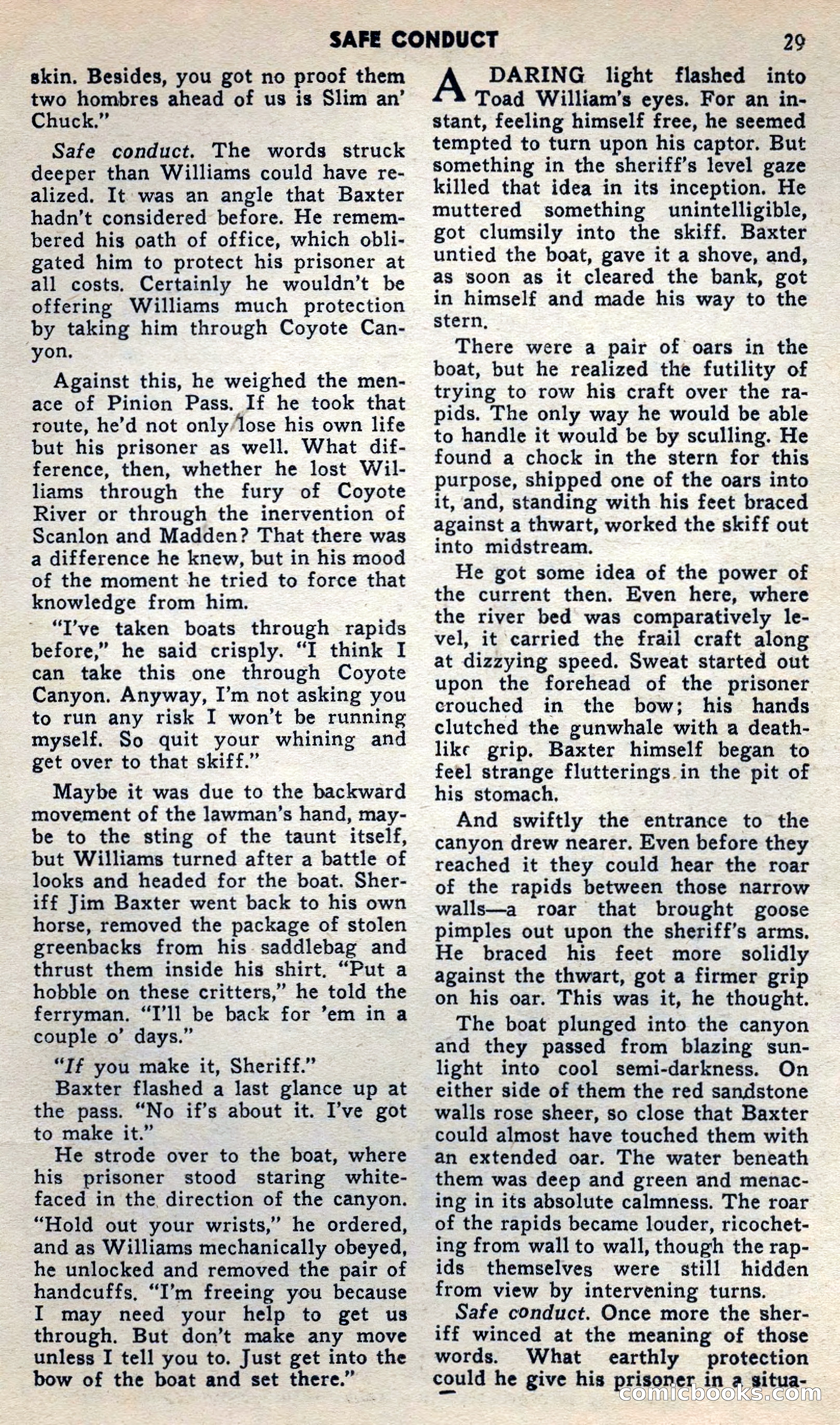
A restored page from Pulp Fiction, 1957. Page through the whole issue in the reader above.
📄 Transcribed text from this page (OCR, searchable)
Machine-transcribed from the original scan — historical spelling and the odd misread are preserved.
SAFE CONDUCT 29 skin. Besides, you got no proof them two hombres ahead of us is Slim an’ Chuck.” Safe conduct. The words struck deeper than Williams could have re- alized. It was an angle that Baxter hadn’t considered before. He remem- bered his oath of office, which obli- gated him to protect his prisoner at all costs. Certainly he wouldn’t be offering Williams much protection by taking him through Coyote Can- yon, Against this, he weighed the men- ace of Pinion Pass. If he took that route, he’d not only/lose his own life but his prisoner as well. What dif- ference, then, whether he lost Wil- liams through the fury of Coyote River or through the inervention of Scanlon and Madden? That there was a difference he knew, but in his mood of the moment he tried to force that knowledge from him. “T’ve taken boats through rapids before,” he said crisply. “I think I can take this one through Coyote Canyon. Anyway, I’m not asking you to run any risk I won't be running myself. So quit your whining and get over to that skiff.” Maybe it was due to the backward movement of the lawman’s hand, may- be to the sting of the taunt itself, but Williams turned after a battle of looks and headed for the boat. Sher- iff Jim Baxter went back to his own horse, removed the package of stolen greenbacks from his. saddlebag and thrust them inside his shirt. “Put a hobble on these critters,” he told the ferryman. “I’ll be back for ’em in a couple o’ days.” “If you make it, Sheriff.” Baxter flashed a last glance up at the pass. “No if’s about it. I’ve got to make it.” He strode over to the boat, where his prisoner stood staring white- faced in the, direction of the canyon. “Hold out your wrists,” he ordered, and as Williams mechanically obeyed, he unlocked and removed the pair of handcuffs, “I’m freeing you because I may need your help to get us through. But don’t make any move unless I tell you to. Just get into the bow of the boat and set there.” A DARING light flashed into Toad William’s eyes. For an in- stant, feeling himself free, he seemed tempted to turn upon his captor. But something in the sheriff’s level gaze killed that idea in its inception. He muttered something unintelligible, got clumsily into the skiff. Baxter untied the boat, gave it a shove, and, as soon as it cleared the bank, got in himself and made his way to the stern, There were a pair of oars in the boat, but he realized the futility of trying to row his craft over the ra- pids. The only way he would be able to handle it would be by sculling. He found a chock in the stern for this purpose, shipped one of the oars into it, and, standing with his feet braced against a thwart, worked the skiff out into midstream. He got some idea of the power of the current then. Even here, where the river bed was comparatively le- vel, it carried the frail craft along at dizzying speed. Sweat started out upon the forehead of the prisoner crouched in the bow; his hands clutched the gunwhale with a death- like grip. Baxter himself began to feel strange flutterings in the pit of his stomach, And swiftly the entrance to the canyon drew nearer. Even before they reached it they could hear the roar of the rapids between those narrow walls—a roar that brought goose pimples out upon the sheriff's arms. He braced his feet more solidly against the thwart, got a firmer grip on his oar. This was it, he thought. The boat plunged into the canyon and they passed from blazing sun- light into cool semi-darkness. On either side of them the red sandstone walls rose sheer, so close that Baxter could almost have touched them with an extended oar. The water beneath them was deep and green and menac- ing in its absolute calmness. The roar of the rapids became louder, ricochet- ing from wall to wall, though the rap- ids themselves were still hidden from view by intervening turns. Safe conduct. Once more the sher- iff winced at the meaning of those words. What earthly protection could he give his prisoner, in a, situa- = SOMNMIC OOS a COL