
Pulp Fiction, 1955 · page 25 of 99
2-Gun Western, November 1955 — page 25: what you’re looking at
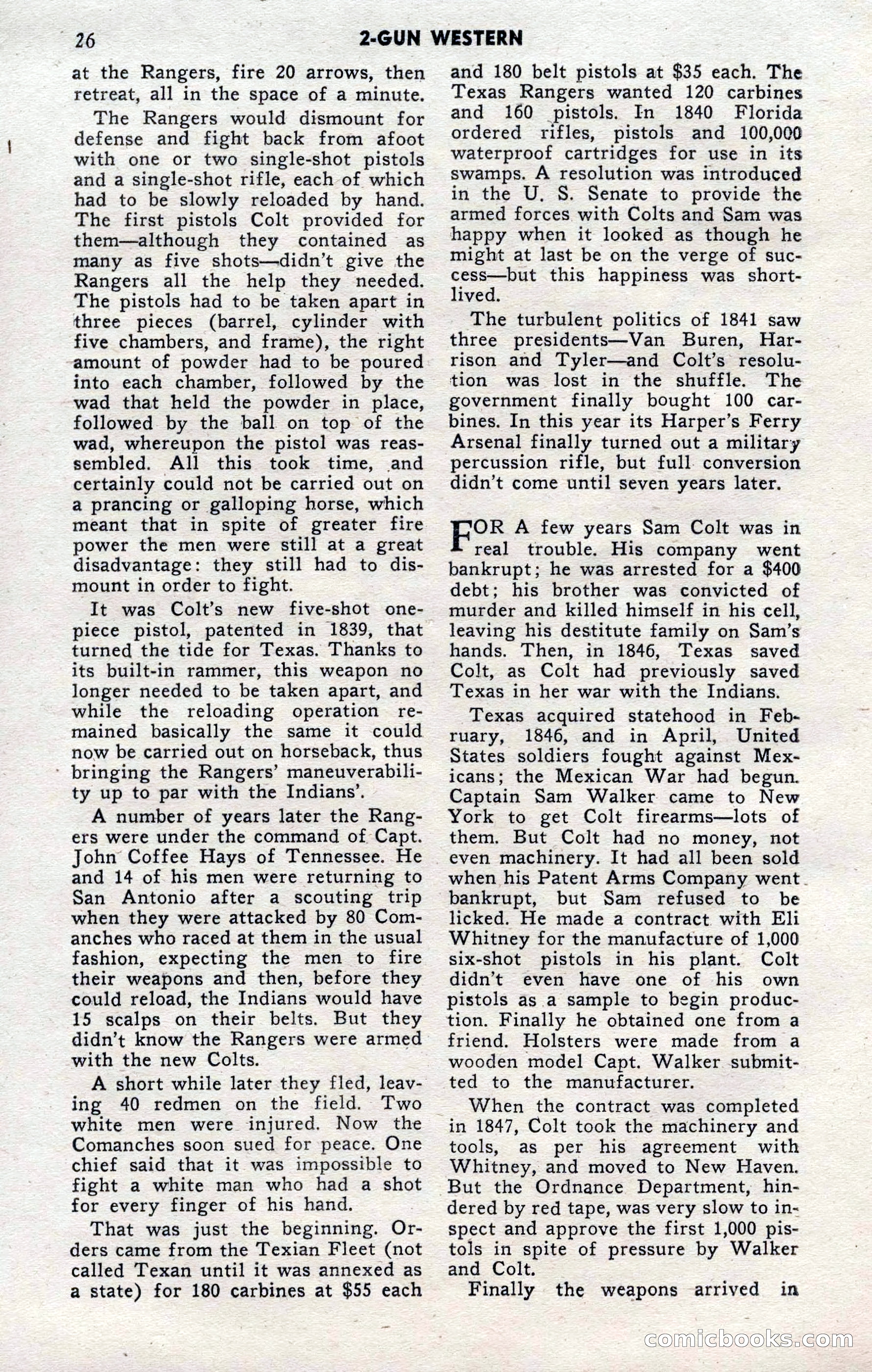
A restored page from Pulp Fiction, 1955. Page through the whole issue in the reader above.
📄 Transcribed text from this page (OCR, searchable)
Machine-transcribed from the original scan — historical spelling and the odd misread are preserved.
26 at the Rangers, fire 20 arrows, then retreat, all in the space of a minute. The Rangers would dismount for defense and fight back from afoot with one or two single-shot pistols and a single-shot rifle, each of which had to be slowly reloaded by hand. The first pistols Colt provided for them—although they contained as many as five shots—didn’t give the Rangers all the help they needed. The pistols had to be taken apart in three pieces (barrel, cylinder with five chambers, and frame), the right amount of powder had to be poured into each chamber, followed by the wad that held the powder in place, followed by the ball on top of the wad, whereupon the pistol was reas- sembled. All this took time, and certainly could not be carried out on a prancing or galloping horse, which meant that in spite of greater fire power the men were still at a great disadvantage: they still had to dis- mount in order to fight. It was Colt’s new five-shot one- piece pistol, patented in 1839, that turned the tide for Texas. Thanks to its built-in rammer, this weapon no longer needed to be taken apart, and while the reloading operation re- mained basically the same it could now be carried out on horseback, thus ' bringing the Rangers’ maneuverabili- ty up to par with the Indians’. A number of years later the Rang- ers were under the command of. Capt. John Coffee Hays of Tennessee. He and 14 of his men were returning to San Antonio after a scouting trip when they were attacked by 80 Com- anches who raced at them in the usual fashion, expecting the men to fire their weapons and then, before they could reload, the Indians would have 15 scalps on their belts. But they didn’t know the Rangers were armed with the new Colts. A short while later they fled, leav- ing 40 redmen on the field. Two white men were injured. Now the Comanches soon sued for peace. One chief said that it was impossible to fight a white man who had a shot for every finger of his hand. That was just the beginning. Or- ders came from the Texian Fleet (not called Texan until it was annexed as a state) for 180 carbines at $55 each 2-GUN WESTERN and 180 belt pistols at $35 each. The Texas Rangers wanted 120 carbines and 160 pistols. In 1840 Florida ordered rifles, pistols and 100,000 waterproof cartridges for use in its swamps. A resolution was introduced in the U, S. Senate to provide the armed forces with Colts and Sam was happy when it looked as though he might at last be on the verge of suc- cess—but this happiness was short- lived. The turbulent politics of 1841 saw three presidents—Van Buren, Har- rison and Tyler—and Colt’s resolu- tion was lost in the shuffle. The government finally bought 100 car- bines. In this year its Harper’s Ferry Arsenal finally turned out a military percussion rifle, but full. conversion didn’t come until seven years later. ES A few years Sam Colt was in real trouble. His company went bankrupt; he was arrested for a $400 debt; his brother was convicted of murder and killed himself in his cell, leaving his destitute family on Sam’s hands. Then, in 1846, Texas saved Colt, as Colt had previously saved Texas in her war with the Indians. Texas acquired statehood in Feb- ruary, 1846, and in April, United States soldiers fought against Mex- icans; the Mexican War had begun. Captain Sam Walker came to New York to get Colt firearms—lots of them. But Colt had no money, not even machinery. It had all been sold when his Patent Arms Company went. bankrupt, but Sam refused to be licked. He made a contract with Eli Whitney for the manufacture of 1,000 six-shot pistols in his plant. Colt didn’t even have one of his own pistols as a sample to begin produc- tion. Finally he obtained one from a friend. Holsters were made from a wooden model Capt. Walker submit- ted to the manufacturer. When the contract was completed in 1847, Colt took the machinery and tools, as per his agreement with Whitney, and moved to New Haven. But the Ordnance Department, hin- dered by red tape, was very slow to in~ spect and approve the first 1,000 pis- tols in spite of pressure by Walker and Colt. Finally the weapons arrived in oO Comicbooks Eo