
Pulp Fiction, 1955 · page 24 of 99
2-Gun Western, November 1955 — page 24: what you’re looking at
A restored page from Pulp Fiction, 1955. Page through the whole issue in the reader above.
📄 Transcribed text from this page (OCR, searchable)
Machine-transcribed from the original scan — historical spelling and the odd misread are preserved.
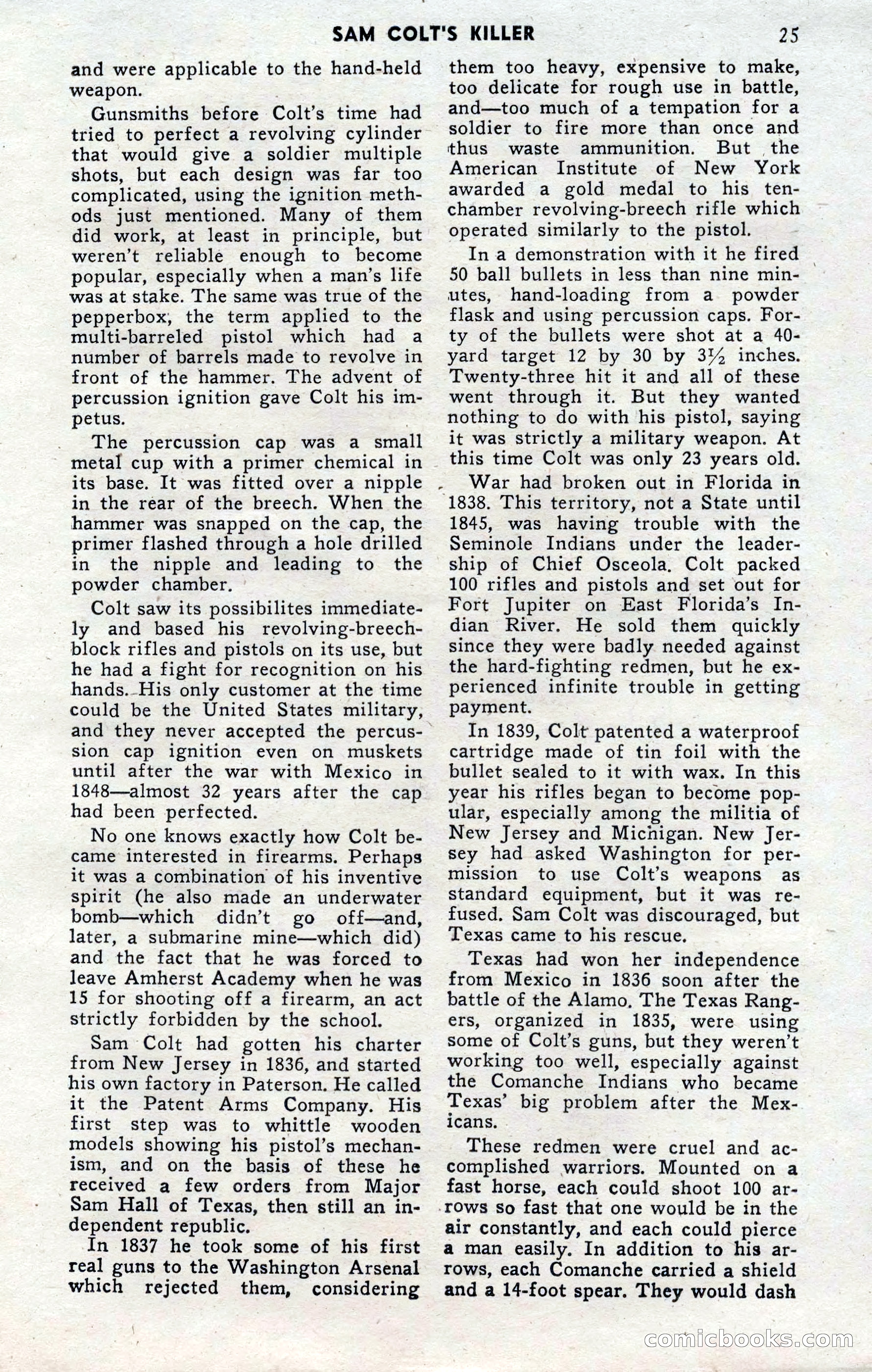
SAM COLT'S KILLER and were applicable to the hand-held weapon. : Gunsmiths before Colt’s time had tried to perfect a revolving cylinder that would give a soldier multiple shots, but each design was far too complicated, using the ignition meth- ods just mentioned. Many of them did work, at least in principle, but weren't reliable enough to become popular, especially when a man’s life was at stake. The same was true of the pepperbox, the term applied to the multi-barreled pistol which had a number of barrels made to revolve in front of the hammer. The advent of percussion ignition gave Colt his im- petus. The percussion cap was a small metal cup with a primer chemical in its base. It was fitted over a nipple . in the rear of the breech. When the hammer was snapped on the cap, the primer flashed through a hole drilled in the nipple and leading to the powder chamber. Colt saw its possibilites immediate- ly and based his revolving-breech- block rifles and pistols on its use, but he had a fight for recognition on his hands.-His only customer at the time could be the United States military, and they never accepted the percus-— sion cap ignition even on muskets until after the war with Mexico in 1848—almost 32 years after the cap had been perfected. No one knows exactly how Colt be- came interested in firearms. Perhaps it was a combination of his inventive spirit (he also made an underwater bomb—which didn’t go off—and, later, a submarine mine—which did) and the fact that he was forced to leave Amherst Academy when he was 15 for shooting off a firearm, an act strictly forbidden by the school. Sam Colt had gotten his charter from New Jersey in 1836, and started his own factory in Paterson. He called it the Patent Arms Company. His first step was to whittle wooden models showing his pistol’s mechan- ism, and on the basis of these he received a few orders from Major Sam Hall of Texas, then still an in- dependent republic. In 1837 he took some of his first real guns to the Washington Arsenal which rejected them, considering 25 them too heavy, expensive to make, too delicate for rough use in battle, and—too much of a tempation for a soldier to fire more than once and thus waste ammunition. But the American Institute of New York awarded a gold medal to his ten- chamber revolving-breech rifle which operated similarly to the pistol. In a demonstration with it he fired © 50 ball bullets in less than nine min- utes, hand-loading from a powder flask and using percussion caps. For- ty of the bullets were shot at a 40- yard target 12 by 30 by 3%% inches. Twenty-three hit it and all of these went through it. But they wanted nothing to do with his pistol, saying it was strictly a military weapon. At this time Colt was only 23 years old. War had broken out in Florida in 1838. This territory, not a State until 1845, was having trouble with the Seminole Indians under the leader- ship of Chief Osceola, Colt packed 100 rifles and pistols and set out for Fort Jupiter on East Florida’s In- dian River. He sold them quickly since they were badly needed against the hard-fighting redmen, but he ex- perienced infinite trouble in getting payment. In 1839, Colt patented a waterproof cartridge made of tin foil with the bullet sealed to it with wax. In this year his rifles began to become pop- ular, especially among the militia of New Jersey and Michigan. New Jer- sey had asked Washington for per- mission to use Colt’s weapons as standard equipment, but it was re- fused. Sam Colt was discouraged, but Texas came to his rescue. Texas had won her independence from Mexico in 1836 soon after the battle of the Alamo, The Texas Rang- ers, organized in 1835, were using some of Colt’s guns, but they weren’t working too well, especially against the Comanche Indians who became Texas’ big problem after the Mex- icans. These redmen were cruel and ac- complished warriors. Mounted on a fast horse, each could shoot 100 ar- -rows so fast that one would be in the air constantly, and each could pierce a man easily. In addition to his ar- rows, each Comanche carried a shield and a 14-foot spear. They would dash Oo Connicaoooks CO