
Pulp Fiction, 1955 · page 26 of 99
2-Gun Western, November 1955 — page 26: what you’re looking at
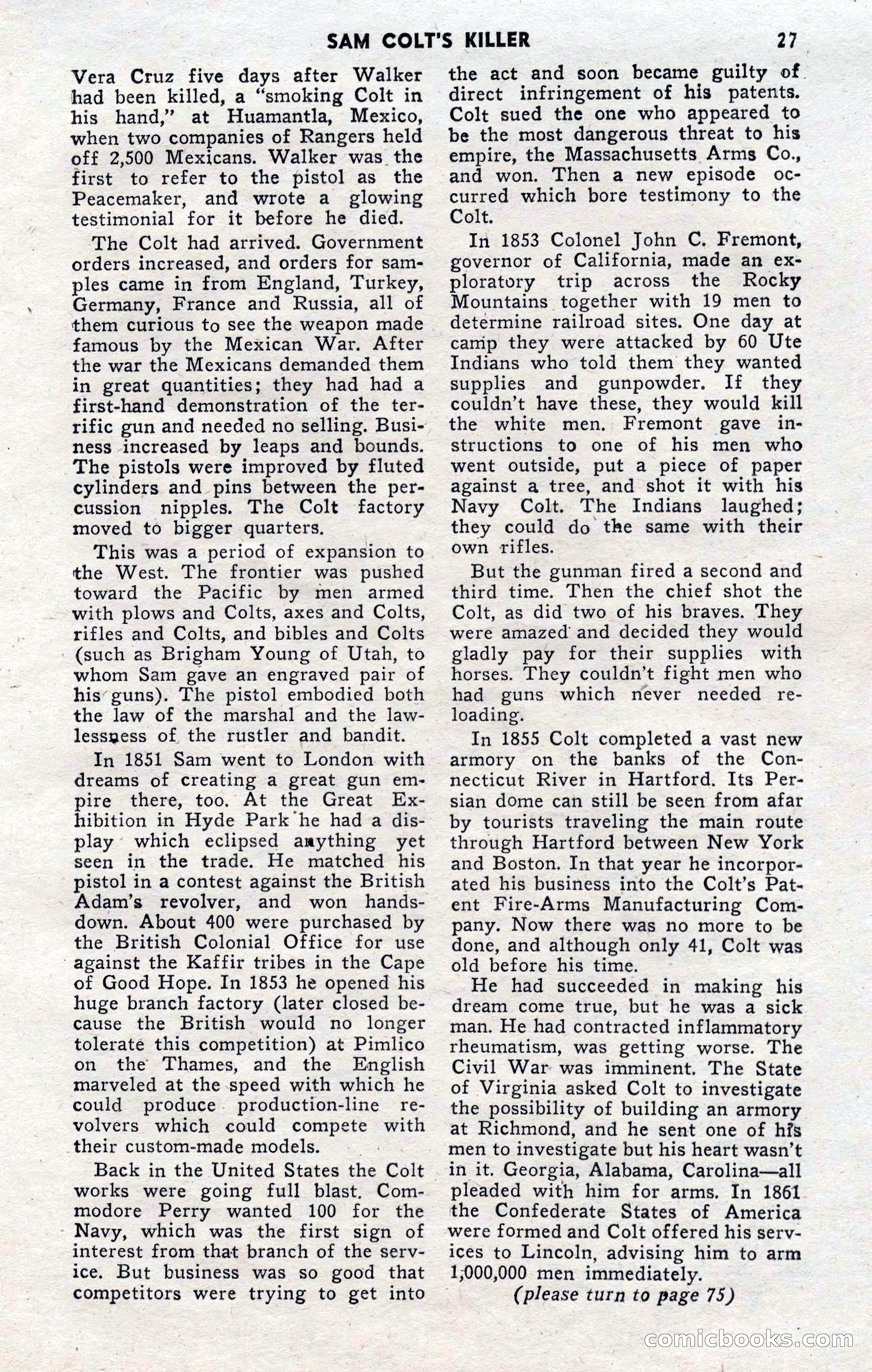
A restored page from Pulp Fiction, 1955. Page through the whole issue in the reader above.
📄 Transcribed text from this page (OCR, searchable)
Machine-transcribed from the original scan — historical spelling and the odd misread are preserved.
SAM COLT’S KILLER 27, the act and soon became guilty of. Vera Cruz five days after Walker had been killed, a “smoking Colt in his hand,’ at Huamantla, Mexico, when two companies of Rangers held off 2,500 Mexicans. Walker was the first to refer to the pistol as the Peacemaker, and wrote a_ glowing testimonial for it before he died. The Colt had arrived. Government orders increased, and orders for sam- ples came in from England, Turkey, Germany, France and Russia, all of them curious to see the weapon made famous by the Mexican War. After the war the Mexicans demanded them in great quantities; they had had a first-hand demonstration of the ter- rific gun and needed no selling. Busi- ness increased by leaps and bounds. The pistols were improved by fluted cylinders and pins between the per- cussion nipples. The Colt factory moved to bigger quarters. This was a period of expansion to the West. The frontier was pushed toward the Pacific by men armed with plows and Colts, axes and Colts, rifles and Colts, and bibles and Colts (such as Brigham Young of Utah, to whom Sam gave an engraved pair of his‘ guns). The pistol embodied both the law of the marshal and the law- lessnpess of the rustler and bandit. In 1851 Sam went to London with dreams of creating a great gun em- pire there, too. At the Great Ex- hibition in Hyde Park he had a dis- play which eclipsed auything yet seen in the trade. He matched his pistol in a contest against the British Adam’s revolver, and won _ hands- down. About 400 were purchased by the British Colonial Office for use -against the Kaffir tribes in the Cape of Good Hope. In 1853 he opened his huge branch factory (later closed be- cause the British would no longer tolerate this competition) at Pimlico on the Thames, and the English marveled at the speed with which he could produce. production-line re- volvers which could compete with their custom-made models. : Back in the United States the Colt works were going full blast. Com- modore Perry wanted 100 for the Navy, which was the first sign of interest from that branch of the serv- ice. But business was so good that competitors were trying to get into direct infringement of his patents. Colt sued the one who appeared to be the most dangerous threat to his empire, the Massachusetts Arms Co., and won. Then a new episode oc- curred which bore testimony to the Colt. In 1853 Colonel John C. Fremont, governor of California, made an ex- ploratory trip across the Rocky Mountains together with 19 men to determine railroad sites. One day at camip they were attacked by 60 Ute Indians who told them they wanted supplies and gunpowder. If they couldn’t have these, they would kill the white men. Fremont gave in- structions to one of his men who went outside, put a piece of paper against a tree, and shot it with his Navy Colt. The Indians laughed; they could do the same with their own rifles. But the gunman fired a second and | third time. Then the chief shot the Colt, as did two of his braves. They were amazed and decided they would gladly pay for their supplies with horses. They couldn’t fight men who had guns which never needed re- loading. In 1855 Colt completed a vast new armory on the banks of the Con- necticut River in Hartford. Its Per- sian dome can still be seen from afar by tourists traveling the main route through Hartford between New York and Boston. In that year he incorpor- ated his business into the Colt’s Pat- ent Fire-Arms Manufacturing Com- pany. Now there was no more to be done, and although only 41, Colt was old before his time. He had succeeded in making his dream come true, but he was a sick man. He had contracted inflammatory rheumatism, was getting worse. The Civil War was imminent. The State of Virginia asked Colt to investigate the possibility of building an armory at Richmond, and he sent one of his men to investigate but his heart wasn’t in it. Georgia, Alabama, Carolina—all pleaded with him for arms. In 1861 the Confederate States of America ‘were formed and Colt offered his serv- ices to Lincoln, advising him to arm 1;000,000 men immediately. (please turn to page 75) conmmicbooks.cO®