
Pulp Fiction, 1954 · page 69 of 100
2-Gun Western, February 1954 — page 69: what you’re looking at
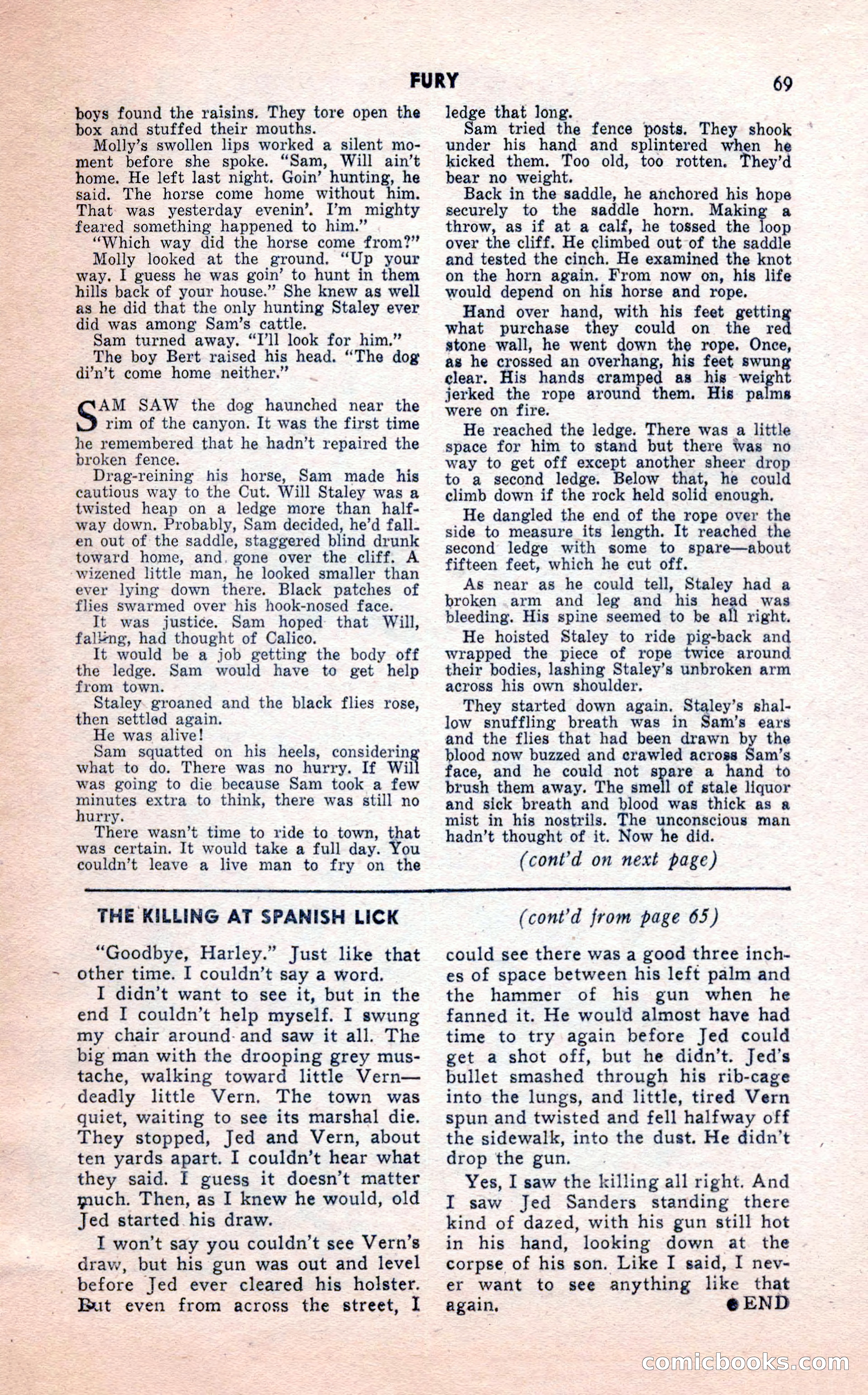
A restored page from Pulp Fiction, 1954. Page through the whole issue in the reader above.
📄 Transcribed text from this page (OCR, searchable)
Machine-transcribed from the original scan — historical spelling and the odd misread are preserved.
FURY - boys found the raisins. They tore open the box and stuffed their mouths. Molly’s swollen lips worked a silent mo- ment before she spoke. “Sam, Will ain’t home. He left last night. Goin’ hunting, he said. The horse come home without him. That was yesterday evenin’. I’m mighty feared something happened to him.” “Which way did the horse come from?” Molly looked at the ground, “Up your way. I guess he was goin’ to hunt in them hills back of your house.” She knew as well as he did that the only hunting Staley ever did was among Sam’s cattle. Sam turned away. “I'll look for him.” The boy Bert raised his head. “The dog di’n’t come home neither.” AM SAW the dog haunched near the rim of the canyon. It was the first time he remembered that he hadn’t repaired the broken fence. Drag-reining his horse, Sam made his cautious way to the Cut. Will Staley was a twisted heap on a ledge more than half- way down. Probably, Sam decided, he’d fall. en out of the saddle, staggered blind drunk toward home, and. gone over the cliff. A -wizened little man, he looked smaller than ever lying down there. Black patches of flies swarmed over his hook-nosed face. It was justice. Sam hoped that Will, falling, had thought of Calico. It would be a job getting the body off the ledge. Sam would have to get help from town. Staley. groaned and the black flies rose, then settled again. He was alive! Sam squatted on his heels, considerin what to do. There was no hurry. If Wil was going to die because Sam took a few minutes extra to think, there was still no hurry. There wasn’t time to ride to town, that was certain. It would take a full day. You couldn’t leave a live man to fry on the 69 ledge that long. Sam tried the fence posts. They shook under his hand and splintered when he kicked them. Too old, too rotten. They’d bear no weight. Back in the saddle, he anchored his hope securely to the saddle horn. Making a throw, as if at a calf, he tossed the nae over the cliff. He climbed out of the saddle and tested the cinch. He examined the knot on the horn again. From now on, his life would depend on his horse and rope. Hand over hand, with his feet gettin what purchase they could on the re stone wall, he went down the rope. Once, as he crossed an overhang, his feet swung clear. His hands cramped as his weight jerked the rope around them. His palms were on fire. He reached the ledge. There was a little space for him to stand but there Was no way to get off except another sheer drop to a second ledge. Below that, he could climb down if the rock held solid enough. He dangled the end of the rope over the side to measure its length. It reached the second ledge with some to spare—about fifteen feet, which he cut off. As near as he could tell, Staley had a broken arm and leg and his head was bleeding. His spine seemed to be all right. He hoisted Staley to ride pig-back and wrapped the piece of rope twice around their bodies, lashing Staley’s unbroken arm across his own shoulder. They started down again. Staley’s shal- low snuffling breath was in Sam’s ears and the flies that had been drawn by the blood now buzzed and crawled across face, and he could not spare a hand to brush them away. The smell of stale liquor and sick breath and blood was thick as a mist in his nostrils. The unconscious man hadn’t thought of it. Now he did. (cont'd on next page) Rt, LS THE KILLING AT SPANISH LICK “Goodbye, Harley.” Just like that other time. I couldn’t say a word. I didn’t want to see it, but in the end I couldn’t help myself. I swung my chair around-and saw it all. The big man with the drooping grey mus- tache, walking toward little Vern— deadly little Vern. The town was quiet, waiting to see its marshal die. They stopped, Jed and Vern, about ten yards apart. I couldn’t hear what they said. I guess it doesn’t matter much. Then, as I knew he would, old Jed started his draw. I won't say you couldn’t see Vern’s draw, but his gun was out and level _ before Jed ever cleared his holster. But even from across the street, I (cont'd from page 65) could see there was a good three inch- es of space between his left palm and the hammer of his gun when he fanned it. He would almost have had time to try again before Jed could get a shot off, but he didn’t. Jed’s bullet smashed through his rib-cage into the lungs, and little, tired Vern spun and twisted and fell halfway off the sidewalk, into the dust. He didn’t drop the gun. Yes, I saw the killing all right. And I saw Jed Sanders standing there kind of dazed, with his gun still hot in his hand, looking down at the corpse of his son. Like I said, I nev- er want to see anything like that again, @END GoOmichbooks am’s . (C@