
Pulp Fiction, 1954 · page 68 of 100
2-Gun Western, February 1954 — page 68: what you’re looking at
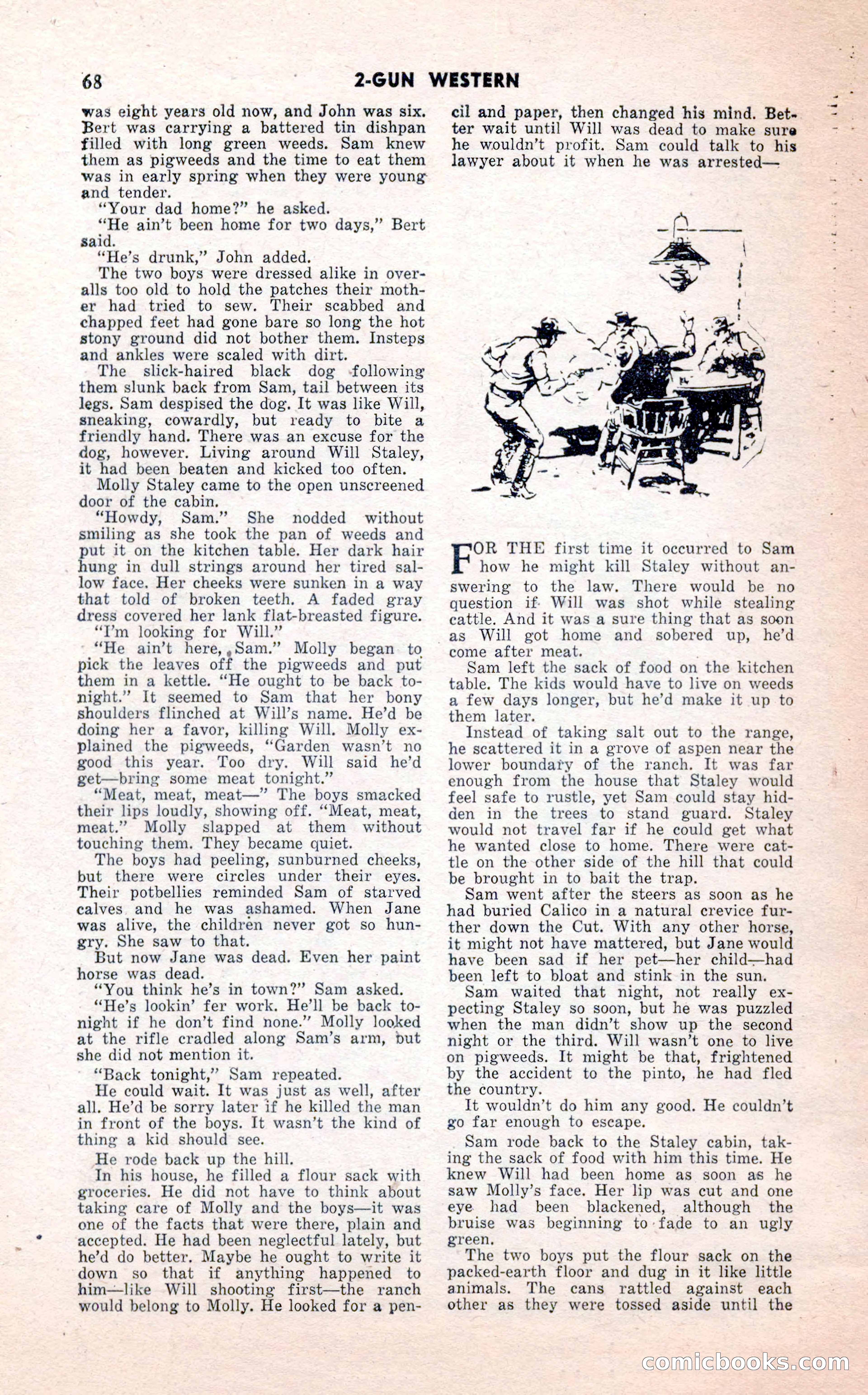
A restored page from Pulp Fiction, 1954. Page through the whole issue in the reader above.
📄 Transcribed text from this page (OCR, searchable)
Machine-transcribed from the original scan — historical spelling and the odd misread are preserved.
68 was eight years old now, and John was six, Bert was carrying a battered tin dishpan filled with long green weeds. Sam knew them as pigweeds and the time to eat them was in early spring when they were young and tender. “Your dad home?” he asked. ts ain’t been home for two days,” Bert said. “He’s drunk,” John added. The two boys were dressed alike in over- alls too old to hold the patches their moth- er had tried to sew. Their scabbed and chapped feet had gone bare so long the hot stony ground did not bother them. Insteps and ankles were scaled with dirt. The slick-haired black dog -following them slunk back from Sam, tail between its legs. Sam despised the dog. It was like Will, sneaking, cowardly, but ready to bite a friendly hand. There was an excuse for the dog, however. Living around Will Staley, it had been beaten and kicked too often. Molly Staley came to the open unscreened door of the cabin. “Howdy, Sam.” She nodded without smiling as she took the pan of weeds and put it on the kitchen table. Her dark hair hung in dull strings around her tired sal- low face. Her cheeks were sunken in a way that told of broken teeth. A faded gray dress covered her lank flat-breasted figure. “T’m looking for Will.” “He ain’t here,,Sam.” Molly began to pick the leaves off the pigweeds and put them in a kettle. “He ought to be back to- night.” It seemed to Sam that her bony shoulders flinched at Will’s name. He’d be doing her a favor, killing Will. Molly ex- plained the pigweeds, “Garden wasn’t no good this year. Too dry. Will said he’d get—bring some meat tonight.” “Meat, meat, meat—” The boys smacked their lips loudly, showing off. ““Meat, meat, meat.” Molly slapped at them without touching them. They became quiet. The boys had peeling, sunburned cheeks, but there were circles under their eyes. Their potbellies reminded Sam of starved calves and he was ashamed. When Jane was alive, the children never got so hun- gry. She saw to that. But now Jane was dead. Even her paint horse was dead. “You think he’s in town?” Sam asked. “He’s lookin’ fer work. He’ll be back to- night if he don’t find none.’ Molly looked at the rifle cradled along Sam’s arm, but she did not mention it. “Back tonight,” Sam repeated. He could wait. It was just as well, after all. He’d be sorry later if he killed the man in front of the boys. It wasn’t the kind of thing a kid should see. He rode back up the hill. In his house, he filled a flour sack with groceries. He did not have to think about taking care of Molly and the boys—it was one of the facts that were there, plain and accepted. He had been neglectful lately, but he’d do better. Maybe he ought to write it down so that if anything happened to him—like Will shooting first—the ranch would belong to Molly. He looked for a pen- 2-GUN WESTERN cil and paper, then changed his mind. Bet. ter wait until Will was dead to make sure he wouldn’t profit. Sam could talk to his lawyer about it when he was arrested— OR THE first time it occurred to Sam how he might kill Staley without an- swering to the law. There would be no question if: Will was shot while stealing cattle. And it was a sure thing that as soon as Will got home and sobered up, he’d come after meat. | Sam left the sack of food on the kitchen table. The kids would have to live on weeds a few days longer, but he’d make it up to them later. Instead of taking salt out to the range, he scattered it in a grove of aspen near the lower boundary of the ranch. It was far enough from the house that Staley would feel safe to rustle, yet Sam could stay hid- den in the trees to stand guard. Staley would not travel far if he could get what he wanted close to home. There were cat- tle on the other side of the hill that could be brought in to bait the trap. Sam went after the steers as soon as he had buried Calico in a natural crevice fur- ther down the Cut. With any other horse, it might not have mattered, but Jane would have been sad if her pet—her child—had been left to bloat and stink in the sun. Sam waited that night, not really ex- pecting Staley so soon, but he was puzzled when the man didn’t show up the second night or the third. Will wasn’t one to live on pigweeds. It might be that, frightened by the accident to the pinto, he had fled the country. It wouldn’t do him any good. He couldn’t go far enough to escape. Sam rode back to the Staley cabin, tak- ing the sack of food with him this time. He knew Will had been home as soon as he saw Molly’s face. Her lip was cut and one eye had been blackened, although the bruise was beginning to fade to an ugly green, The two boys put the flour sack on the packed-earth floor and dug in it like little animals. The cans rattled against each | we a other as they were tossed aside until the ECORMICLOOOKS com