
Pulp Fiction, 1939 · page 68 of 114
Cowboy Short Stories, November 1939 — page 68: what you’re looking at
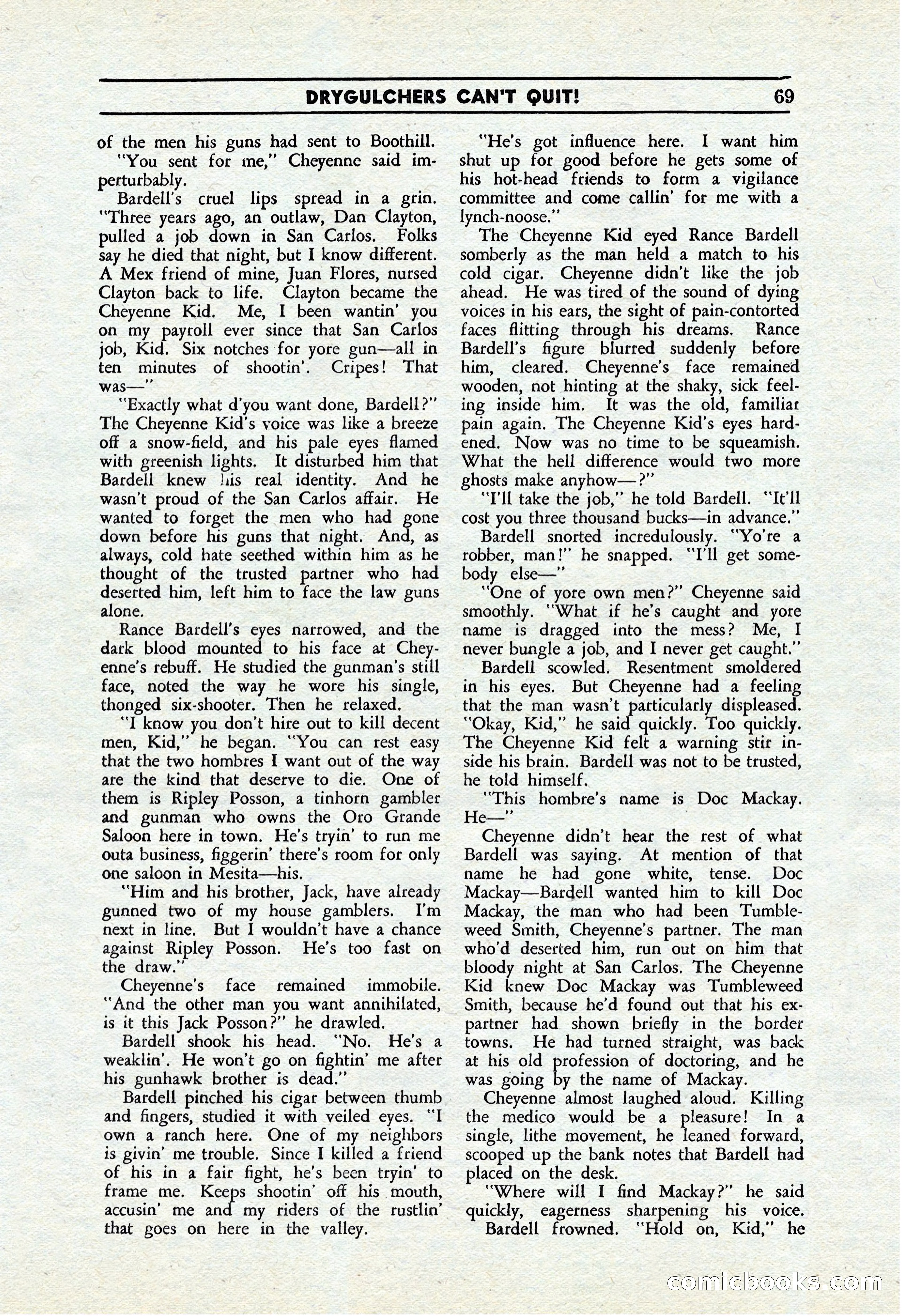
A restored page from Pulp Fiction, 1939. Page through the whole issue in the reader above.
📄 Transcribed text from this page (OCR, searchable)
Machine-transcribed from the original scan — historical spelling and the odd misread are preserved.
DRYGULCHERS CAN'T QUIT! 69 of the men his guns had sent to Boothill. “You sent for me,” Cheyenne said im- perturbably. Bardell’s cruel lips spread in a grin. “Three years ago, an outlaw, Dan Clayton, pulled a job down in San Carlos. Folks say he died that night, but I know different. A Mex friend of mine, Juan Flores, nursed Clayton back to life. Clayton became the Cheyenne Kid. Me, I been wantin’ you on my payroll ever since that San Carlos job, Kid. Six notches for yore gun—all in ten minutes of shootin’. Cripes! That was— ‘Exactly what d’you want done, Bardell ?” The Cheyenne Kid’s voice was like a breeze off a snow-field, and his pale eyes flamed with greenish lights. It disturbed him that Bardell knew liis real identity. And he wasn't proud of the San Carlos affair. He wanted to forget the men who had gone down before his guns that night. And, as always, cold hate seethed within him as he thought of the trusted partner who had deserted him, left him to face the law guns alone. Rance Bardell’s eyes narrowed, and the datk blood mounted to his face at Chey- enne’s rebuff. He studied the gunman’s still face, noted the way he wore his single, thonged six-shooter. Then he relaxed. “I know you don’t hire out to kill decent men, Kid,” he began. “You can rest easy that the two hombres I want out of the way are the kind that deserve to die. One of them is Ripley Posson, a tinhorn gambler and gunman who owns the Oro Grande Saloon here in town. He’s tryin’ to run me outa business, figgerin’ there’s room for only one saloon in Mesita—his. “Him and his brother, Jack, have already gunned two of my house gamblers. I’m next in line. But I wouldn’t have a chance against Ripley Posson. He's too fast on the draw.” Cheyenne’s face remained immobile. “And the other man you want annihilated, is it this Jack Posson?” he drawled. Bardell shook his head. “No. He's a weaklin’. He won’t go on fightin’ me after his gunhawk brother is dead.” Bardell pinched his cigar between thumb and fingers, studied it with veiled eyes. “I own a ranch here. One of my neighbors is givin’ me trouble. Since I killed a friend of his in a fair fight, he’s been tryin’ to frame me. Keeps shootin’ off his mouth, accusin’ me and my riders of the rustlin’ that goes on here in the valley. ‘“‘He’s got influence here. I want him shut up for good before he gets some of his hot-head friends to form a vigilance committee and come callin’ for me with a lynch-noose.”’ The Cheyenne Kid eyed Rance Bardell somberly as the man held a match to his cold cigar. Cheyenne didn’t like the job ahead. He was tired of the sound of dying voices in his ears, the sight of pain-contorted faces flitting through his dreams. Rance Bardell’s figure blurred suddenly before him, cleared. Cheyenne’s face remained wooden, not hinting at the shaky, sick feel- ing inside him. It was the old, familiar pain again. The Cheyenne Kid’s eyes hard- ened. Now was no time to be squeamish. What the hell difference would two more ghosts make anyhow— ?”’ “T'll take the job,” he told Bardell. “It'll cost you three thousand bucks—in advance.” Bardell snorted incredulously. “Yo're a robber, man!” he snapped. “I'll get some- body else—”’ “One of yore own men?” Cheyenne said smoothly. ‘“What if he’s caught and yore name is dragged into the mess? Me, I never bungle a job, and I never get caught.” Bardell scowled. Resentment smoldered in his eyes. But Cheyenne had a feeling that the man wasn’t particularly displeased. “Okay, Kid,” he said quickly. Too quickly. The Cheyenne Kid felt a warning stir in- side his brain. Bardell was not to be trusted, he told himself. ‘This hombre’s name is Doc Mackay. He—” . Cheyenne didn’t hear the rest of what Bardell was saying. At mention of that name he had gone white, tense. Doc Mackay—Bardell wanted him to kill Doc Mackay, the man who had been Tumble- weed Smith, Cheyenne’s partner. The man who'd deserted him, run out on him that bloody night at San Carlos. The Cheyenne Kid knew Doc Mackay was Tumbleweed Smith, because he’d found out that his ex- partner had shown briefly in the border towns. He had turned straight, was back at his old profession of doctoring, and he was going by the name of Mackay. Cheyenne almost laughed aloud. Killing the medico would be a pleasure! In a single, lithe movement, he leaned forward, scooped up the bank notes that Bardell had placed on the desk. “Where will I find Mackay?’ he said quickly, eagerness sharpening his voice. Bardell frowned. “Hold on, Kid,’ he CoOnniclooo S (©