
Pulp Fiction, 1939 · page 67 of 114
Cowboy Short Stories, November 1939 — page 67: what you’re looking at
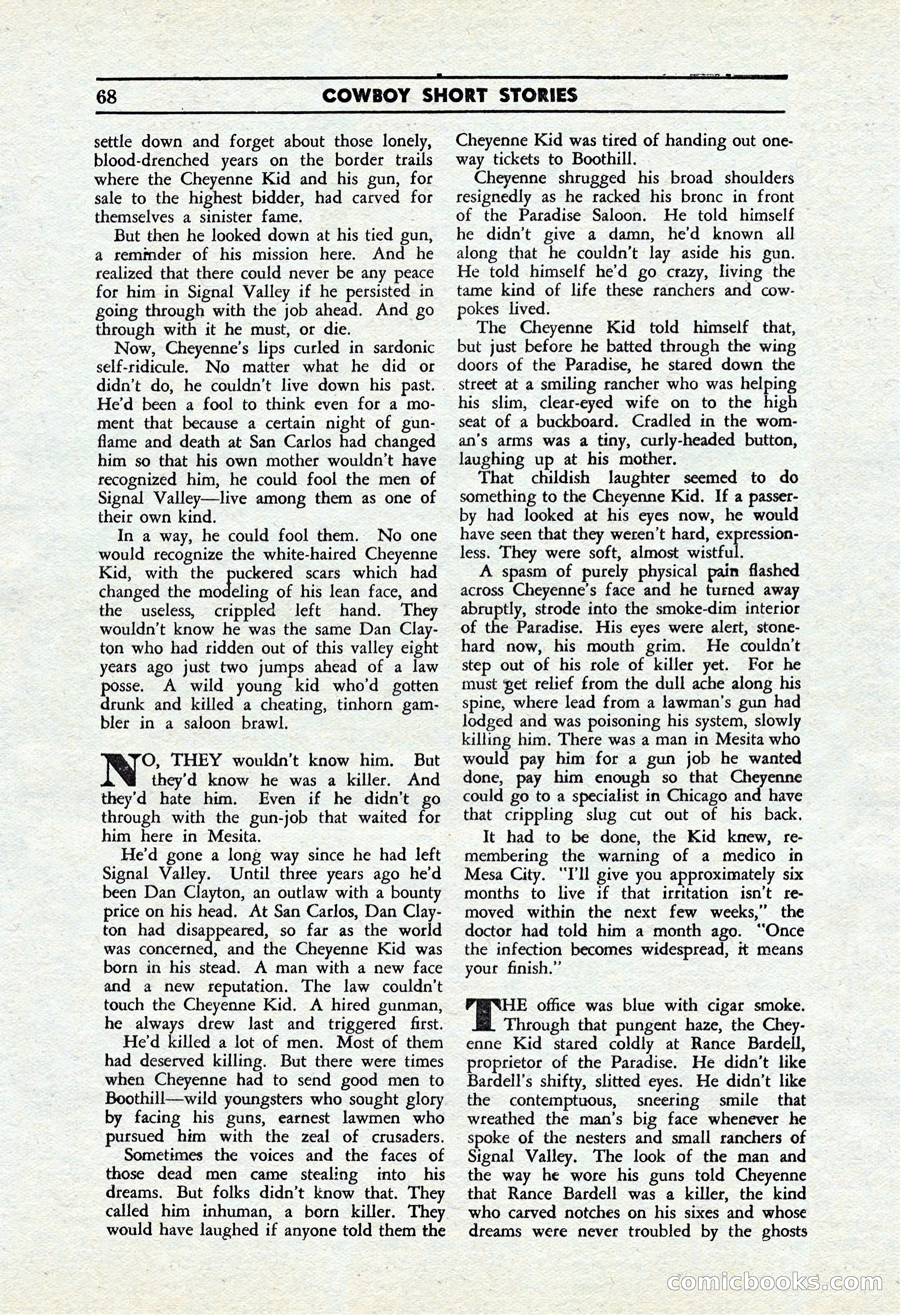
A restored page from Pulp Fiction, 1939. Page through the whole issue in the reader above.
📄 Transcribed text from this page (OCR, searchable)
Machine-transcribed from the original scan — historical spelling and the odd misread are preserved.
2 ee 68 COWBOY SHORT STORIES settle down and forget about those lonely, blood-drenched years on the border trails where the Cheyenne Kid and his gun, for sale to the highest bidder, had carved for themselves a sinister fame. But then he looked down at his tied gun, a reminder of his mission here. And he realized that there could never be any peace for him in Signal Valley if he persisted in going through with the job ahead. And go through with it he must, or die. Now, Cheyenne’s lips curled in sardonic self-ridicule. No matter what he did or didn’t do, he couldn’t live down his past. He’d been a fool to think even for a mo- ment that because a certain night of gun- flame and death at San Carlos had changed him so that his own mother wouldn’t have recognized him, he could fool the men of Signal Valley—live among them as one of their own kind. In a way, he could fool them. No one would recognize the white-haired Cheyenne Kid, with the puckered scars which had changed the abating of his lean face, and the useless, crippled left hand. They wouldn’t know he was the same Dan Clay- ton who had ridden out of this valley eight years ago just two jumps ahead of a law posse. A wild young kid who'd gatten drunk and killed a cheating, tinhorn gam- bler in a saloon brawl. O, THEY wouldn’t know him. But they’d know he was a killer. And they'd hate him. Even if he didn’t go through with the gun-job that waited for him here in Mesita. He'd gone a long way since he had left Signal Valley. Until three years ago he'd been Dan Clayton, an outlaw with a bounty price on his head, At San Carlos, Dan Clay- ton had disappeared, so far as the world was concerned, and the Cheyenne Kid was born in his stead. A man with a new face and a new reputation. The law couldn’t touch the Cheyenne Kid. A hired gunman, he always drew last and triggered first. He'd killed a lot of men. Most of them had deserved killing. But there were times when Cheyenne had to send good men to Boothill—wild youngsters who sought glory by facing his guns, earnest lawmen who pursued him with the zeal of crusaders. Sometimes the voices and the faces of those dead men came stealing into his dreams. But folks didn’t know that. They called him inhuman, a born killer. They would have laughed if anyone told them the Cheyenne Kid was tired of handing out one- way tickets to Boothill. Cheyenne shrugged his broad shoulders resignedly as he racked his bronc in front of the Paradise Saloon. He told himself he didn’t give a damn, he'd known all along that he couldn’t lay aside his gun. He told himself he’d go crazy, living the tame kind of life these ranchers and cow- pokes lived. The Cheyenne Kid told himself that, but just before he batted through the wing doors of the Paradise, he stared down the _ street at a smiling rancher who was helping his slim, clear-eyed wife on to the high seat of a buckboard. Cradled in the wom- an’s arms was a tiny, curly-headed button, laughing up at his mother. That childish laughter seemed to do something to the Cheyenne Kid. If a passer- by had looked at his eyes now, he would have seen that they weren’t hard, SapieSSIOn: less. They were soft, almost wistful. A spasm of purely physical pain flashed across Cheyenne’s face and he turned away abruptly, strode into the smoke-dim interior of the Paradise. His eyes were alert, stone- hard now, his mouth grim. He couldn't step out of his role of killer yet. For he must pet relief from the dull ache along his spine, where lead from a lawman’s gun had lodged and was poisoning his system, slowly killing him. There was a man in Mesita who would pay him for a gun job he wanted done, pay him enough so that Cheyenne could go to a specialist in Chicago and have that crippling slug cut out of his back, It had to be done, the Kid knew, re- membering the warning of a medico in Mesa City. “I'll give you approximately six months to live if that irritation isn’t re- moved within the next few weeks,” the doctor had told him a month ago. “Once the infection becomes widespread, tt means your finish.” HE office was blue with cigar smoke. Through that pungent haze, the Chey- enne Kid stared coldly at Rance Bardell, proprietor of the Paradise. He didn’t like Bardell’s shifty, slitted eyes. He didn’t like the contemptuous, sneering smile that wreathed the man’s big face whenever he spoke of the nesters and small ranchers of Signal Valley. The look of the man and the way he wore his guns told Cheyenne that Rance Bardell was a killer, the kind who carved notches on his sixes and whose dreams were never troubled by the ghosts CoOnniclooo S EO