
Pulp Fiction, 1939 · page 69 of 114
Cowboy Short Stories, November 1939 — page 69: what you’re looking at
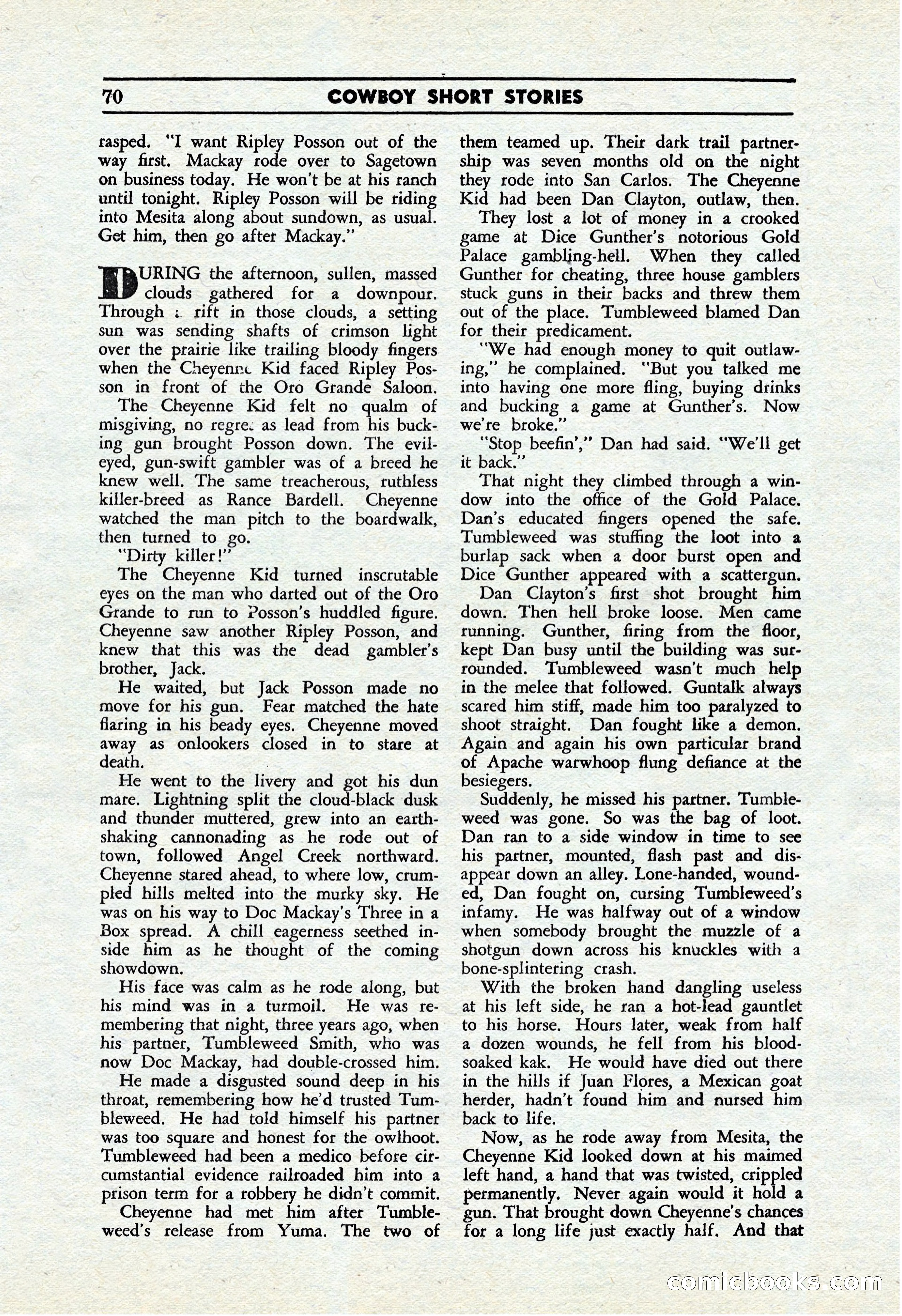
A restored page from Pulp Fiction, 1939. Page through the whole issue in the reader above.
📄 Transcribed text from this page (OCR, searchable)
Machine-transcribed from the original scan — historical spelling and the odd misread are preserved.
70 COWBOY SHORT STORIES tasped, “I want Ripley Posson out of the way first. Mackay rode over to Sagetown on business today. He won’t be at his ranch until tonight. Ripley Posson will be riding into Mesita along about sundown, as usual. Get him, then go after Mackay.” | | eee the afternoon, sullen, massed clouds gathered for a downpour. Through : rift in those clouds, a setting sun was sending shafts of crimson light over the prairie like trailing bloody fingers when the Cheyenrc Kid faced Ripley Pos- son in front of the Oro Grande Saloon. The Cheyenne Kid felt no qualm of misgiving, no regrec as lead from his buck- ing gun brought Posson down. The evil- eyed, gun-swift gambler was of a breed he knew well. The same treacherous, ruthless killer-breed as Rance Bardell. Cheyenne watched the man pitch to the boardwalk, then turned to go. “Dirty killer!’ The Cheyenne Kid turned inscrutable eyes on the man who darted out of the Oro Grande to run to Posson’s huddled figure. Cheyenne saw another Ripley Posson, and knew that this was the dead gambler’s brother, Jack. He waited, but Jack Posson made no move for his gun. Fear matched the hate flaring in his beady eyes. Cheyenne moved away as onlookers closed in to stare at death. 3 He went to the livery and got his dun mare. Lightning split the cloud-black dusk and thunder muttered, grew into an earth- Shaking cannonading as he rode out of town, followed Angel Creek northward. Cheyenne stared ahead, to where low, crum- pled hills melted into the murky sky. He was on his way to Doc Mackay’s Three in a Box spread. A chill eagerness seethed in- side him as he thought of the coming showdown. His face was calm as he rode along, but his mind was in a turmoil. He was re- membering that night, three years ago, when his partner, Tumbleweed Smith, who was now Doc Mackay, had double-crossed him. He made a disgusted sound deep in his throat, remembering how he’d trusted Tum- bleweed. He had told himself his partner was too square and honest for the owlhoot. Tumbleweed had been a medico before cir- cumstantial evidence railroaded him into a prison term for a robbery he didn’t commit. Cheyenne had met him after Tumble- weed’s release from Yuma. The two of them teamed up. Their dark trail partner- ship was seven months old on the night they rode into San Carlos. The Cheyenne Kid had been Dan Clayton, outlaw, then. They lost a lot of money in a crooked game at Dice Gunther’s notorious Gold Palace gambling-hell. When they called Gunther for cheating, three house gamblers stuck guns in their backs and threw them out of the place. Tumbleweed blamed Dan for their predicament. “We had enough money to quit outlaw- ing,’ he complained. ‘But you talked me into having one more fling, buying drinks and bucking a game at Gunther’s. Now we're broke.” “Stop beefin’,” Dan had said. “We'll get it back.” That night they climbed through a win- dow into the office of the Gold Palace. Dan’s educated fingers opened the safe. Tumbleweed was stuffing the loot into a burlap sack when a door burst open and Dice Gunther appeared with a scattergun. Dan Clayton’s first shot brought him down. Then hell broke loose. Men came running. Gunther, firing from the floor, kept Dan busy until the building was sur- rounded. Tumbleweed wasn’t much help in the melee that followed. Guntalk always scared him stiff, made him too paralyzed to shoot straight. Dan fought like a demon. Again and again his own particular brand of Apache warwhoop flung defiance at the besiegers. Suddenly, he missed his partner. Tumble- weed was gone. So was the bag of loot. Dan ran to a side window in time to see his partner, mounted, flash past and dis- appear down an alley. Lone-handed, wound- ed, Dan fought on, cursing Tumbleweed’s infamy. He was halfway out of a window when somebody brought the muzzle of a shotgun down across his knuckles with a bone-splintering crash. With the broken hand dangling useless at his left side, he ran a hot-lead gauntlet to his horse. Hours later, weak from half a dozen wounds, he fell from his blood- soaked kak. He would have died out there in the hills if Juan Flores, a Mexican goat herder, hadn’t found him and nursed him back to life. Now, as he rode away from Mesita, the Cheyenne Kid looked down at his maimed left hand, a hand that was twisted, crippled permanently. Never again would it hold a gun. That brought down Cheyenne’s chances for a long life just exactly half. And that CoOnniclooo S (C@