
Pulp Fiction, 1955 · page 6 of 101
15 Western Short Stories — page 6: what you’re looking at
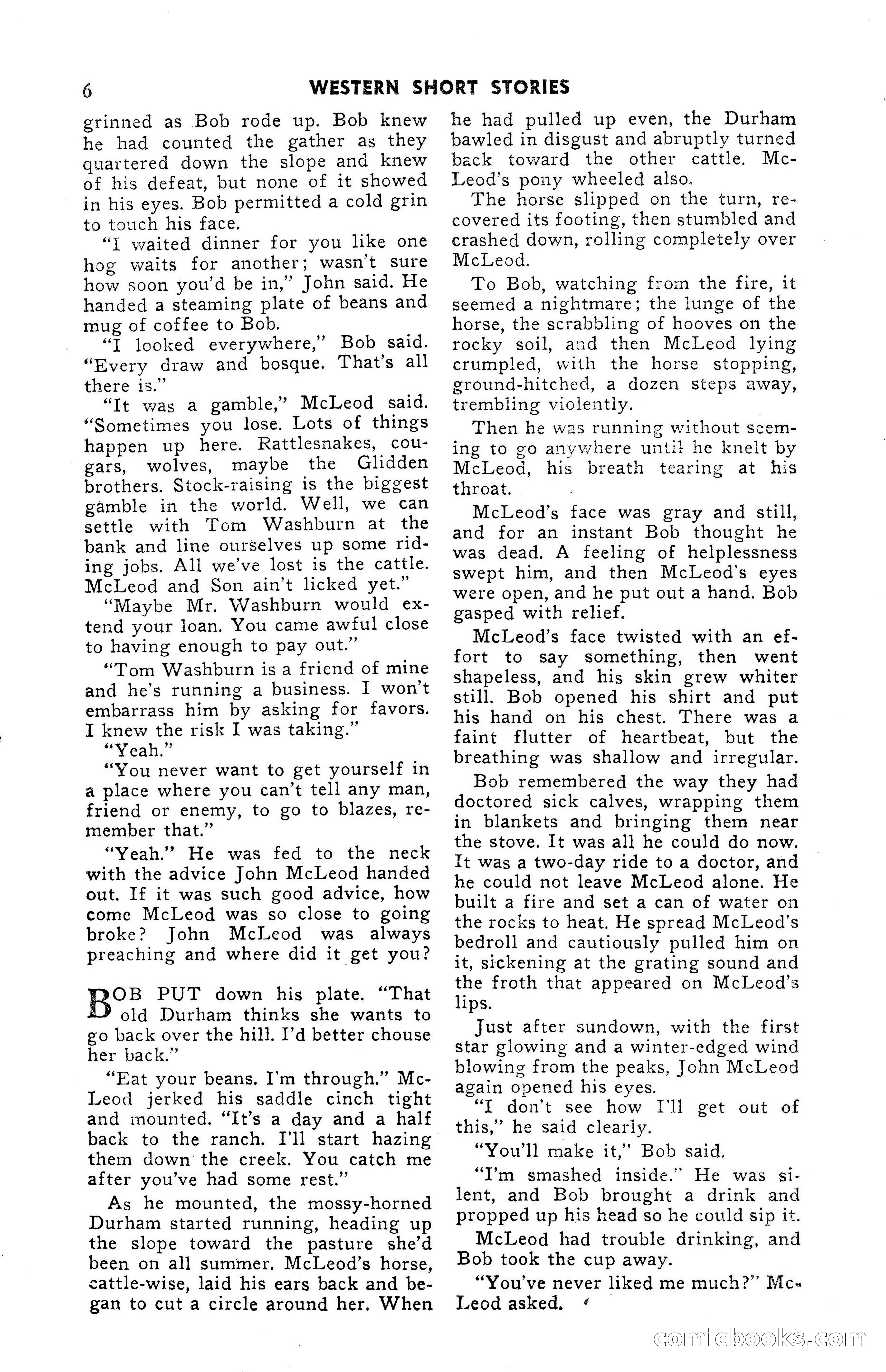
A restored page from Pulp Fiction, 1955. Page through the whole issue in the reader above.
📄 Transcribed text from this page (OCR, searchable)
Machine-transcribed from the original scan — historical spelling and the odd misread are preserved.
6 WESTERN SHORT STORIES grinned as Bob rode up. Bob knew he had counted the gather as they quartered down the slope and knew of his defeat, but none of it showed in his eyes. Bob permitted a cold grin to touch his face. “TY waited dinner for you like one hog waits for another; wasn’t sure how soon you'd be in,’ John said. He handed a steaming plate of beans and mug of coffee to Bob. “T looked everywhere,” Bob said. “Every draw and bosque. That’s all there is.” “It was a gamble,” McLeod said. “Sometimes you lose. Lots of things happen up here. Rattlesnakes, cou- gars, wolves, maybe the Glidden brothers. Stock-raising is the biggest gamble in the world. Well, we can settle with Tom Washburn at the bank and line ourselves up some rid- ing jobs. All we’ve lost is the cattle. McLeod and Son ain’t licked yet.” “Maybe Mr. Washburn would ex- tend your loan. You came awful close to having enough to pay out.” “Tom Washburn is a friend of mine and he’s running a business. I won't embarrass him by asking for favors. I knew the risk I was taking.” “Yeah.” “You never want to get yourself in a place where you can’t tell any man, friend or enemy, to go to blazes, re- member that.” “Yeah.” He was fed to the neck with the advice John McLeod handed out. If it was such good advice, how come McLeod was so close to going broke? John McLeod was always preaching and where did it get you? B= PUT down his plate. “That old Durham thinks she wants to go back over the hill. I’d better chouse her back.” “Eat your beans. I’m through.” Mc- Leod jerked his saddle cinch tight and mounted. “It’s a day and a half back to the ranch. I'll start hazing them down the creek. You catch me after you’ve had some rest.” As he mounted, the mossy-horned Durham started running, heading up the slope toward the pasture she’d been on all summer. McLeod’s horse, cattle-wise, laid his ears back and be- gan to cut a circle around her. When he had pulled up even, the Durham bawled in disgust and abruptly turned back toward the other cattle. Mc- Leod’s pony wheeled also. The horse slipped on the turn, re- covered its footing, then stumbled and crashed down, rolling completely over McLeod. To Bob, watching from the fire, it seemed a nightmare; the lunge of the horse, the scrabbling of hooves on the rocky soil, and then McLeod lying crumpled, with the horse stopping, ground-hitched, a dozen steps away, trembling violently. Then he was running without seem- ing to go anywhere until he knelt by McLeod, his breath tearing at his throat. McLeod’s face was gray and still, and for an instant Bob thought he was dead. A feeling of helplessness swept him, and then McLeod’s eyes were open, and he put out a hand. Bob gasped with relief. McLeod’s face twisted with an ef- fort to say something, then went shapeless, and his skin grew whiter still. Bob opened his shirt and put his hand on his chest. There was a faint flutter of heartbeat, but the breathing was shallow and irregular. Bob remembered the way they had doctored sick calves, wrapping them in blankets and bringing them near the stove. It was all he could do now. It was a two-day ride to a doctor, and he could not leave McLeod alone. He built a fire and set a can of water on the rocks to heat. He spread McLeod's bedroll and cautiously pulled him on it, sickening at the grating sound and the froth that appeared on McLeod's lips. Just after sundown, with the first star glowing and a winter-edged wind blowing from the peaks, John McLeod again opened his eyes. “I don’t see how I'll get out of this,” he said clearly. “You'll make it,’ Bob said. “I’m smashed inside.” He was si- lent, and Bob brought a drink and propped up his head so he could sip it. McLeod had trouble drinking, and Bob took the cup away. “You've never liked me much?” Mc- Leod asked. ¢ © DOO AMUG S C© Al