
Pulp Fiction, 1955 · page 7 of 101
15 Western Short Stories — page 7: what you’re looking at
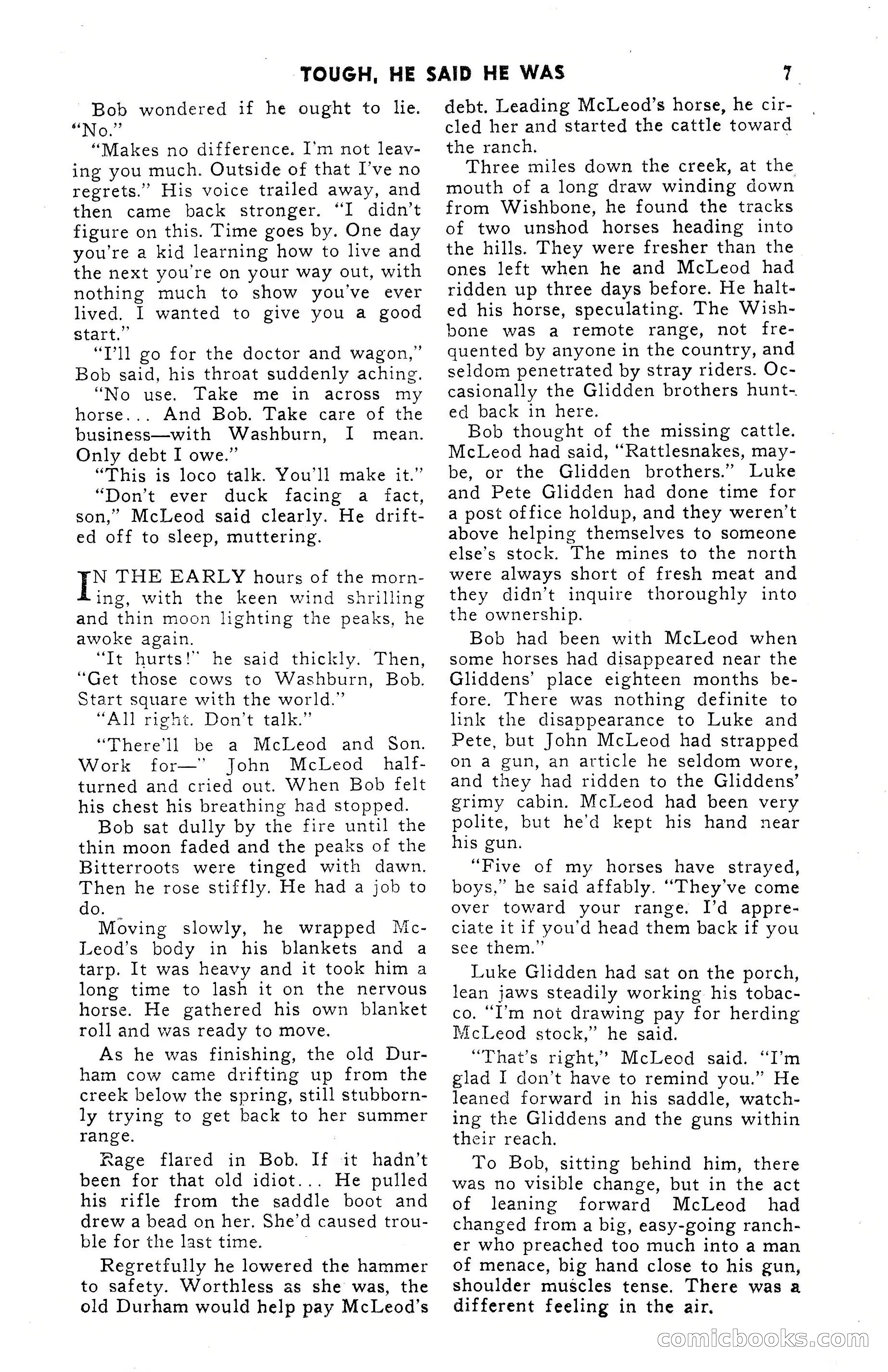
A restored page from Pulp Fiction, 1955. Page through the whole issue in the reader above.
📄 Transcribed text from this page (OCR, searchable)
Machine-transcribed from the original scan — historical spelling and the odd misread are preserved.
TOUGH, HE SAID HE WAS 7 ~ Bob wondered if he ought to lie. “No.” “Makes no difference. I’m not leav- ing you much. Outside of that I’ve no regrets.” His voice trailed away, and then came back stronger. “I didn’t figure on this. Time goes by. One day you're a kid learning how to live and the next you're on your way out, with nothing much to show you've ever lived. I wanted to give you a good start.” “T’ll go for the doctor and wagon,” Bob said, his throat suddenly aching. “No use. Take me in across my horse... And Bob. Take care of the business—with Washburn, I mean. Only debt I owe.” “This is loco talk. You’ll make it.” “Don’t ever duck facing a fact, son,” McLeod said clearly. He drift- ed off to sleep, muttering. N THE EARLY hours of the morn- ing, with the keen wind shrilling and thin moon lighting the peaks, he awoke again. “Tt hurts!” he said thickly. Then, “Get those cows to Washburn, Bob. Start square with the world.” “All right. Don’t talk.” “There'll be a McLeod and Son. Work for—’ John McLeod half- turned and cried out. When Bob felt his chest his breathing had stopped. Bob sat dully by the fire until the thin moon faded and the peaks of the Bitterroots were tinged with dawn. Then he rose stiffly. He had a job to do. Moving slowly, he wrapped Mc- Leod’s body in his blankets and a tarp. It was heavy and it took him a long time to lash it on the nervous horse. He gathered his own blanket roll and was ready to move. As he was finishing, the old Dur- ham cow came drifting up from the creek below the spring, still stubborn- ly trying to get back to her summer range. it hadn’t Rage flared in Bob. If been for that old idiot... He pulled his rifle from the saddle boot and drew a bead on her. She’d caused trou- ble for the last time. Regretfully he lowered the hammer to safety. Worthless as she was, the old Durham would help pay McLeod’s debt. Leading McLeod’s horse, he cir- cled her and started the cattle toward the ranch. Three miles down the creek, at the mouth of a long draw winding down from Wishbone, he found the tracks of two unshod horses heading into the hills. They were fresher than the ones left when he and McLeod had ridden up three days before. He halt- ed his horse, speculating. The Wish- bone was a remote range, not fre- quented by anyone in the country, and seldom penetrated by stray riders. Oc- casionally the Glidden brothers hunt- ed back in here. Bob thought of the missing cattle. McLeod had said, “Rattlesnakes, may- be, or the Glidden brothers.” Luke and Pete Glidden had done time for a post office holdup, and they weren't above helping themselves to someone else’s stock. The mines to the north were always short of fresh meat and they didn’t inquire thoroughly into the ownership. Bob had been with McLeod when some horses had disappeared near the Gliddens’ place eighteen months be- fore. There was nothing definite to link the disappearance to Luke and Pete, but John McLeod had strapped on a gun, an article he seldom wore, and they had ridden to the Gliddens’ grimy cabin. McLeod had been very polite, but he’d kept his hand near his gun. “Five of my horses have strayed, boys,” he said affably. “They’ve come over toward your range. I’d appre- ciate it if you'd head them back if you see them.” Luke Glidden had sat on the porch, lean jaws steadily working his tobac- co. “I’m not drawing pay for herding McLeod stock,” he said. “That’s right,’ McLeod said. “I’m glad I don’t have to remind you.” He leaned forward in his saddle, watch- ing the Gliddens and the guns within their reach. To Bob, sitting behind him, there was no visible change, but in the act of leaning forward McLeod had changed from a big, easy-going ranch- er who preached too much into a man of menace, big hand close to his gun, shoulder muscles tense. There was a different feeling in the air. COMICLOO© SS (CO