
Pulp Fiction, 1955 · page 5 of 101
15 Western Short Stories — page 5: what you’re looking at
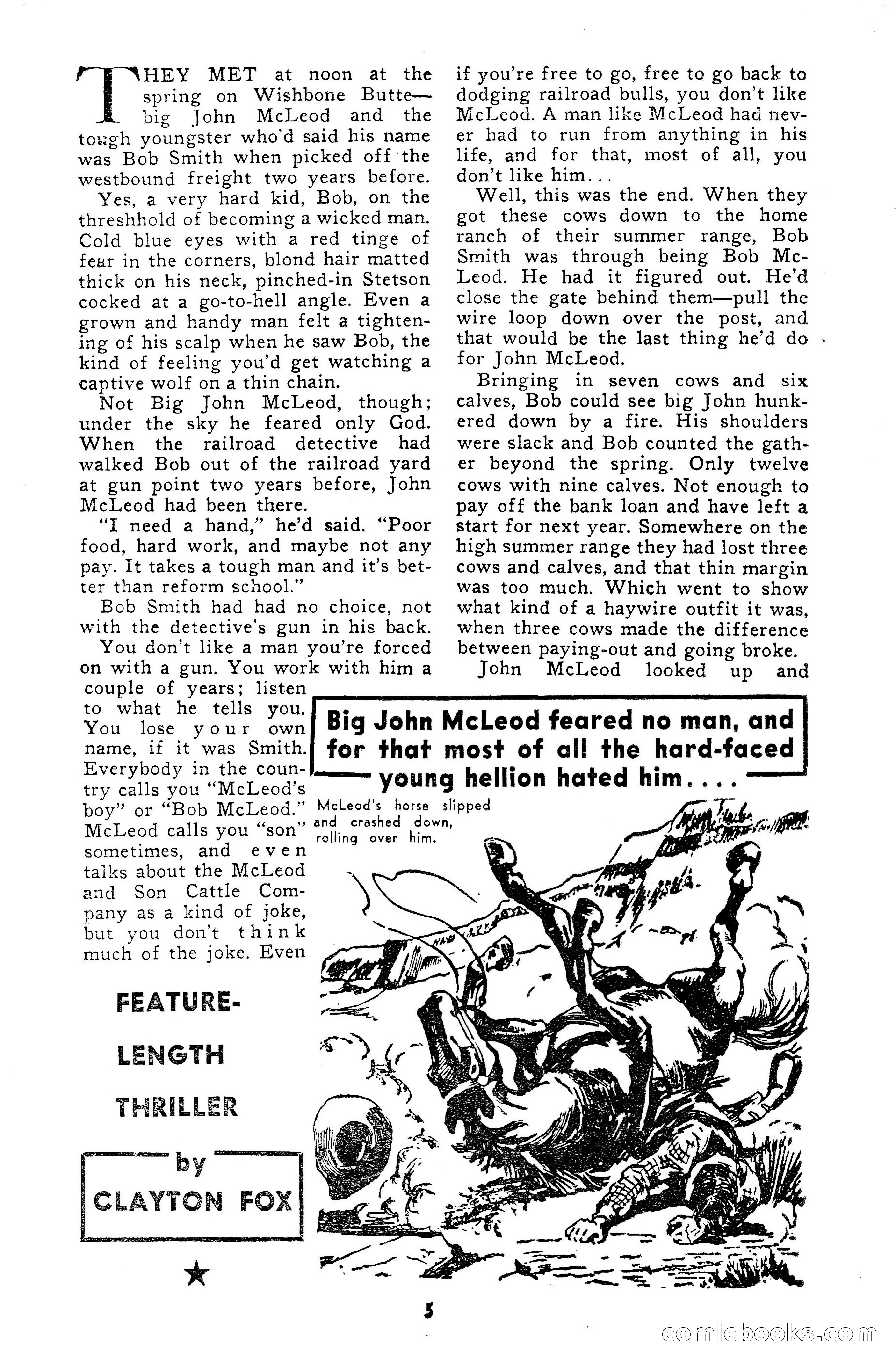
A restored page from Pulp Fiction, 1955. Page through the whole issue in the reader above.
📄 Transcribed text from this page (OCR, searchable)
Machine-transcribed from the original scan — historical spelling and the odd misread are preserved.
| HEY MET at noon at the spring on Wishbone Butte— big John McLeod and _ the tough youngster who'd said his name was Bob Smith when picked off ‘the westbound freight two years before. Yes, a very hard kid, Bob, on the threshhold of becoming a wicked man. Cold blue eyes with a red tinge of feur in the corners, blond hair matted thick on his neck, pinched-in Stetson cocked at a go-to-hell angle. Even a grown and handy man felt a tighten- ing of his scalp when he saw Bob, the kind of feeling you'd get watching a captive wolf on a thin chain. Not Big John McLeod, though; under the sky he feared only God. When the railroad detective had walked Bob out of the railroad yard at gun point two years before, John McLeod had been there. “T need a hand,” he’d said. “Poor food, hard work, and maybe not any pay. It takes a tough man and it’s bet- ter than reform school.” Bob Smith had had no choice, not with the detective’s gun in his back. You don’t like a man you're forced on with a gun. You work with him a couple of years; listen to what he tells you. You lose your own name, if it was Smith. Everybody in the coun- try calls you “McLeod's boy” or “Bob McLeod.” McLeod calls you “son” sometimes, and even talks about the McLeod and Son Cattle Com- pany as a kind of joke, but you don’t think much of the joke. Even FEATURE- LENGTH THRILLER rolling over him. [CLAYTON FOX] , Big John McLeod feared no man, and for that most of all the hard-faced young hellion hated him.... McLeod's horse slipped and crashed down, if you're free to go, free to go back to dodging railroad bulls, you don’t like McLeod. A man like McLeod had nev- er had to run from anything in his life, and for that, most of all, you don’t like him... Well, this was the end. When they got these cows down to the home ranch of their summer range, Bob Smith was through being Bob Mc- Leod. He had it figured out. He'd — close the gate behind them—pull the wire loop down over the post, and that would be the last thing he'd do . for John McLeod. Bringing in seven cows and six calves, Bob could see big John hunk- ered down by a fire. His shoulders were slack and Bob counted the gath- er beyond the spring. Only twelve cows with nine calves. Not enough to pay off the bank loan and have left a start for next year. Somewhere on the high summer range they had lost three cows and calves, and that thin margin was too much. Which went to show what kind of a haywire outfit it was, when three cows made the difference between paying-out and going broke. John McLeod looked up and es (CO