
Pulp Fiction, 1950 · page 106 of 132
15 Story Detective, April 1950 — page 106: what you’re looking at
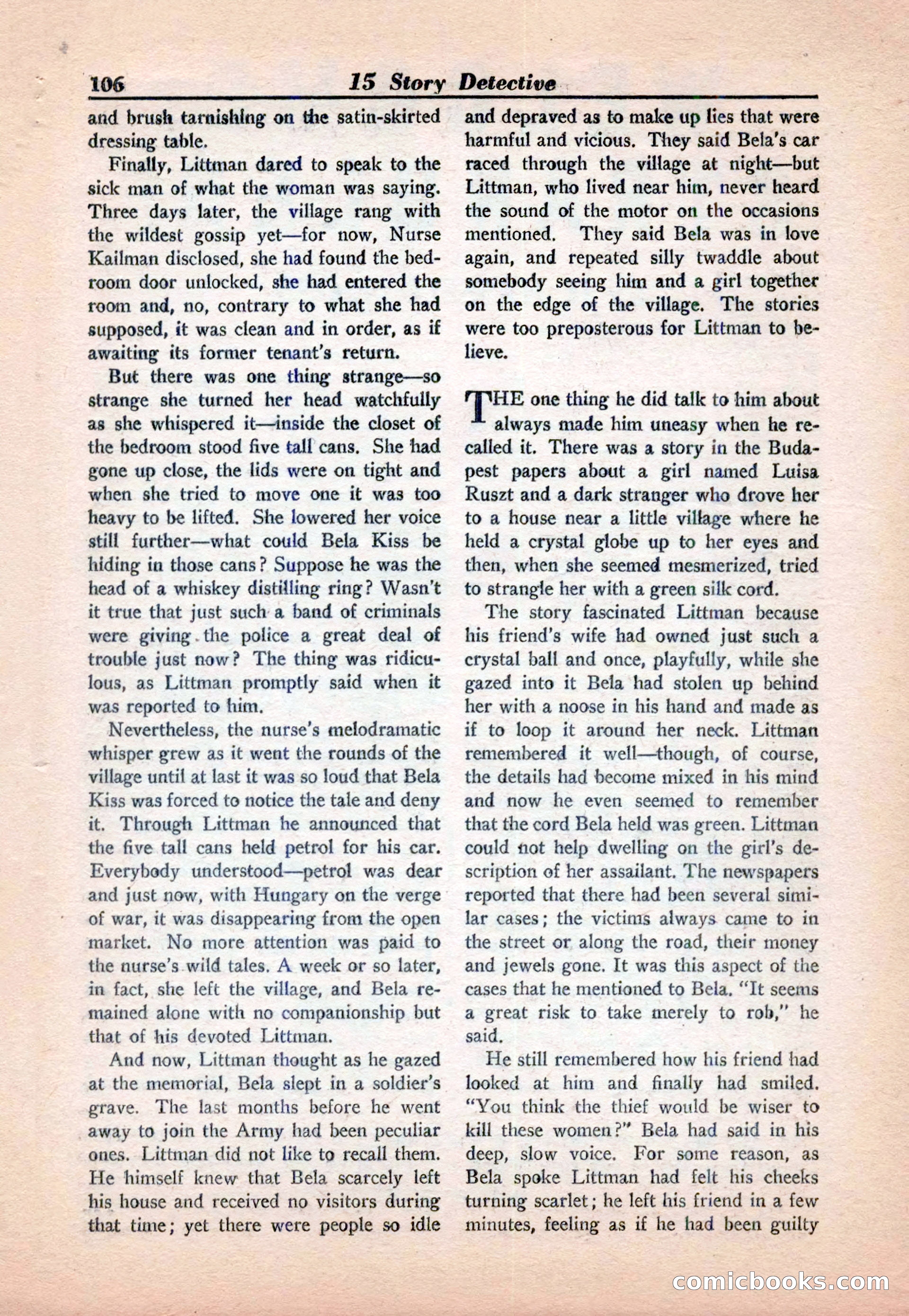
A restored page from Pulp Fiction, 1950. Page through the whole issue in the reader above.
📄 Transcribed text from this page (OCR, searchable)
Machine-transcribed from the original scan — historical spelling and the odd misread are preserved.
106 and brush tarnishing on the satin-skirted dressing table. Finally, Littman dared to speak to the sick man of what the woman was saying. Three days later, the village rang with the wildest gossip yet—for now, Nurse Kailman disclosed, she had found the bed- room door unlocked, she had entered the room and, no, contrary to what she had supposed, it was clean and in order, as if awaiting its former tenant’s return. But there was one thing strange—so strange she turned her head watchfully as she whispered it—inside the closet of the bedroom stood five tall cans, She had gone up close, the lids were on tight and when she tried to move one it was too heavy to be lifted. She lowered her voice still further—what could Bela Kiss be hiding in those cans? Suppose he was the head of a whiskey distilling ring? Wasn't it true that just such a band of criminals were giving.the police a great deal of trouble just now? The thing was ridicu- lous, as Littman promptly said when it was reported to him. Nevertheless, the nurse’s melodramatic whisper grew as it went the rounds of the village until at last it was so loud that Bela Kiss was forced to notice the tale and deny it. Through Littman he announced that the five tall cans held petrol for his car. Everybedy understood—petrol was dear and just now, with Hungary on the verge of war, it was disappearing from the open market. No more attention was paid to the nurse’s wild tales. A week or so later, in fact, she left the village, and Bela re- mained alone with no companionship but that of his devoted Littman. And now, Littman thought as he gazed at the memorial, Bela slept in a soldier’s grave. The last months before he went away to join the Army had been peculiar ones. Littman did not like to recall them. He himself knew that Bela scarcely left his house and received no visitors during that time; yet there were people so idle 15 Story Detective. and depraved as to make up lies that were harmful and vicious. They said Bela’s car raced through the village at night—but Littman, who lived near him, never heard the sound of the motor on the occasions mentioned, They said Bela was in love again, and repeated silly twaddle about somebody seeing him and a girl together on the edge of the village. The stories were too preposterous for Littman to be- lieve. a one thing he did talk to him about always made him uneasy when he re- called it. There was a story in the Buda- pest papers about a girl named Luisa Ruszt and a dark stranger who drove her to a house near a little village where he held a crystal globe up to her eyes and then, when she seemed mesmerized, tried to strangle her with a green silk cord. The story fascinated Littman because his friend’s wife had owned just such a crystal ball and once, playfully, while she gazed into it Bela had stolen up behind her with a noose in his hand and made as if to loop it around her neck. Littman remembered it well—though, of course, the details had become mixed in his mind and now he even seemed to remember that the cord Bela held was green. Littman could not help dwelling on the girl’s de- scription of her assailant. The newspapers reported that there had been several simi- lar cases; the victims always came to in the street or along the road, their money and jewels gone. It was this aspect of the cases that he mentioned to Bela, “It seems a great risk to take merely to rob,” he said, : He still remembered how his friend had looked at him and finally had smiled. “You think the thief would be wiser to kill these women?” Bela had said in his deep, slow voice. For some reason, as Bela spoke Littman had felt his cheeks turning scarlet; he left his friend in a few minutes, feeling as if he had been guilty COMEE (E@) DOOKS