
Pulp Fiction, 1950 · page 105 of 132
15 Story Detective, April 1950 — page 105: what you’re looking at
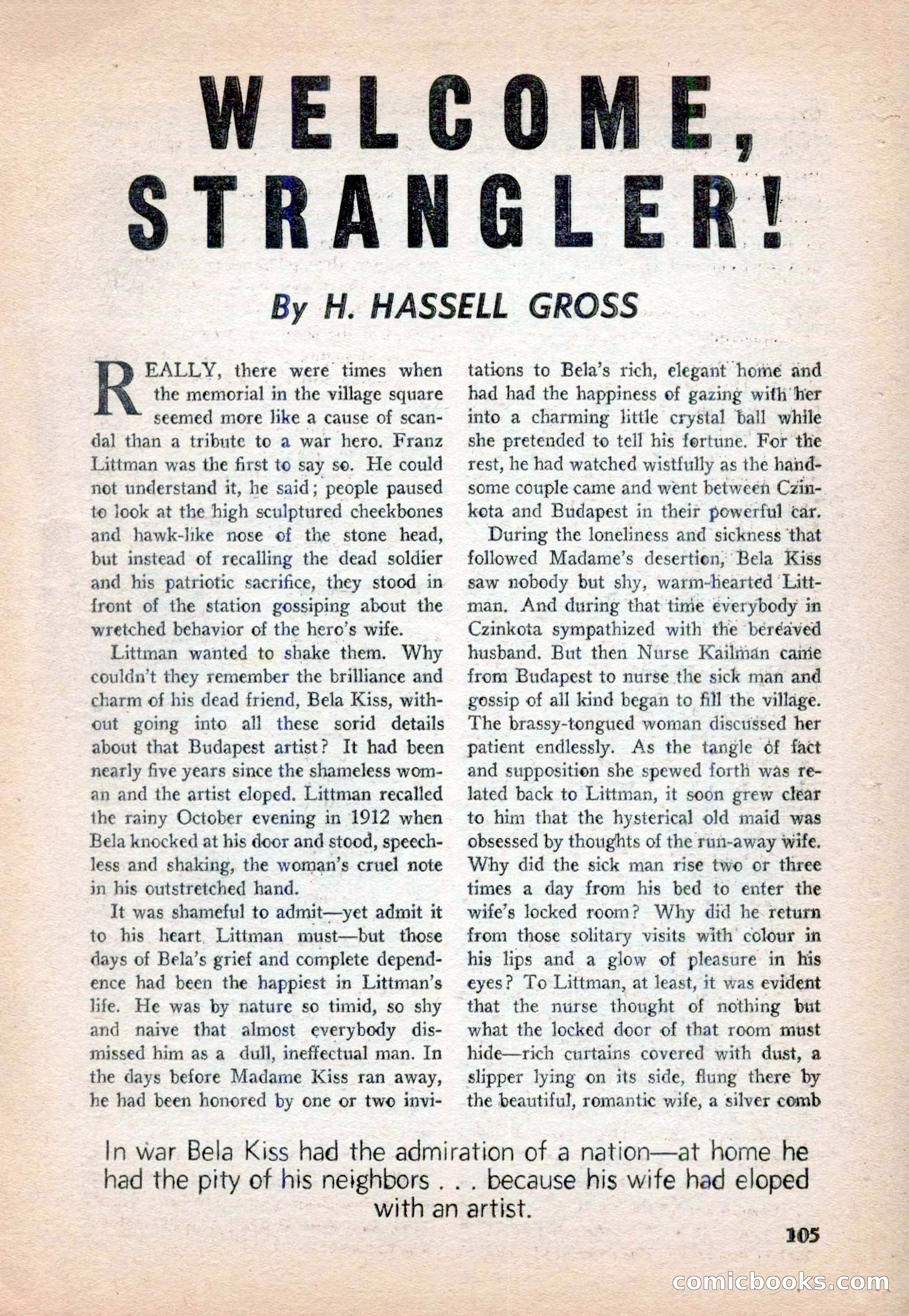
A restored page from Pulp Fiction, 1950. Page through the whole issue in the reader above.
📄 Transcribed text from this page (OCR, searchable)
Machine-transcribed from the original scan — historical spelling and the odd misread are preserved.
WELCOME. STRANGLER! By H. HASSELL GROSS EALLY, there were times when R the memorial in the village square seemed more like a cause of scan- dal than a tribute to a war hero. Franz Littman was the first to say so. He could not understand it, he said; people paused to look at the high sculptured cheekbones and hawk-like nose of the stone head, but instead of recalling the dead soldier and his patriotic sacrifice, they stood in front of the station gossiping about the wretched behavior of the hero’s wife. Littman wanted to shake them. Why couldn’t they remember the brilliance and charm of his dead friend, Bela Kiss, with- out going into all these sorid details about that Budapest artist? It had been nearly five years since the shameless wom- an and the artist eloped. Littman recalled the rainy October evening in 1912 when Bela knocked at his door and stood, speech- less and shaking, the woman’s cruel note in his outstretched hand. It was shameful to admit—yet admit it to his heart, Littman must—but those days of Bela’s grief and complete depend- ence had been the happiest in Littman’s life. He was by nature so timid, so shy and naive that almost everybody dis- missed him as a dull, ineffectual man. In the days before Madame Kiss ran away, he had been honored by one or two invi- tations to Bela’s rich, elegant home and had had the happiness ef gazing with her into a charming little crystal ball while she pretended to tell his fortune. For the rest, he had watched wistfully as the hand- some couple came and went between Czin- kota and Budapest in their powerful car. During the loneliness and sickness ‘that followed Madame’s desertion, Bela Kiss saw nobody but shy, warm-hearted ‘Litt- man, And during that time everybody in Czinkota sympathized with the beéréaved husband. But then Nurse Kailmdn canie from Budapest to nurse the sick man and gossip of all kind began to fill the village. The brassy-tongued woman discussed her patient endlessly. As the tangle of fact and supposition she spewed forth was re- lated back to Littman, it soon grew clear to him that the hysterical old maid was obsessed by thoughts of the run-away wife. Why did the sick man rise two or three times a day from his bed to enter the wife’s locked room? Why did he return from those solitary visits with colour in his lips and a glow of pleasure in his eyes? To Littman, at least, it was evident that the nurse thought of nothing but what the locked door of that room must hide—trich curtains covered with dust, a slipper lying on its side, flung there by the beautiful, romantic wife, a silver comb In war Bela Kiss had the admiration of a nation—at home he had the pity of his neighbors . .. because his wife had eloped with an artist. 405 CEOPMIE OOO KS (E@