
Pulp Fiction, 1950 · page 107 of 132
15 Story Detective, April 1950 — page 107: what you’re looking at
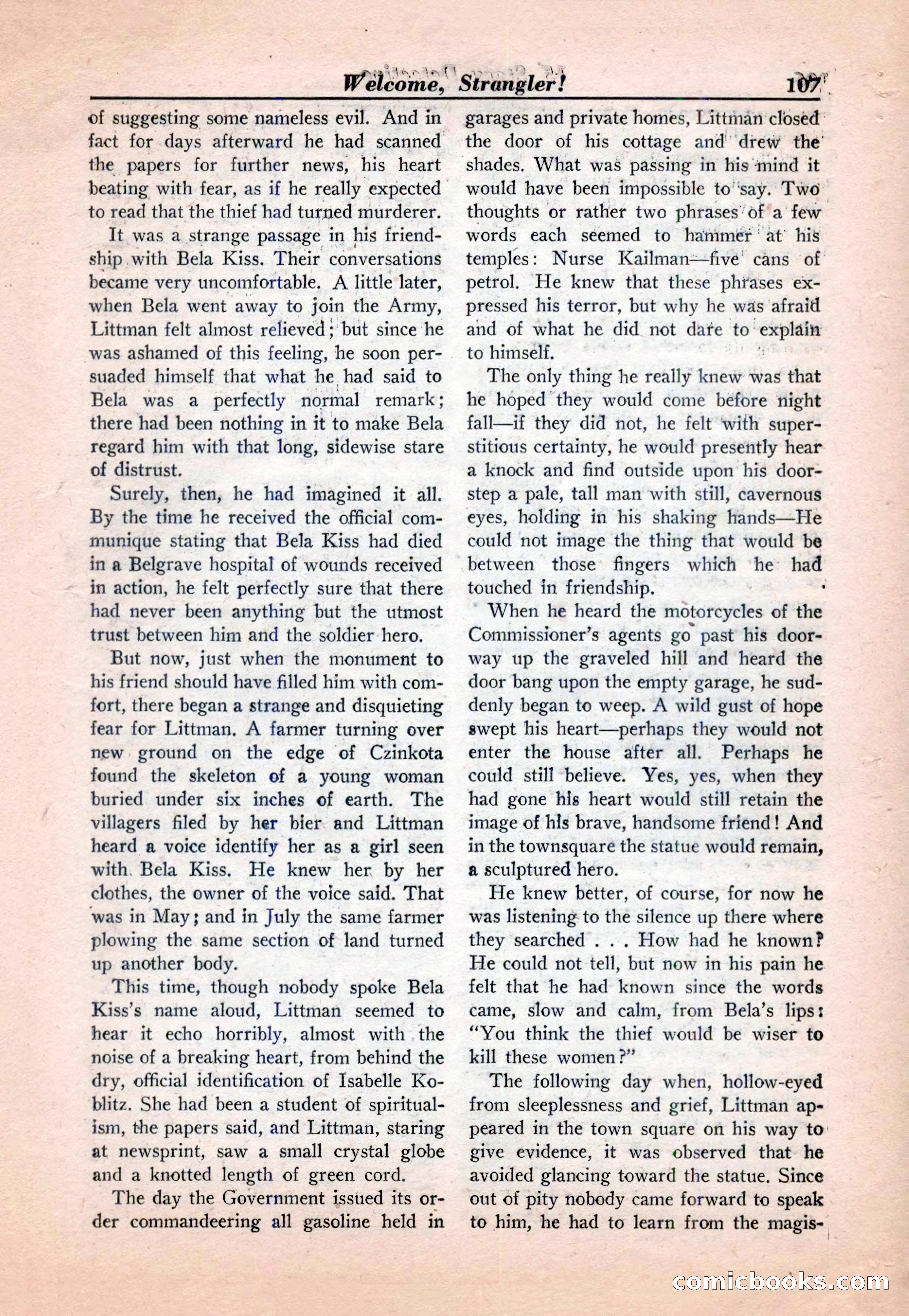
A restored page from Pulp Fiction, 1950. Page through the whole issue in the reader above.
📄 Transcribed text from this page (OCR, searchable)
Machine-transcribed from the original scan — historical spelling and the odd misread are preserved.
giisninG quini? BA Welcome, Strangler! of suggesting some nameless evil. And in fact for days afterward he had scanned the papers for further news, his heart beating with fear, as if he really expected to read that the thief had turned murderer. It was a strange passage in his friend- ship with Bela Kiss. Their conversations became very uncomfortable. A little later, when Bela went away to join the Army, Littman felt almost relieved; but since he was ashamed of this feeling, he soon per- suaded himself that what he had said to Bela was a perfectly normal remark; there had been nothing in it to make Bela regard him with that long, sidewise stare of distrust. Surely, then, he had imagined it all. By the time he received the official com- munique stating that Bela Kiss had died in a Belgrave hospital of wounds received in action, he felt perfectly sure that there had never been anything but the utmost trust between him and the soldier hero. But now, just when the monument to his friend should have filled him with com- fort, there began a strange and disquieting fear for Littman, A farmer turning over new ground on the edge of Czinkota found the skeleton of a young woman buried under six inches of earth. The villagers filed by her bier and Littman heard a voice identify her as a girl seen with. Bela Kiss, He knew her by her clothes, the owner of the voice said. That was in May; and in July the same farmer plowing the same section of land turned up another body. This time, though nobody spoke Bela Kiss’s name aloud, Littman seemed to hear it echo horribly, almost with. the noise of a breaking heart, from behind the dry, official identification of Isabelle Ko- blitz. She had been a student of spiritual- ism, the papers said, and Littman, staring at newsprint, saw a small crystal globe and a knotted length of green cord. The day the Government issued its or- der commandeering all gasoline held in garages and private homes, Littman ‘closed: the door of his cottage and’ drew the’ shades. What was passing in his ‘mind it would have been impossible to'‘say. Two thoughts or rather two phrases’ of a few words each seemed to hammer ' at’ his temples: Nurse Kailman—five' cans of petrol. He knew that these phi‘ases ex- pressed his terror, but why he was afraid and of what he did not dafe to —— to himself. The only thing he really knew was that he hoped they would come before night fall—if they did not, he felt ‘with super- stitious certainty, he would presently hear a knock and find outside upon his door- step a pale, tall man with still, cavernous eyes, holding in his shaking hands—He could not image the thing that would be between those fingers which he had touched in friendship. When he heard the motorcycles of the Commissioner’s agents go past his door- way up the graveled hill and heard the door bang upon the empty garage, he sud- denly began to weep. A wild gust of hope swept his heart—perhaps they would not enter the house after all. Perhaps he could still believe. Yes, yes, when they had gone his heart would still retain the image of his brave, handsome friend! And in the townsquare the statue would remain, a sculptured hero. He knew better, of course, for now he was listening to the silence up there where they searched . . . How had he known? He could not tell, but now in his pain he felt that he had known since the words came, slow and calm, from Bela’s lips: “You think the thief would be wiser to kill these women?” The following day when, hollow-eyed from sleeplessness and grief, Littman ap- peared in the town square on his way to: give evidence, it was observed that he avoided glancing toward the statue. Since out of pity nobody came forward to speak to him, he had to learn from the magis- Gomichboo (G <S) 107" (E@)