
Puck, 1879-07-23 · page 10 of 16
Puck — July 23, 1879 — page 10: what you’re looking at
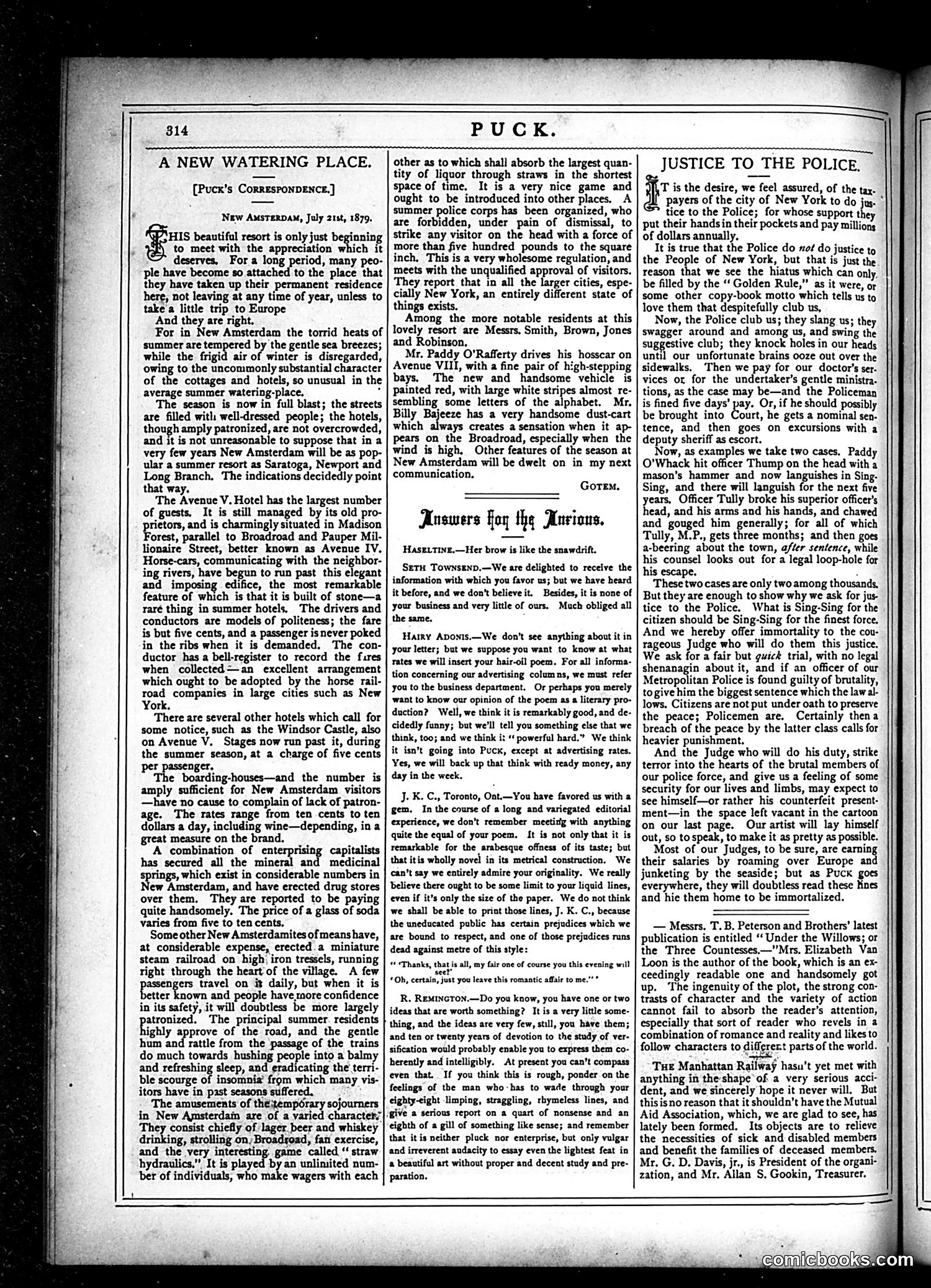
What you’re looking at
This page consists primarily of text content rather than cartoons. It contains three sections: 1. **"A New Watering Place"** — a correspondence piece about New Amsterdam (likely referring to a resort or recreational area), describing its attractions and visiting patterns. 2. **"Answers for the Anxious"** — an advice column addressing reader inquiries on various topics, including poetry criticism and personal matters. 3. **"Justice to the Police"** — an opinion piece criticizing New York City police brutality, advocating for accountability and reform of what the writer calls the "Golden Rule" abuse within the force. The page also includes notices about new publications, including one titled "Under the Willows" and information about the Metropolitan Railway. This appears to be a typical issue page mixing editorial content, correspondence, and social commentary rather than featuring prominent political cartoons.
📄 Transcribed text from this page (OCR, searchable)
Machine-transcribed from the original scan — historical spelling and the odd misread are preserved.
PUCK. A NEW WATERING PLACE. [Puck's CorresponDENCcE.] New AMSTERDAM, July 218t, 1879. HIS beautiful resort is only just beginning to meet with the appreciation which it deserves, Fora Jong period, many peo- ple have become so attached to the place that they have taken up their permanent residence here, not leaving at any time of year, unless to take’a little trip to Europe And they are right. For in New Amsterdam the torrid heats of summer Sts semapered by the gentle sea breezes; while the frigid air of winter is disregarded, owing to the uncommonly substantial character of the cottages and hotels, so unusual in the average summer watering-place, E The season is now in full blast; the streets are filled with well-dressed people; the hotels, though amply patronized, are not overcrowded, and it is not unreasonable to suppose that in a very few years New Amsterdam will be as pop- ular a summer resort as Saratoga, Newport and Long Branch. The indications decidedly point that way. The Avenue V. Hotel has the largest number of guests, It is still managed by its old pro- rietors, and is charmingly situated in Madison ‘orest, parallel to Broadroad and Pauper Mil- lionaire Street, better known as Avenue IV, Horse-cars, communicating with the neighbor- ing rivers, have begun to run past this elegant and imposing edifice, the most remarkable feature of which is that it is built of stone—a raré thing in summer hotels, The drivers and conductors are models of politeness; the fare is but five cents, and a passenger isnever poked in the ribs when it is demanded. The con- ductor has a bell-register to record the fires when collected—an excellent arrangement which ought to be adopted by the horse rail- road companies in large cities such as New York, There are several other hotels which call for some notice, such as the Windsor Castle, also on Avenue V. Stages now run past it, during the summer season, at a charge of five cents T passent er. ui e ourding-houses—and the number is amply sufficient for New Amsterdam visitors —have no cause to complain of lack of patron- age. The rates range from ten cents to ten dollars a day, including wine—depending, in a great measure on the brand. A combination of enterprising capitalists has secured all the mineral and medicinal rings, which exist in considerable numbers in New Amsterdam, and have erected drug stores over them, They are reported to be paying quite handsomely. The price of a glass of soda varies from five to ten cents. Some other New Amsterdamites of means have, at considerable expense, erected. a miniature steam railroad on high’ iron tressels, running right through the heart of the village. A few SS ers travel on it daily, but when it is tter known and people have,more confidence in its safety, it will doubtless be more largely atronized. The principal summer. residents ighly approve of the road, and the gentle hum and rattle from the re of the trains do much towards hushing People into a balmy and refreshing sleep, and eradicating the terri- ble scourge of insomnia’ from which many vis- itors have in past seasons suffered. ¢ The amusements of wexeenpirary sojourners in New Amsterdain are of a varied character. aber consist chiefly of lager beer and whiskey drinking, strolling on, , fan exercise, and the very interesting. game called “ straw hydraulics,” It is playe aby aa unlimited num- ber of individuals, who ¢ wagers with each other as to which shall absorb the largest quan- tity of liquor through straws in the shortest space of time. It is a very nice game and ought to be introduced into other places. A summer police corps has been organized, who are forbidden, under pain of dismissal, to strike any visitor on the head with a force of more than five hundred pounds to the square inch, This is a very wholesome regulation, and meets with the unqualified approval of visitors. They report that in all the larger cities, espe- cially New York, an entirely different state of things exists. Among the more notable residents at this lovely resort are Messrs, Smith, Brown, Jones and Robinson. Mr. Paddy O’Rafferty drives his hosscar on Avenue VIII, with a fine pair of high-stepping bays, The new and handsome vehicle is painted red, with large white stripes almost re- sembling some letters of the alphabet. Mr. Billy Bajeeze has a very handsome dust-cart which always creates a sensation when it ap- pears on the Broadroad, especially when the wind is high, Other features of the season at New Amsterdam will be dwelt on in my next communication, Gotem, Answers foq the Aurions, Hase.ting.—Her brow is like the snawdrift. SetH Townsenn.—We are delighted to receive the information with which you favor us; but we have heard it before, and we don't believe it. Besides, it is none of your business and very little of ours. Much obliged all the same. Harry Apowis.—We don't see anything about it in your letter; but we suppose you want to know at what rates we will insert your hair-oil poem. For all informa- tion concerning our advertising columns, we must refer you to the business department. Or perhaps you merely ‘want to know our opinion of the poem as a literary pro- duction? Well, we think it is remarkably good, and de- cidedly fanny; but we'll tell you something else that we think, too; and we think it “ powerful hard.” We think it isn't going into Puck, except at advertising rates. Yes, we will back up that think with ready money, any day in the week. J. K. C., Toronto, Ont.—You have favored us with a gem. In the course of a long and variegated editorial experience, we don’t remember meeting with anything quite the equal of your poem. {t is not only that it is remarkable for the arabesque offness of its taste; but that itis wholly novel in its metrical construction, We can't say we entirely admire your originality, We really Believe there ought to be some limit to your liquid lines, even if it’s only the size of the paper. We do not think we shall be able to print those lines, J. K. C., because the uneducated public has certain prejudices which we are bound to respect, and one of those prejudices runs dead against metre of this style: Thanks, that is all, my fair one of course you this evening will see! Oh, certain, just you leave this romantic affair to me. R. REMINGTON.—Do you know, you have one or two ideas that are worth something? It is a very little some- thing, and the ideas are very few, still, you have them; and ten or twenty years of devotion to the study of ver- sification would probably enable you to express them co- herently and intelligibly. At present you can’t compass even that. If you think this is rough, ponder on the feelings of the man who-has to wade through your cighty-cight limping, straggling, rhymeless lines, and give a serious report on a quart of nonsense and an eighth of a gill of something like sense; and remember that it is neither pluck nor enterprise, but only vulgar and irreverent audacity to essay even the lightest feat in a beautiful art without proper and decent study and pre- paration. JUSTICE TO THE POLICE. T is the desire, we feel assured, of the tax- payers of the city of New York to do jus. ° tice to the Police; for whose support they put their hands in their pockets and pay millions of dollars annually, It is true that the Police do not do justice to the People of New York, but that is just the reason that we see the hiatus which can only, be filled by the ‘‘ Golden Rule,” as it were, or some other copy-book motto which tells us to love them that despitefully club us, Now, the Police club us; they slang us; they swagger around and among us, and swing the suggestive club; they knock holes in our heads until our unfortunate brains ooze out over the sidewalks. Then we pay for our doctor's ser- vices or for the undertaker’s gentle ministra. tions, as the case may be—and the Policeman is fined five days’ pay. Or, if he should possibly be brought into Court, he gets a nominal sen. tence, and then goes on excursions with a deputy sheriff as escort. Now, as examples we take two cases. Paddy O'Whack hit officer Thump on the head with a mason’s hammer and now languishes in Sing- Sing, and there will languish for the next five years, Officer Tully broke his superior officer's head, and his arms and his hands, and chawed and gouged him generally for all of which Tully, M.P., gets three months; and then goes a-beering about the town, after sentence, while his counsel looks out for a legal loop-hole for his escape. These two cases are only twoamong thousands, But they are enough to show why we ask for jus- tice to the Police. What is Sing-Sing for the citizen should be Sing-Sing for the finest force, And we hereby offer immortality to the cou- rageous Judge who will do them this justice. We ask for a fair but guick trial, with no legal shenanagin about it, and if an officer of our Metropolitan Police is found guilty of brutality, togive him the biggest sentence which the law al- lows. Citizens are not put under oath to preserve the peace; Policemen are. Certainly thena breach of the peace by the latter class calls for heavier punishment. ‘And the Judge who will do his duty, strike terror into the hearts of the brutal members of our police force, and give us a feeling of some security for our lives and limbs, may expect to see himself—or rather his counterfeit present- ment—in the space left vacant in the cartoon on our last page. Our artist will lay himself out, so to speak, to make it as pretty as possible. Most of our Judges, to be sure, are earnin; their salaries by roaming over Europe ani junketing by the seaside; but as Puck goes everywhere, they will doubtless read these Hines and hie them home to be immortalized. — Messrs. T. B, Peterson and Brothers’ latest publication is entitled ‘‘ Under the Willows; or the Three Countesses.—"Mrs. Elizabeth Van Loon is the author of the book, which is an ex- ceedingly readable one and handsomely got up. The ingenuity of the plot, the strong con- trasts of character and the variety of action cannot fail to absorb the reader’s attention, especially that sort of reader who revels in a combination of romance and reality and likes to follow characters to differert parts of the world. Tue Manhattan Railway hasu’t yet met with anything in the shape’ of a very serious acci- dent, and we sincerely hope it never will. But this isno reason that it shouldn't have the Mutual Aid Association, which, we are glad to see, has lately been formed. Its objects are to relieve the necessities of sick and disabled members and benefit the families of deceased members, Mr. G. D. Davis, jr., is President of the organi- zation, and Mr. Allan S. Gookin, Treasurer.