
Puck, 1878-11-13 · page 3 of 16
Puck — November 13, 1878 — page 3: what you’re looking at
What you’re looking at
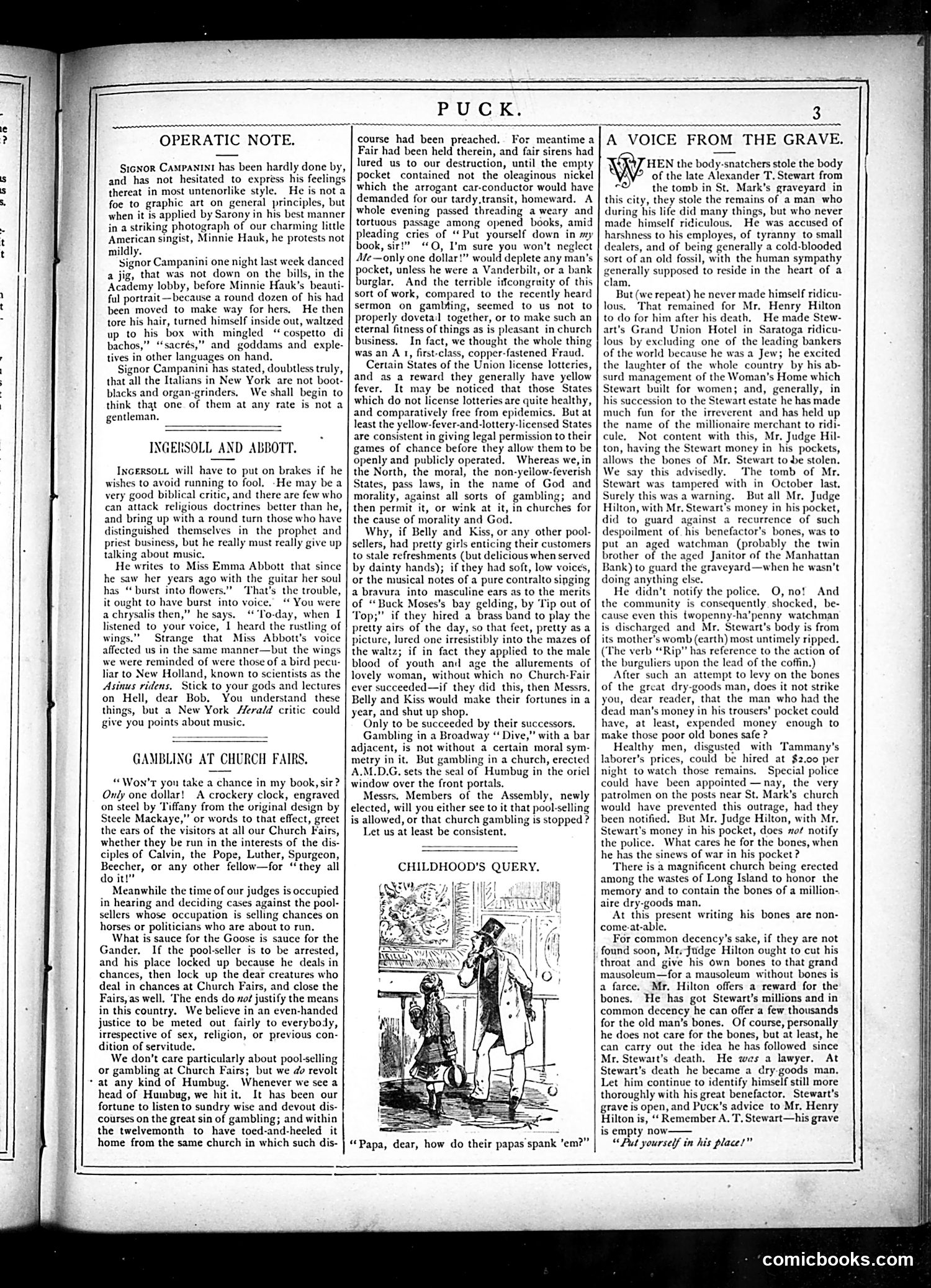
This page contains three distinct articles and one illustration rather than political cartoons: **"Operatic Note"** mocks Signor Campanini's dancing at the Academy lobby, praising actress Minnie Hauk's beauty while satirizing his performance. **"Ingersoll and Abbott"** discusses Robert Ingersoll (likely the famous atheist lecturer) and his approach to religious criticism, praising his intellectual method. **"Gambling at Church Fairs"** criticizes the hypocrisy of churches running gambling games (lotteries, raffles) while condemning gambling elsewhere—a clear social satire on institutional moral inconsistency. **"Childhood's Query"** features an illustration of a child asking an adult about funeral customs ("Papa, dear, how do their papas spark 'em?"), creating dark humor about death and burial practices. The page emphasizes Puck's satirical critique of social and religious hypocrisy.
📄 Transcribed text from this page (OCR, searchable)
Machine-transcribed from the original scan — historical spelling and the odd misread are preserved.
PUCK. OPERATIC NOTE. Signor Campantnt has been hardly done by, and has not hesitated to express his feelings thereat in most untenorlike style. He is not a foe to graphic art on general principles, but when it is applied by Sarony in his best manner in a striking photograph of our charming little American singist, Minnie Hauk, he protests not mildly. Signor Campanini one night last week danced a jig, that was not down on the bills, in the Academy lobby, before Minnie Hauk’s beauti- ful portrait —because a round dozen of his had been moved to make way for hers, He then tore his hair, turned himself inside out, waltzed up to his box with mingled “cospetto di bachos,” “sacrés," and goddams and exple- tives in other languages on hand. Signor Campanini has stated, doubtless truly, that all the Italians in New York are not boot- blacks and organ-grinders. We shall begin to think that one of them at any rate is not a gentleman, INGERSOLL AND ABBOTT. InGersott will have to put on brakes if he wishes to avoid running to fool. -He may be a very good biblical critic, and there are few who can attack religious doctrines better than he, and bring up with a round turn those who have distinguished themselves in the prophet and priest business, but he really must really give up talking about music. He writes to Miss Emma Abbott that since he saw her years ago with the guitar her soul has “ burst into flowers.” at’s the trouble, it ought to have burst into voice. You were a chrysalis then,” he says. “To-day, when I listened to your voice, 1 heard the rustling of wings.” Strange that Miss Abbott's voice affected us in the same manner—but the wings we were reminded of were those of a bird pecu- liar to New Holland, known to scientists as the Asinus ridens, Stick to your gods and lectures on Hell, dear Bob, You understand these things, but a New York Hera/d critic could give you points about music. GAMBLING AT CHURCH FAIRS. “Won't you take a chance in my book, sir? Only one dollar! A crockery clock, engraved on steel by Tiffany from the original design by Steele Mackaye,” or words to that effect, greet the ears of the visitors at all our Church Fairs, whether they be run in the interests of the dis- ciples of Calvin, the Pope, Luther, Spurgeon, Beecher, or any other fellow—for “they all do it!” Meanwhile the time of our judges is occupied in hearing and deciding cases against the pool- sellers whose occupation is selling chances on horses or politicians who are about to run, What is sauce for the Goose is sauce for the Gander, If the pool-seller is to be arrested, and his place locked up because he deals in chances, then lock up the dear creatures who deal in chances at Church Fairs, and close the Fairs, as well. ‘The ends do not justify the means in this country. We believe in an even-handed justice to be meted out fairly to everybody, irrespective of sex, religion, or previous con- dition of servitude, We don’t care particularly about pool-selling or gambling at Church Fairs; but we do revolt at any kind of Humbug. Whenever we see a head of Humbug, we hit it. It has been our fortune to listen to sundry wise and devout dis- courses on the great sin of gambling; and within the twelvemonth to have toed-and-heeled it home from the same church in which such dis- course had been preached. For meantime a Fair had been held therein, and fair sirens had lured us to our destruction, until the empty pocket contained not the oleaginous nickel which the arrogant car-conductor would have demanded for our tardy,transit, homeward. A whole evening passed threading a weary and tortuous passage among opened books, amid pleading cries of “Put yourself down in my book, sir!” “O, I'm sure you won't neglect AMe—only one dollar!” would deplete any man’s pocket, unless he were a Vanderbilt, or a bank burglar. And the terrible itfcongrwity of this sort of work, compared to the recently heard sermon on gambting, seemed to us not to properly doveta:l together, or to make such an eternal fitness of things as is pleasant in church business. In fact, we thought the whole thing was an A1, first-class, copper-fastened Fraud. Certain States of the Union license lotteries, and as a reward they generally have yellow fever. It may be noticed that those States which do not license lotteries are quite healthy, and comparatively free from epidemics. But at least the yellow-fever-and-lottery-licensed States are consistent in giving legal permission to their games of chance before they allow them to be openly and publicly operated. Whereas we, in the North, the moral, the non-yeilow-feverish States, pass laws, in the name of God and morality, against all sorts of gambling; and then permit it, or wink at it, in churches for the cause of morality and God. Why, if Belly and Kiss, or any other pool- sellers, had pretty girls enticing their customers to stale refreshments (but delicious when served by dainty hands); if they had soft, low voices, or the musical notes of a pure contralto sipging a bravura into masculine ears as to the merits of “Buck Moses's bay gelding, by Tip out of Top;” if they hired a brass band to play the pretty airs of the day, so that feet, pretty as a picture, lured one irresistibly into the mazes of the waltz; if in fact they applied to the male blood of youth and age the allurements of lovely woman, without which no Church-Fair ever succeeded—if they did this, then Messrs. Belly and Kiss would make their fortunes in a year, and shut up shop. Only to be succeeded by their successors. Gambling in a Broadway “ Dive,” with a bar adjacent, is not without a certain moral sym- metry in it. But gambling in a church, erected A.M.D.G. sets the seal of Humbug in the oriel window over the front portals, Messrs. Members of the Assembly, newly elected, will you either see to it that pool-selling is allowed, or that church gambling is stopped ? Let us at least be consistent. “Papa, dear, how do their papas’spank ’em?” 3 lA VOICE FROM THE GRAVE. AW HEN the body-snatchers stole the body of the late Alexander T. Stewart from m the tomb in St. Mark's graveyard in this city, they stole the remains of a man who during his life did many things, but who never made himself ridiculous, He was accused of harshness to his employes, of tyranny to small dealers, and of being generally a cold-blooded sort of an old fossil, with the human sympathy generally supposed to reside in the heart of a clam, But (we repeat) he never made himself ridicu- lous. That remained for Mr. Henry Hilton to do for him after his death, He made Stew- art's Grand Union Hotel in Saratoga ridicu- lous by excluding one of the leading bankers of the world because he was a Jew; he excited the laughter of the whole country. by his ab- surd management of the Woman’s Home which Stewart built for women; and, generally, in his succession to the Stewart estate he has made much fun for the irreverent and has held up the name of the millionaire merchant to ridi- cule, Not content with this, Mr. Judge Hil- ton, having the Stewart money in his pockets, allows the bones of Mr. Stewart to de stolen. We say this advisedly. The tomb of Mr. Stewart was tampered with in October last. Surely this was a warning. But all Mr. Judge Hilton, with Mr, Stewart’s money in his pocket, did to guard against a recurrence of such despoilment of his benefactor's bones, was to put an aged watchman (probably the twin brother of the aged Janitor of the Manhattan Bank) to guard the graveyard—when he wasn't doing anything else. He didn’t notify the police. O,no! And the community is consequently shocked, be- cause even this twopenny-ha’penny watchman is discharged and Mr. Stewart's body is from its mother’s womb (earth) most untimely ripped. (The verb “Rip” has reference to the action of the burguliers upon the lead of the coffin.) After such an attempt to levy on the bones of the great dry-goods man, does it not strike you, dear reader, that the man who had the dead man’s money in his trousers’ pocket could have, at least, expended money enough to make those poor old bones safe ? Healthy men, disgusted with Tammany's laborer’s prices, could be hired at $2.00 per night to watch ‘those remains. Special police could have been appointed —nay, the very patrolmen on the posts near St, Mark’s church would have prevented this outrage, had they been notified, But Mr. Judge Hilton, with Mr. Stewart's money in his pocket, does nof notify the police. What cares he for the bones, when he has the sinews of war in his pocket? ‘There is a magnificent church being erected among the wastes of Long Island to honor the memory and to contain the bones of a million- aire dry-goods man. At this present writing his bones are non- come-at-able. For common decency’s sake, if they are not found soon, MrsJudge Hilton ought to cut his throat and give his own bones to that grand mausoleum—for a mausoleum without bones is a farce. Mr. Hilton offers a reward for the bones. He has got Stewart’s millions and in common decency he can offer a few thousands for the old man’s bones. Of course, personally he does not care for the bones, but at least, he can carry out the idea he has followed since Mr. Stewart’s death, He wes a lawyer. At Stewart's death he became a dry-goods man, Let him continue to identify himself still more thoroughly with his great benefactor. Stewart's grave is open, and Puck's advice to Mr. Henry Hilton is, “‘ Remember A. T, Stewart—his grave is empty now—— “Put yourself in his place!” comicbooks.com