
Puck, 1878-10-16 · page 6 of 16
Puck — October 16, 1878 — page 6: what you’re looking at
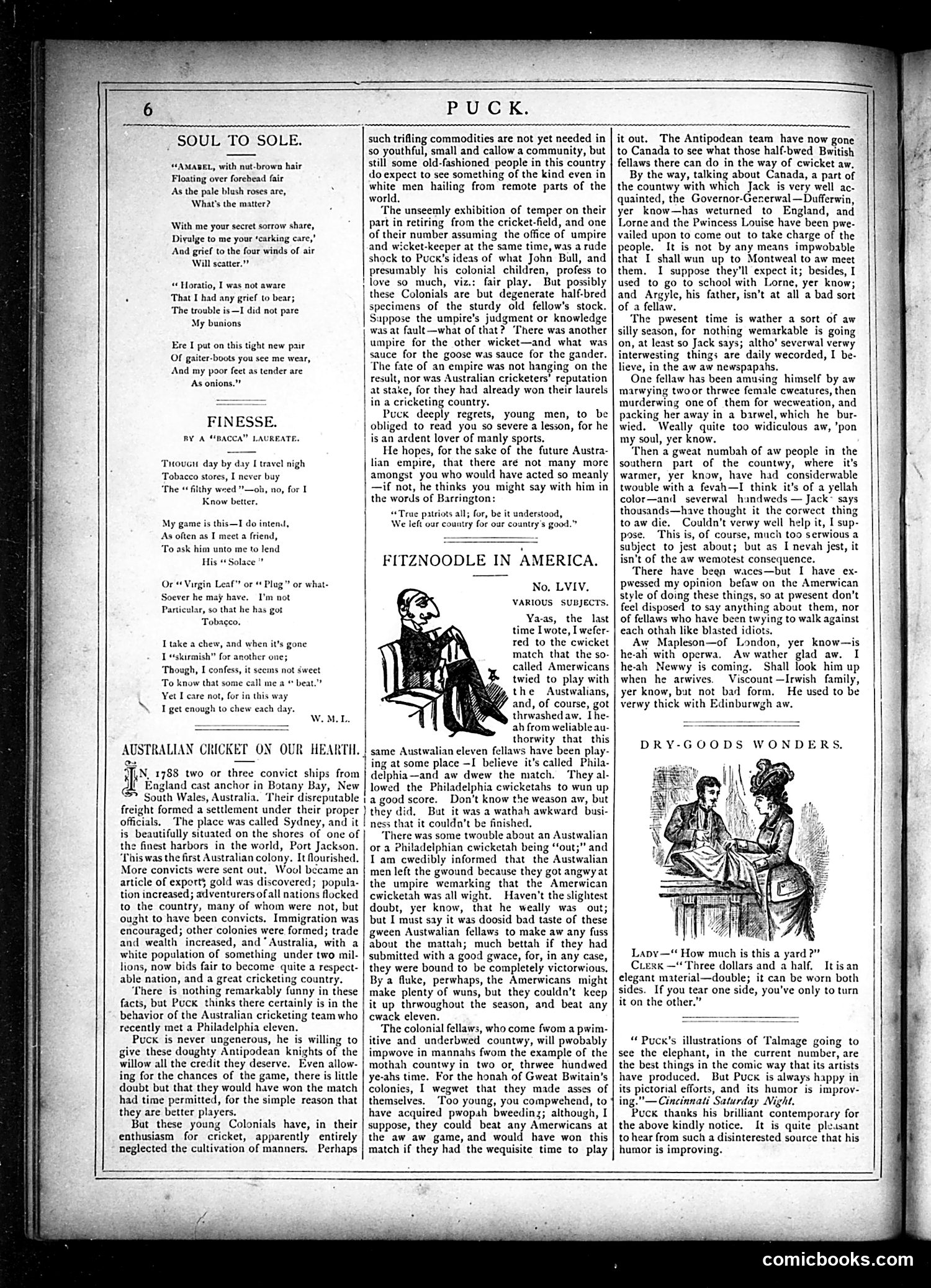
A restored page from Puck, 1878-10-16. Page through the whole issue in the reader above.
📄 Transcribed text from this page (OCR, searchable)
Machine-transcribed from the original scan — historical spelling and the odd misread are preserved.
PUCK. _ SOUL TO SOLE. “AMABEL, with nut-browa hair Floating over forebead fair As the pale blush roses are, What's the matter? With me your secret sorrow share, Divulge to me your ‘carking care,? ‘And grief to the four winds of air Will scatter.”” « Horatio, I was not aware ‘That I had any grief to bear; The trouble is—I did not pare My bunions Ere I put on this tight new pair Of gaiter-boots you see me wear, And my poor feet as tender are ‘As onions."” FINESSE. RY A “BACCA” LAURE. Tuovet day by day [travel nigh Tobacco stores, I never buy ‘The filthy weed "—ob, no, for I Know better. My game is this—I do intend, As often as I meet a friend, To ask him unto me to lend Or Virgin Leaf’? or “ Plug” or what- Soever he may have. I'm not Particular, so that he has got Tobacco. I take a chew, and when it's gone I “skirmish” for another one; Though, I confess, it seems not sweet To know that some call me a * beat.” Yet I care not, for in this way I get enough to chew each day. W.M.L. AUSTRALIAN CRICKET ON OUR HEARTH I 1788 two or three convict ships from Alf Bagland cast anchor in Botany Bay, New ‘> South Wales, Australia. ‘Their disreputable freight formed a settlement under their proper officials. The place was called Sydney, and it is beautifully situated on the shores of one of the finest harbors in the world, Port Jackson. ‘This was the first Australian colony. It flourished. More convicts were sent out, Wool became an article of exports gold was discovered; popula- tion increased; adventurers ofall nations flocked to the country, many of whom were not, but ought to have been convicts. Immigration was encouraged; other colonies were formed; trade and wealth increased, and‘ Australia, with a white population of something under two mil- lions, now bids fair to become quite a respect- able nation, and a great cricketing country. ‘There is nothing remarkably funny in these facts, but Puck thinks there certainly is in the behavior of the Australian cricketing team who recently met a Philadelphia eleven. Puck is never ungenerous, he is willing to give these doughty Antipodean knights of the willow all the credit they deserve. Even allow- ing for the chances of the game, there is little doubt but that they would have won the match had time permitted, for the simple reason that they are better players. Bat these young Colonials have, in their enthusiasm for cricket, apparently entirely neglected the cultivation of manners. Perhaps such trifling commodities are not yet needed in so youthful, small and callow a community, but still some old-fashioned people in this country do expect to see something of the kind even in white men hailing from remote parts of the world. ‘The unseemly exhibition of temper on their part in retiring from the cricket-field, and one of their number assuming the office of umpire and w’ rat the same time, was a rude shock to Puck's ideas of what John Bull, and presumably his colonial children, profess to ‘love so much, viz.: fair play. But possibly these Colonials are but degenerate half-bred specimens of the sturdy old fellow’s stock. Suppose the umpire’s judgment or knowledge was at fault—what of that? There was another umpire for the other wicket—and what was sauce for the goose was sauce for the gander. The fate of an empire was not hanging on the result, nor was Australian cricketers’ reputation at stake, for they had already won their laurels | in a cricketing country. | Puck deeply regrets, young men, to be obliged to read you so severe a lesson, for he | isan ardent lover of manly sports. He hopes, for the sake of the future Austra- lian empire, that there aré not many more amongst you who would have acted so meanly —if not, he thinks you might say with him in the words of Barrington “True patriots all; for, be it understood, We left our country for our country's good.” FITZNOODLE IN AMERICA. No, LVIV. vaRious. SUBJECTS. Ya-as, the last time I wote, I wefer- red to the cwicket match that the so- called Amerwicans twied to play with the Austwalians, and, of course, got thrwashed aw. Ihe- ah from weliable au- thorwity that this | same Austwalian eleven fellaws have been play- g at some place —I believe it’s called Phila- delphia—and aw dwew the match. They al- lowed the Philadelphia cwicketahs to wun up 1a good score. Don't know the weason aw, but } they did. But it was a wathah awkward _busi- ness that it coulda’t be finished, ‘There was some twouble about an Austwalian or a Philadelphian cwicketah being ‘‘out;” and I am ewedibly informed that the Austwalian men left the gwound because they got angwy at the umpire wemarking that the Amerwican ewicketah was all wight. Haven't the slightest doubt, yer know, that he weally was out; but I must say it was doosid bad taste of these gween Austwalian fellaws to make aw any fuss about the mattah; much bettah if they had submitted with a good gwace, for, in any case, they were bound to be completely victorwious, By a fluke, perwhaps, the Amerwicans might make plenty of wuns, but they couldn’t keep it up thrwoughout the season, and beat any cwack eleven. The colonial fellaws, who come fwom a pwim- itive and underbwed countwy, will pwobably impwove in mannahs fwom the example of the mothah countwy in two or, thrwee hundwed ye-ahs time. For the honah of Gweat Bwitain’s colonies, 1 wegwet that they made asses of themselves. Too young, you compwehend, to have acquired pwopah bweeding; although, I suppose, they could beat any Amerwicans at the aw aw game, and would have won this match if they had the wequisite time to play it out. The Antipodean team have now gone to Canada to see what those half-bwed Bwitish fellaws there can do in the way of cwicket aw, By the way, talking about Canada, a part of the countwy with which Jack is very well ac- quainted, the Governor-Gererwal—Dufferwin, yer know—has weturned to England, and Lorne and the Pwincess Louise have been pwe- vailed upon to come out to take charge of the people. It is not by any means impwobable that I shall wun up to Montweal to aw meet them. I suppose they'll expect it; besides, I used to go to school Lorne, yer know; and Argyle, his father, isn’t at all a bad sort of a fellaw. The pwesent time is silly season, for nothing wemarkable is going on, at least so Jack says; altho’ severwal verwy interwesting things are daily wecorded, I be- lieve, in the aw aw newspapahs. One fellaw has been amusing himself by aw marwying twoor thrwee female cweatures, then murderwing one of them for wecweation, and packing her away in a barwel, which he bur- wied. Weally quite too widiculous aw, ‘pon my soul, yer know, ‘Then a gweat numbah of aw people in the southern part of the countwy, where it’s warmer, yer know, have had considerwable twouble with a fevah—I think it’s of a yellah color—and severwal handweds — Jack says thousands—have thought it the corwect thing to aw die. Couldn't verwy well help it, I sup- pose. This is, of course, much too serwious a subject to jest about; but as I nevah jest, it isn’t of the aw wemotest consequence. There have been waces—but I have ex- pwessed my opinion befaw on the Amerwican style of doing these things, so at pwesent don't feel disposed to say anything about them, nor of fellaws who have been twying to walk against each othah like blasted idiots, Aw Mapleson—of London, yer know—is he-ah with operwa. Aw wather glad aw. I he-ah Newwy is coming. Shall look him up when he arwives. Viscount —Irwish family, yer know, but not bad form. He used to be verwy thick with Edinburwgh aw. wather a sort of aw DRY-GOODS WONDERS Lapy— How much is this a yard?” Creak —‘* Three dollars and a half. It isan elegant material—double; it can be worn both sides. If you tear one side, you've only to turn it on the other.” “ Puck's illustrations of ‘Talmage going to see the elephant, in the current number, are the best things in the comic way that its artists have produced. But Puck is always happy in its pictorial efforts, and its humor is improv- ing." —Cincinnati Saturday Night. Puck thanks his brilliant contemporary for the above kindly notice. It is quite pleasant to hear from such a disinterested source that his humor is improving. comicbooks.com