
Puck, 1878-10-16 · page 3 of 16
Puck — October 16, 1878 — page 3: what you’re looking at
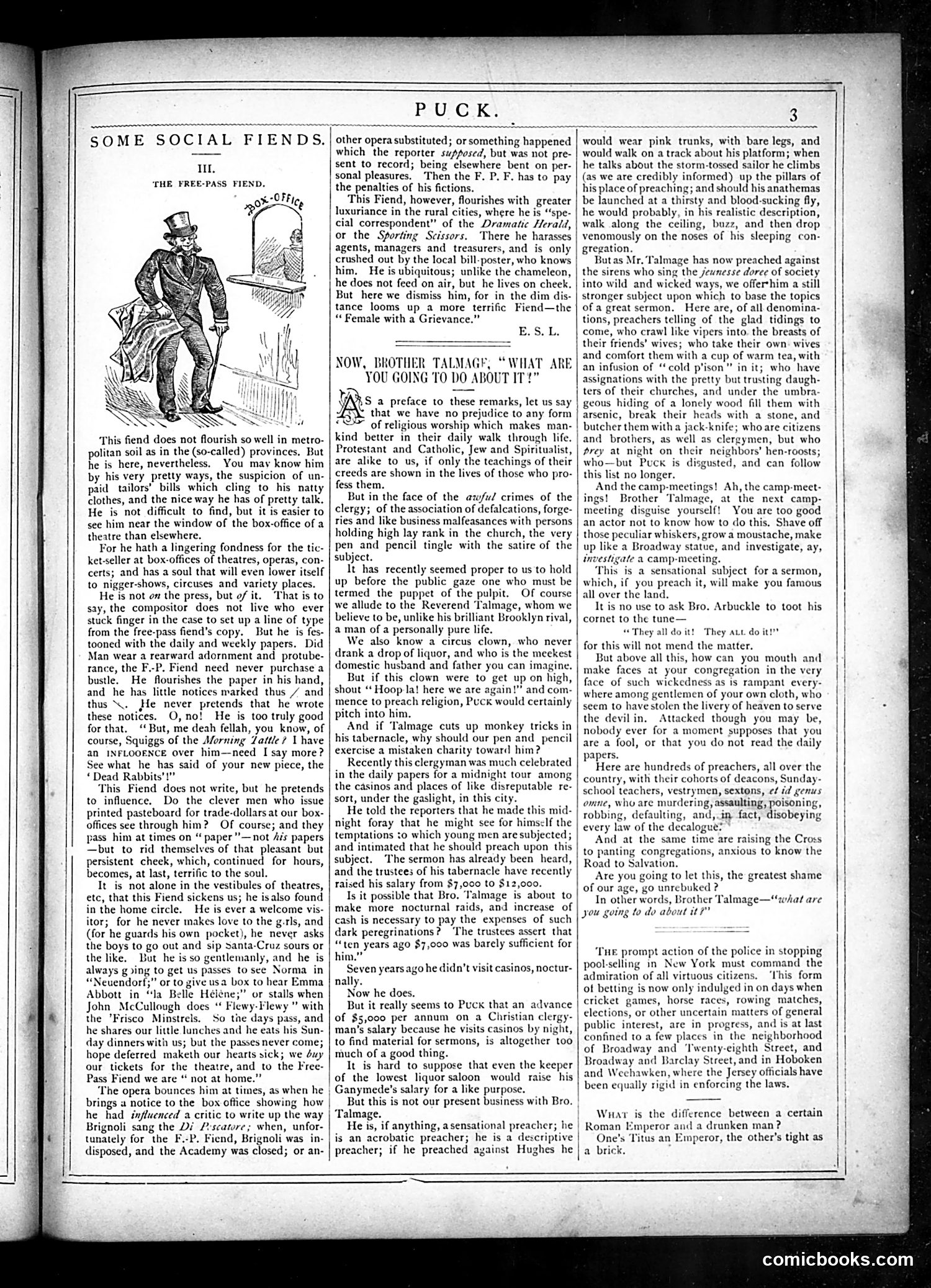
What you’re looking at
This page satirizes **Brother Talmage**, a prominent clergyman (appears to be T. DeWitt Talmage, a famous late-19th-century Brooklyn preacher). The cartoon mocks the contradiction between his public morality and private conduct. The satire focuses on Talmage's visits to casinos and saloons by night while preaching virtue by day. The text ridicules him as a hypocrite—a man who condemns worldly pleasures from the pulpit yet secretly frequents them. The accompanying illustration depicts him as a pompous figure in clerical dress. The piece criticizes how Talmage allegedly raises church funds to $5,000-$12,000 annually while justifying casino visits as "research for sermons," exposing the gap between his preaching and behavior as fundamentally dishonest.
📄 Transcribed text from this page (OCR, searchable)
Machine-transcribed from the original scan — historical spelling and the odd misread are preserved.
SOME SOCIAL FIENDS. Ut. ‘THE FREE-PASS FIEND. ‘This fiend does not flourish so well in metro- politan soil as in the (so-called) provinces, But he is here, nevertheless. You may know him by his very pretty ways, the suspicion of un- paid tailors’ bills which cling to his natty clothes, and the nice way he has of pretty talk. He is not difficult to find, but it is easier to see him near the window of the box-office of a theatre than elsewhere. For he hath a lingering fondness for the tic- ket-seller at box-offices of theatres, operas, con- certs; and has a soul that will even lower itself to nigger-shows, circuses and variety places. He is not on the press, but of it. ‘That is to say, the compositor does not live who ever stuck finger in the case to set up a line of type from the free-pass fiend’s copy. But he is fes- tooned with the daily and weekly papers. Did Man wear a rearward adornment and_protube- rance, the F.-P. Fiend need never purchase a bustle. He flourishes the paper in his hand, and he has little notices marked thus / and thus \. He never pretends that he wrote these notices. O,no! He is too truly good for that. ‘But, me deah fellah, you know, of course, Squiggs of the Morning Zattle? have an INFLOOENCE over him—need I say more? See what he has said of your new piece, the ‘Dead Rabbits’!” This Fiend does not write, but he pretends to influence. Do the clever men who issue printed pasteboard for trade-dollars at our box- offices see through him? Of course; and they pass him at times on “ paper”’—not Ais papers —but to rid themselves of that pleasant but persistent cheek, which, continued for hours, becomes, at last, terrific to the soul. It is not alone in the vestibules of theatres, etc, that this Fiend sickens us; he isalso found in the home circle. He is ever a welcome vis- itor; for he never makes love to the g.rls, and (for he guards his own pocket), he nev. the boys to go out and sip Santa-Cruz sours or the like. But he is so gentlemanly, and he is always g ing to get us passes to see Norma in “Neuendorf;” or to give usa box to hear Emma Abbott in “la Belle Héi¢ne;” or stalls when John McCullough does “ Flewy-Flewy ” with the ’Frisco Minstrels. So the days pass, and he shares our little lunches and he eats his Sun- day dinners with us; but the passes never come; hope deferred maketh our hearts sick; we duy our tickets for the theatre, and to the = Pass Fiend we are “ not at home.”” ‘The opera bounces him at times, as when he brings a notice to the box office showing how he had influenced a critic to write up the way Brignoli sang the Di /:scatore; when, unfor- tunately for the F.-P. Fiend, Brignoli was in- disposed, and the Academy was closed; or an- | | or the Sporting Scissors. other opera substituted; or something happened which the reporter supposed, but was not pre- sent to record; being elsewhere bent on per- sonal pleasures. Then the F. P. F. has to pay the penalties of his fictions. This Fiend, however, flourishes with greater luxuriance in the rural cities, where he is “spe- ial correspondent” of the Dramatic Herald, There he harasses agents, managers and treasurers, and is only crushed out by the local bill-poster, who knows | him. He is ubiquitous; unlike the chameleon, he does not feed on air, but he lives on cheek. But here we dismiss him, for in the dim dis- tance looms up a more terrific Fiend—the “ Female with a Grievance.” E.S.L, TALMAGF, “WHAT ARE YOU GOING TO DO ABOUT IT?” Ws 2 preface to these remarks, let us say EX: that we have no prejudice to any form * >" of religious worship which makes man- kind better in their daily walk through life. Protestant and Catholic, Jew and Spiritualist, are alike to us, if only the teachings of their creeds are shown in the lives of those who pro- fess them. But in the face of the aw/u/ crimes of the clergy; of the association of defalcations, forge- ries and like business malfeasances with persons holding high lay rank in the church, the very pen and pencil tingle with the satire of the subject. It has recently seemed proper to us to hold up before the public gaze one who must be termed the puppet of the pulpit. Of course we allude to the Reverend Talmage, whom we believe to be, unlike his brilliant Brooklyn rival, a man of a personally pure life. We also know a circus clown, who never drank a drop of liquor, and who is the meekest domestic husband and father you can imagine, But if this clown were to get up on high, shout “ Hoop la! here we are again!” and com- mence to preach religion, Puck would certainly pitch into him. And if Talmage cuts up monkey tricks in his tabernacle, why should our pen and_ pencil exercise a mistaken charity toward him? Recently this clergyman was much celebrated in the daily papers for a midnight tour among the casinos and places of like disreputable re: sort, under the gaslight, in this city. He told the reporters that he made this mid- night foray that he might see for himself the temptations :o which young men are subjected; and intimated that he should preach upon this subject. and the trustees of his tabernacle have recently raised his salary from $7,000 to $12,000. Is it possible that Bro, ‘Talmage is about to | make more nocturnal raids, and increase of cash is necessary to pay the expenses of such dark peregrinations? ‘The trustees assert that “ten years ago $7,000 was barely sufficient for him.” Seven yearsa nally. Now he does. But it really seems to Puck that an advance of $5,000 per annum on a Christian clergy- man’s salary because he visits casinos by night, to find material for sermons, is altogether too much of a good thing. It is hard to suppose that even the keeper of the lowest liquor saloon would raise his Ganymede's salary for a like purpo: But this is not our present business with Bro. Talmage. He is, if anything, asensational preacher; he is an acrobatic preacher; he is a descriptive preacher; if he preached against Hughes he ‘o he didn’t visit casinos, noctur- ‘The sermon has already been heard, | would wear pink trunks, with bare legs, and would walk on a track about his platform; when he talks about the storm-tossed sailor he climbs (as we are credibly informed) up the pillars of his place of preaching; and should his anathemas be launched at a thirsty and blood-sucking fly, he would probably, in his realistic description, | walk along the ceiling, buzz, and then drop | venomously on the noses of his sleeping con- gregation. Butas Mr.’Talmage has now preached against the sirens who sing the jeunesse doree of society | into wild and wicked ways, we offerhim a still stronger subject upon which to base the topics of a great sermon. Here are, of all denomina- tions, preachers telling of the glad tidings to come, who crawl like vipers into. the breasts of their friends’ wives; who take their own: wives and comfort them with a cup of warm tea, with an infusion of ‘cold p'ison” in it; who have assignations with the pretty but trusting daugh- ters of their churches, and under the umbra- | geous hiding of a lonely wood fill them with | arsenic, break their heads with a stone, and | butcher them witha jack-knife; who are citizens | and brothers, as well as clergymen, but who prey at night on their neighbors’ hen-roosts; who—but Puck is disgusted, and can follow this list no longer. And the camp-meetings! Ah, the camp-meet- ings! Brother ‘Talmage, at the next camp- meeting disguise yourself! You are too good an actor not to know how to do this. Shave off those peculiar whiskers, grow a moustache, make up like a Broadway statue, and investigate, ay, | investigate a camp-meeting. This is a sensational subject for a sermon, which, if you preach it, will make you famous all over the land. It is no use to ask Bro, Arbuckle to toot his cornet to the tune— “They all do it! They aut do it!” for this will not mend the matter. But above all this, how can you mouth and make faces at your congregation in the very face of such wickedness as is rampant every- where among gentlemen of your own cloth, who seem to have stolen the livery of heaven to serve the devil in, Attacked though you may be, nobody ever for a moment supposes that you are a fool, or that you do not read the daily papers. Here are hundreds of preachers, all over the country, with their cohorts of deacons, Sunday- school teachers, vestrymen, sextons, ef id genus omne, who are murdering, assaulting, poisoning, robbing, defaulting, and,.in fact, disobeying every law of the decalog: And at the same time are raising the Cross | to panting congregations, anxious to know the Road to Salvation. Are you going to let this, the greatest shame of our age, go unrebuked ? In other words, Brother Talmage—“what are you going to do about it?” ‘THE prompt action of the police in stopping pool-selling in New York must command the admiration of all virtuous citizens. ‘his form of betting is now only indulged in on days when cricket games, horse races, rowing matches, elections, or other uncertain matters of general public interest, are in progress, and is at last confined to a few places in the neighborhood of Broadway and ‘I'wenty-eighth Street, and Broadway and Barclay Street, and in Hoboken and Weehawken, where the Jersey officials have been equally rigid in enforcing the laws. Wuar is the difference between a certain :mperor and a drunken man? Titus an Emperor, the other's tight as comicbooks.com