
Puck, 1878-10-16 · page 10 of 16
Puck — October 16, 1878 — page 10: what you’re looking at
What you’re looking at
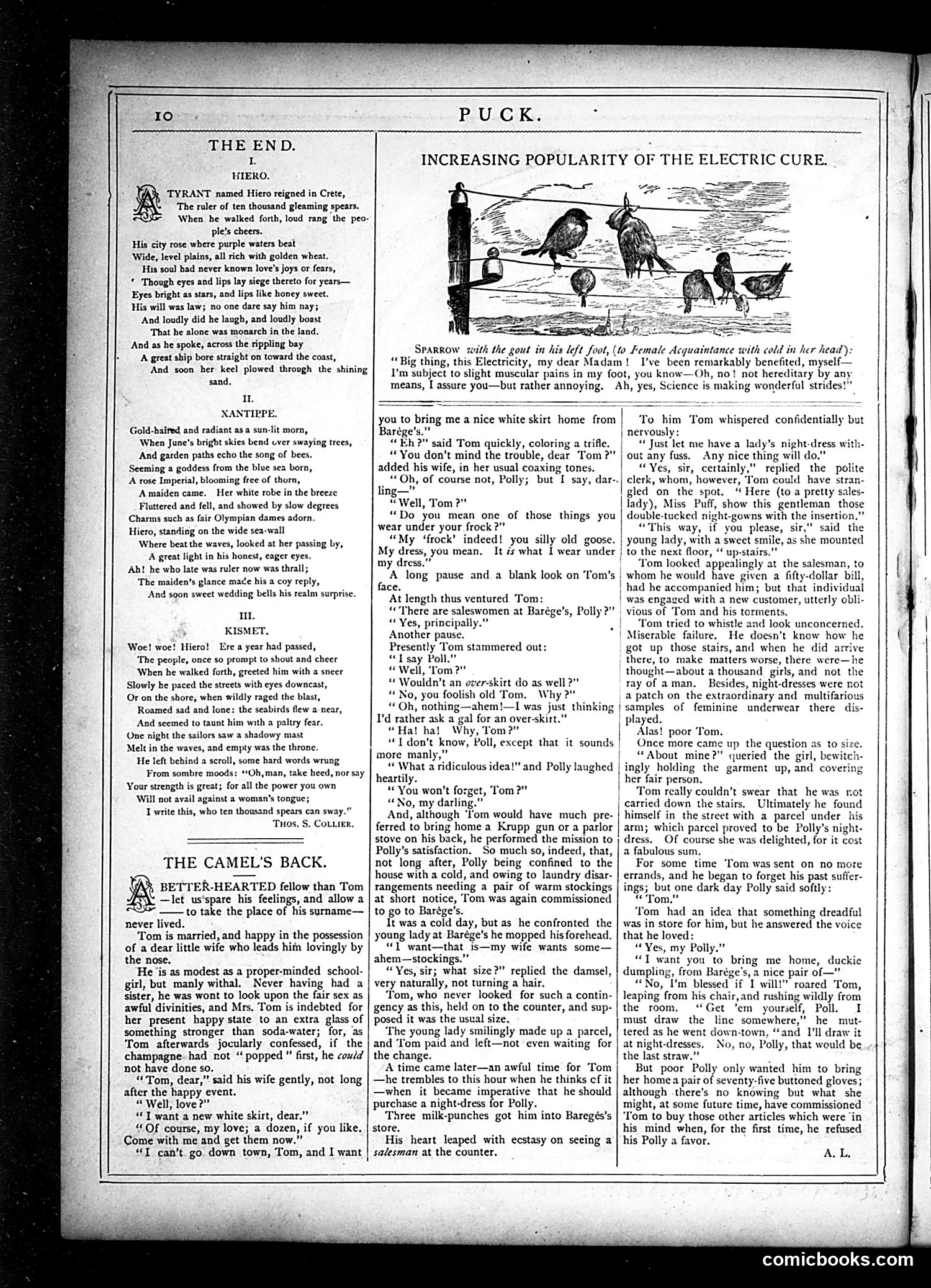
This cartoon satirizes the late-19th-century fad of using electrical treatment for medical ailments. The illustration shows birds perched on electrical poles, with a sparrow complaining to a female acquaintance about muscular pain in its foot. The female suggests electricity as a cure, boasting that "Science is making wonderful strides!" The satire mocks how indiscriminately electrical "cures" were being promoted for various complaints—the sparrow's skeptical response ("no, no! not hereditary by any means") suggests the treatment was becoming a catch-all remedy regardless of actual cause. Puck is ridiculing both the pseudoscience of electrical medicine and public gullibility in embracing trendy but unproven treatments.
📄 Transcribed text from this page (OCR, searchable)
Machine-transcribed from the original scan — historical spelling and the odd misread are preserved.
PUCK. THE END. I HIERO. TYRANT named Hiero reigned in Crete, The ruler of ten thousand gleaming spears. When he walked forth, loud rang ‘the peo- ple’s cheers. His city rose where purple waters beat Wide, level plains, all rich with golden wheat. His soul had never known love's joys or fears, * Though eyes and lips lay siege thereto for years— Eyes bright as stars, and lips like honey sweet. His will was law; no one dare say him nay; ‘And loudly did he laugh, and loudly boast That he alone was monarch in the land. ‘And as he spoke, across the rippling bay A great ship bore straight on toward the coast, And soon her keel plowed throvgh the shining sand, I. XANTIEPE. Gold-haired and radiant asa sun-lit morn, When June's bright skies bend uver swaying trees, ‘And garden paths echo the song of bees. Seeming a goddess from the blue sea born, A rose Imperial, blooming free of thorn, Amaiden came. Her white robe in the breeze Fluttered and fell, and showed by slow degrees Charms such as fair Olympian dames adorn. Hiero, standing on the wide sea-wall Where beat the waves, looked at her passing by, A great light in his honest, eager eyes. Ab! he who late was ruler now was thrall; ‘The maiden’s glance mace his a coy reply, And soon sweet wedding bells his realm surprise. Ml. KISMET. Woe! woe! Hiero! Ere a year had passed, ‘The people, once so prompt to shout and cheer ‘When he walked forth, greeted him with a sneer Slowly he paced the streets with eyes downcast, Or on the shore, when wildly raged the blast, Roamed sad and lone: the seabirds flew a-near, And seemed to taunt him with a paltry fear. ‘One night the sailors saw a shadowy mast Melt in the waves, and empty was the throne. He left behind a scroll, some hard words wrung From sombre moods: “Oh,man, take heed, nor say Your strength is great; for all the power you own Will not avail against a woman's tongue; THE CAMEL’S BACK. I write this, who ten thousand spears can sway.” Tos, S. CoLLier. BETTER-HEARTED fellow than Tom —let us'spare his feelings, and allow a —to take the place of his surname— never lived. ‘Tom is married, and happy in the possession of a dear little wife who leads him lovingly by the nose, He ‘is as modest as a proper-minded school- girl, but manly withal, Never having had a sister, he was wont to look upon the fair sex as awful divinities, and Mrs. Tom is indebted for her present happy state to an extra glass of something stronger than soda-water; for, as Tom afterwards jocularly confessed, if the champagne had not “popped ” first, he could not have done so. “Tom, dear,” said his wife gently, not long after the happy event. “ Well; love?” “T want a new white skirt, dear.” “Of course, my love; a dozen, if you like, Come with me and get them now.” “I can’t. go down town, Tom, and I want INCREASING POPULARITY OF THE ELECTRIC CURE. Sparrow with the gout in his left foot, (to Female Acquaintance with cold in her head): “Big thing, this Electricity, my dear Madam ! I've been remarkably benefited, myself— I’m subject to slight muscular pains in my foot, you know—Oh, no! not hereditary by any means, [ assure you—but rather annoying. you to bring me a nice white skirt home from Barege’s.”” “Eh?” said Tom quickly, coloring a trifle. “You don’t mind the trouble, dear Tom ?” | out any fuss. added his wife, in her usual coaxing tones. “Oh, of course not, Polly; but I say, dar-.| clerk, whom, however, | | ling—” “Well, Tom 2?” “Do you mean one of those things you wear under your frock ?” “My ‘frock’ indeed! you silly old goose. My dress, you mean. It és what I wear under my dress.” A long pause anda blank look on ‘Tom’s face. At length thus ventured Tom: “There are saleswomen at Barége’s, Polly?” “ Yes, principally.” Another pause. Presently Tom stammered out: “Tsay Poll.” “ Well, ‘Tom ?” *Wouldn’t an over-skirt do as well ?” “No, you foolish old Tom. Why ?” Ah, y “Oh, nothing—ahem!—I was just thinking | I'd rather ask a gal for an over-skirt.”” “Hal! ha! Why, Tom?” “IT don’t know, Poll, except that it sounds more manly,” “‘ What a ridiculous idea!” and Polly laughed | heartily. “ You won't forget, ‘Tom ?” “No, my darling. And, although ‘I'om would have much pre- ferred to bring home a Krupp gun or a parlor stove on his back, he performed the mission to Polly’s satisfaction. So much so, indeed, that, not long after, Polly being confined to the house with a cold, and owing to laundry disar- rangements needing a pair of warm stockings at short notice, Tom was again commissioned to go to Barége’s. It was a cold day, but as he confronted the young lady at Barége’s he mopped his forehead. “YT want—that is—my wife wants some— ahem—stockings.”” “Yes, sir; what size?” replied the damsel, very naturally, not turning a hair. Tom, who never looked for such a contin- gency as this, held on to the counter, and sup- posed it was the usual size, ‘The young lady smilingly made up a parcel, and ‘Tom paid and left—not ‘even waiting for the change. A time came later—an awful time for Tom —he trembles to this hour when he thinks cf it —when it became imperative that he should purchase a night-dress for Polly. Three milk-punches got him into Baregés’s store, His heart leaped with ecstasy on seeing a salesman at the counter. | carried down the stairs. , Science is making wonderful strides!” To him Tom whispered confidentially but nervously: “ Just let me have a lady’s night-dress with- Any nice thing will do.” “Yes, sir, certainly,” replied the polite Tom could have stran- gled on the spot. “ Here (to a pretty sales- lady), Miss Puff, show this gentleman those double-tucked night-gowns with the inserti “This way, if you please, sir,” young lady, with a sweet smile, as she mounted to the next floor, ‘ up-stairs.”” ‘Tom looked appealingly at the salesman, to whom he would have given a fifty-dollar bill, had he accompanied him; but that individual was engaged with a new customer, utterly obli- vious of Tom and his torments, ‘Tom tried to whistle and look unconcerned. Miserable failure. He doesn’t know how he got up those stairs, and when he did arrive there, to make matters worse, there were—he thought—about a thousand girls, and not the ray of aman. Besides, night-dresses were not a patch on the extraordinary and multifarious samples of feminine underwear there dis- played. Alas! poor Tom. Once more came up the question as to size. “About mine?” queried the girl, bewit ingly holding the garment up, and’ cover: her fair person. Tom really couldn’t swear that he was not Ultimately he found himself in the street with a parcel under his arm; which parcel proved to be Polly's night- dress. Of course she was delighted, for it cost a fabulous sum. For some time ‘Tom was sent on no more errands, and he began to forget his past suffer- ings; but one dark day Polly said softly: “Tom.” ‘Tom had an idea that something dreadful was in store for him, but he answered the voice that he loved: “Yes, my Polly.” “T want you to bring me home, duckie dumpling, from Barége’s, a nice pair of—” “No, I’m blessed if I will!” roared Tom, leaping from his chair, and rushing wildly from the room. “Get ‘em yourself, Poll. I must draw the line somewhere,” he mut- tered as he went down-town, “and I'll draw it at night-dresses. No, no, Polly, that would be | the last straw.” But poor Polly only wanted him to bring her home a pair of seventy-five buttoned gloves; although -there’s no knowing but what she might, at some future time, have commissioned ‘Tom to buy those other articles which were ‘in his mind when, for the first time, he refused his Polly a favor. AL, comicbooks.com