
Puck, 1878-04-17 · page 12 of 16
Puck — April 17, 1878 — page 12: what you’re looking at
What you’re looking at
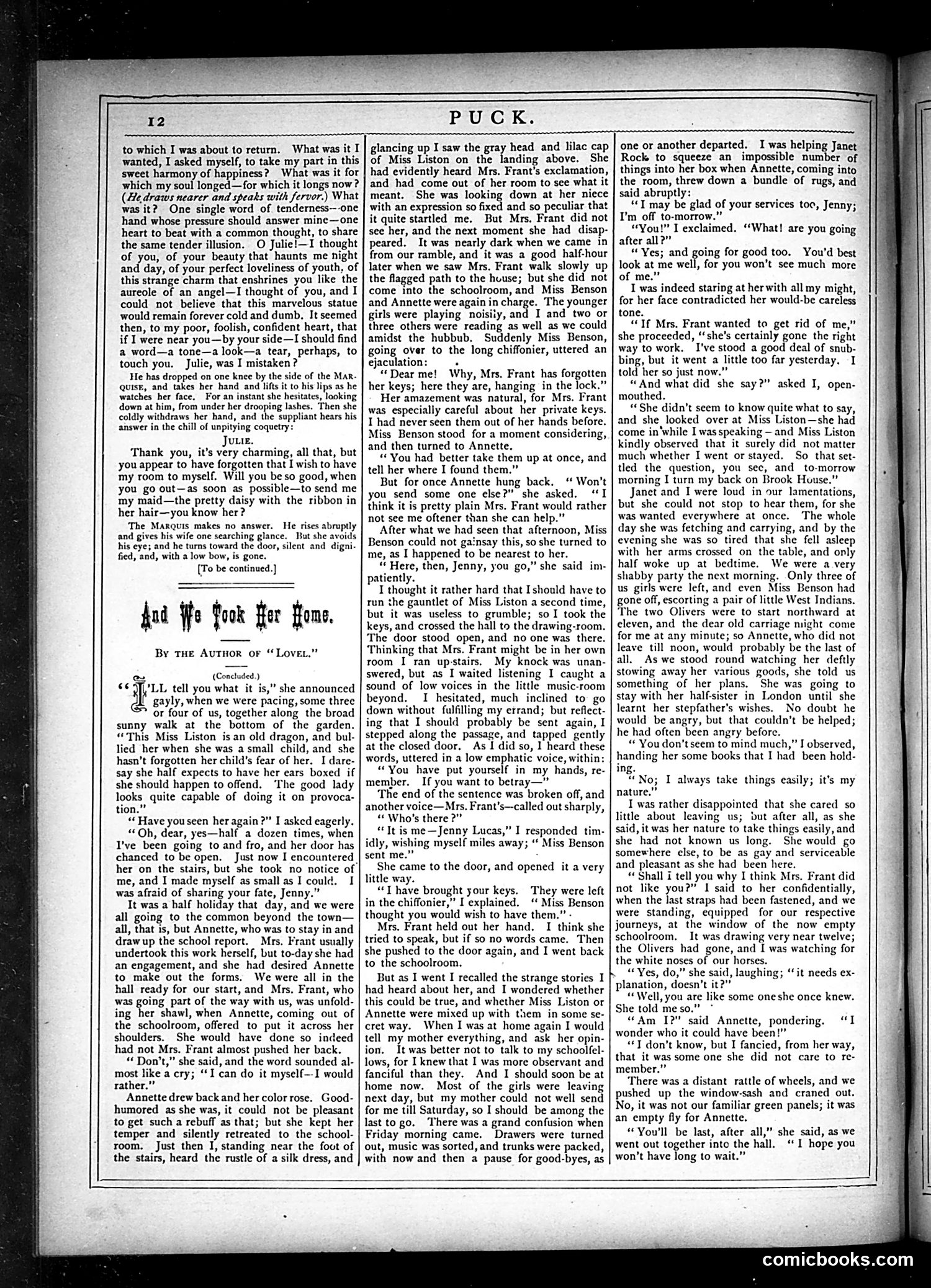
This page from *Puck* contains serialized fiction rather than political satire or cartoons. The main text is "And We Took Her Home," credited as "By the Author of 'Lovel.'" The narrative appears to be a domestic comedy about a governess or companion named Miss Lisbon and tensions with a housekeeper named Mrs. Frant. The passage discusses keys, household management disputes, and social awkwardness among servants and their employers—typical Victorian-era domestic fiction themes. There is a decorative header illustration ("And We Took Her Home" in ornamental text) but no political cartoon or satirical commentary visible on this page. This represents *Puck's* lighter literary content rather than its signature political humor.
📄 Transcribed text from this page (OCR, searchable)
Machine-transcribed from the original scan — historical spelling and the odd misread are preserved.
PUCK. to which I was about to return. What was it I wanted, I asked myself, to take my part in this sweet harmony of happiness? What was it for which my soul longed—for which it longs now ? (He draws nearer and speaks with fervor.) What was it? One single word of tenderness—-one hand whose pressure should answer mine—one heart to beat with a common thought, to share the same tender illusion. O Julie!—I thought of you, of your beauty that haunts me night and day, of your perfect loveliness of youth, of this strange charm that enshrines you like the aureole of an angel—I thought of you, and I could not believe that this marvelous statue would remain forever cold and dumb. It seemed then, to my poor, foolish, confident heart, that if I were near you—by your side—I should find a word—a tone—a look—a tear, perhaps, to touch you. Julie, was I mistaken? He has dropped on one knee by the side of the Mar- Quise, and takes her hand and lifts it to his lips as he watches her face. For an instant she hesitates, looking down at him, from under her drooping lashes. Then she coldly withdraws her hand, and the suppliant hears his answer in the chill of unpitying coquetry: Junie. Thank you, it’s very charming, all that, but you appear to have forgotten that I wish to have my room to myself. Will you be so good, when you go out—as soon as possible—to send me my maid—the pretty daisy with the ribbon in her hair—you know her? The Marquis makes no answer. He rises abruptly and gives his wife one searching glance. But she avoids his eye; and he turns toward the door, silent and digni- fied, and, with a low bow, is gone. [To be continued.] nd ffs fo fe fone, By THE AutHor oF “Lovet.” (Concluded.) <6 nies tell you what it is,” she announced gayly, when we were pacing, some three or four of us, together along the broad sunny walk at the bottom of the garden. “This Miss Liston is an old dragon, and bul- lied her when she was a small child, and she hasn’t forgotten her child’s fear of her. I dare- say she half expects to have her ears boxed if she should happen to offend. ‘The good lady looks quite capable of doing it on provoca- tion.” “Have you seen her again?” I asked eagerly. “Oh, dear, yes—half a dozen times, when I've been going to and fro, and her door has chanced to be open. her on the stairs, but she took no notice of me, and I made myself as small as I could. 1 was afraid of sharing your fate, Jenny.” It was a half holiday that day, and we were all going to the common beyond the town— all, that is, but Annette, who was to stay in and draw up the school report. Mrs. Frant usually undertook this work herself, but to-day she had an engagement, and she had desired Annette to make out the forms. We were all in the hall ready for our start, and Mrs. Frant, who was going part of the way with us, was unfold- ing her shawl, when Annette, coming out of the schoolroom, offered to put it across her shoulders. She would have done so indeed had not Mrs. Frant almost pushed her back. “Don’t,” she said, and the word sounded al- most like a cry; “I can do it myself--I would rather.” Annette drew back and her color rose. Good- humored as she was, it could not be pleasant to get such a rebuff as that; but she kept her temper and silently retreated to the school- room. Just then I, standing near the foot of the stairs, heard the rustle of a silk dress, and Just now I encountered | Jancing up I saw the gray head and lilac cap 6f Miss Liston on the landing above. She had evidently heard Mrs. Frant’s exclamation, and had come out of her room to see what it meant. She was looking down at her niece with an expression so fixed and so peculiar that it quite startled me. But Mrs. Frant did not see her, and the next moment she had disap- peared. It was nearly dark when we came in from our ramble, and it was a good half-hour later when we saw Mrs. Frant walk slowly up the flagged path to the house; but she did not come into the schoolroom, and Miss Benson and Annette were again in charge. The younger girls were playing noisily, and I and two or three others were reading as well as we could amidst the hubbub. Suddenly Miss Benson, going over to the long chiffonier, uttered an ejaculation: “Dear me! Why, Mrs. Frant has forgotten her keys; here they are, hanging in the lock.” Her amazement was natural, for Mrs. Frant was especially careful about her private keys. Thad never seen them out of her hands before. Miss Benson stood for a moment considering, and then turned to Annette. “You had better take them up at once, and tell her where I found them,” But for once Annette hung back. ‘ Won't you send some one else?” she asked. “I think it is pretty plain Mrs. Frant would rather not sce me oftener than she can help.” After what we had seen that afternoon, Miss Benson could not gainsay this, so she turned to me, as I happened to be nearest to her. “ Here, then, Jenny, you go,” she said im- patiently. I thought it rather hard that I should have to run the gauntlet of Miss Liston a second time, but it was useless to grumble; so I took the keys, and crossed the hall to the drawing-room. ‘The door stood open, and no one was there. Thinking that Mrs. Frant might be in her own room I ran up:stairs, My knock was unan- swered, but as I waited listening I caught a sound of low voices in the little _music-room beyond. I hesitated, much inclined to go down without fulfilling my errand; but reflect- ing that I should probably be sent again, I stepped along the passage, and tapped gently at the closed door, As I did so, 1 heard these words, uttered in a low emphatic voice, within: “You have put yourself in my hands, re- member. If you want to betray—"” The end of the sentence was broken off, and another voice—Mrs. Frant's—called out sharply, “ Who's there ?” “It is me —Jenny Lucas,” I responded tim- idly, wishing myself miles away; “ Miss Benson sent me.” She came to the door, and opened it a very little way. “T have brought your keys. They were left in the chiffonier,” I explained. ‘ Miss Benson thought you would wish to have them.” - Mrs. Frant held out her hand. I think she tried to speak, but if so no words came. Then she pushed to the door again, and I went back to the schoolroom. But as I went I recalled the strange stories I had heard about her, and I wondered whether this could be true, and whether Miss Liston or Annette were mixed up with them in some se- cret way. When I was at home again I would tell my mother everything, and ask her opin- ion. It was better not to talk to my schoolfel- lows, for I knew that I was more observant and fanciful than they. And I should soon be at home now. Most of the girls were leaving next day, but my mother could not well send for me till Saturday, so I should be among the last to go. There was a grand confusion when Friday morning came. Drawers were turned out, music was sorted, and trunks were packed, with now and then a pause for good-byes, as one or another departed. I was helping Janet Rock to squeeze an impossible number of things into her box when Annette, coming into the room, threw down a bundle of rugs, and said abruptly: “T may be glad of your services too, Jenny; I’m off to-morrow.” “You!” I exclaimed. ‘What! are you going after all?” “Yes; and going for good too. You'd best look at me well, for you won’t see much more of me.” I was indeed staring at her with all my might, for her face contradicted her would-be careless tone. “If Mrs, Frant wanted to get rid of me,” she proceeded, ‘she’s certainly gone the right way to work. I’ve stood a good deal of snub- bing, but it went a little too far yesterday, I told her so just now.” “And what did she say?” asked I, open- mouthed. “She didn’t seem to know quite what to say, and she looked over at Miss Liston—she had come in'while I was speaking — and Miss Liston kindly observed that it surely did_not matter much whether I went or stayed. So that set- tled the question, you sec, and to-morrow morning I turn my back on Brook Huuse.”” Janet and I were loud in our lamentations, but she could not stop to hear them, for she was wanted everywhere at once. The whole day she was fetching and carrying, and by the evening she was so tired that she fell asleep with her arms crossed on the table, and only half woke up at bedtime. We were a very shabby party the next morning. Only three of us girls were left, and even Miss Benson had gone off, escorting a pair of little West Indians. ‘The two Olivers were to start northward at eleven, and the dear old carriage might come for me at any minute; so Annette, who did not leave till noon, would probably be the last of all. As we stood round watching her deftly stowing away her various goods, she told us something of her plans. She was going to stay with her half-sister in London until she learnt her stepfather's wishes. No doubt he would be angry, but that couldn't be helped; he had often been angry before. “You don't seem to mind much,” I observed, handing her some books that I had been hold- ing. “No; I always take things easily; it's my nature.” I was rather disappointed that she cared so little about leaving us; but after all, as she said, it was her nature to take things easily, and she had not known us long. She would go somewhere else, to be as gay and serviceable and pleasant as she had been here. “ Shall i tell you why I think Mrs. Frant did not like you?” I said to her confidentially, when the last straps had been fastened, and we were standing, equipped for our respective journeys, at the window of the now empty schoolroom. It was drawing very near twelve; the Olivers had gone, and I was watching for the white noses of our horses. k “Yes, do,” she said, laughing; ‘it needs ex- planation, doesn’t it?” “Well, you are like some one she once knew. She told me so.” “Am I?” said Annette, pondering. wonder who it could have been!” “J don’t know, but I fancied, from her way, that it was some one she did not care to re- member.” ‘There was a distant rattle of wheels, and we pushed up the window-sash and craned out. No, it was not our familiar green panels; it was an empty fly for Annette. “You'll be last, after all,” she said, as we went out together into the hall. “I hope you won't have long to wait.” «y comicbooks.com