
Puck, 1878-04-17 · page 10 of 16
Puck — April 17, 1878 — page 10: what you’re looking at
What you’re looking at
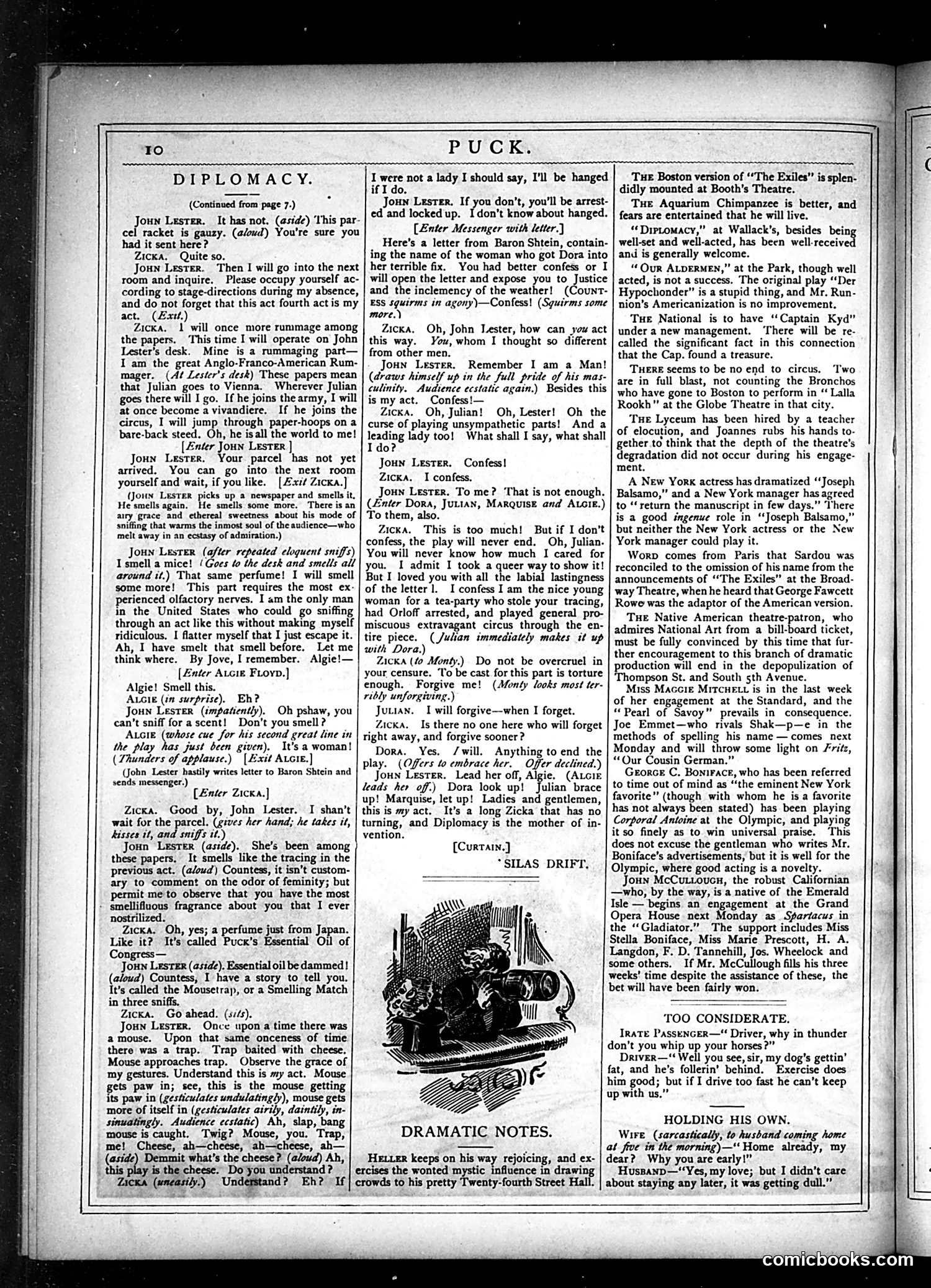
This page from *Puck* contains a satirical play script titled "Diplomacy" (continued from a previous page). The humor centers on a romantic entanglement: character John Lester has carelessly revealed confidential information about a woman named Dora to Baron Stein, creating diplomatic complications. The satire mocks social pretense and male foolishness—Lester must navigate increasingly absurd excuses and confessions to manage the scandal. The dialogue emphasizes how one indiscretion spirals into elaborate cover-ups, a common theme in Victorian-era farce. The right column contains theater reviews and notes about contemporary Broadway productions, typical *Puck* content mixing theatrical criticism with gossip about actors and New York entertainment venues.
📄 Transcribed text from this page (OCR, searchable)
Machine-transcribed from the original scan — historical spelling and the odd misread are preserved.
PUCK. DIPLOMACY. (Continued from page 7.) Joun Lester. It has not. (aside) ‘This par- cel racket is gauzy. (a/oud) You're sure you had it sent here? Zicka. Quite so. Joun Lester. Then I will go into the next room and inquire. Please occupy yourself ac- cording to stage-directions during my absence, and do not forget that this act fourth act is my act. (£xtt.) Zicka. 1 will once more rummage among the papers. This time I will operate on John Lester's desk. Mine is a rummaging part— I am the great Anglo-Franco-American Rum- mager. (At Lester's desk) These papers mean that Julian goes to Vienna. Wherever Julian goes there will I go. If he joins the army, I will at once become a vivandiere. If he joins the circus, I will jump through paper-hoops on a bare-back steed. Oh, he isall the world to me! [Znter Joun Lester } Joun Lester. Your parcel has not yet arrived. You can go into the next room yourself and wait, if you like. [xi Zicxa.] (Joun Lester picks up a newspaper and smells it, He'smells again. He smells some more. There is an airy grace and ethereal sweetness about his mode of sniffing that warms the inmost soul of the audience—who melt away in an ecstasy of admiration.) Joun Lester (after repeated eloquent sniffs) I smell a mice! (Goes to the desk and smells all around it.) That same perfume! I will smell some more! This part requires the most ex- perienced olfactory nerves. I am the only man in the United States who could go sniffing through an act like this without making myself ridiculous. I flatter myself that I just escape it. Ah, I have smelt that smell before. Let me think where. By Jove, I remember. Algie!— [Zater Avcie Froyp.] Algie! Smell this. Avoie (in surprise). Eh? Joun Lester (impatiently). Oh pshaw, you can’t sniff for a scent! Don't you smell? ALGIE (whose cue for his second great line in the play has just been given). It's a woman! (Thunders of applause.) [Exit Acie.) (John Lester hastily writes letter to Baron Shtein and sends messenger.) [Enter Zicxa.] Zicxa. Good by, John Lester. I shan’t wait for the parcel. (gives her hand; he takes it, Kisses it, and sniffs it.) Joun Lester (aside). She’s been among these papers. It smells like the tracing in the previous act. (a/oud) Countess, it isn’t custom- ary to comment on the odor of feminity; but permit me to observe that you have the most + smellifluous fragrance about you that I ever nostrilized. Zicka. Oh, yes; a perfume just from Japan. Like it? It’s' called Puck’s Essential Oil of Congress— Joun Lester (assde). Essential oil be dammed! (aloud) Countess, I have a story to tell you. It’s called the Mousetrap, or a Smelling Match in three sniffs. Zicka. Go ahead. (si/s). Joun Lester. Once upon a time there was a mouse. Upon that same onceness of time. there was a trap. Trap baited with cheese. Mouse approaches trap. Observe the grace of my gestures. Understand this is my act. Mouse gets paw in; see, this is the mouse getting its paw in (gesticulates undulatingly), mouse gets more of itself in (gesticulates airily, daintily, in- sinualingly. Audience ecstatic) Ah, slap, bang mouse is caught. Twig? Mouse, you. Trap, me! Cheese, ah—cheese, ah—cheese, ah— (aside) Demmit what's the cheese? (aloud) Ah, this play is the cheese. Do you understand? Zick (uneasily.) Understand? Eh? If I were not a lady I should say, I'll be hanged if I do. Joun Lester. If you don’t, you'll be arrest- ed and locked up. Idon’t know about hanged. (Enter Messenger with letter.) Here's a letter from Baron Shtein, contain- ing the name of the woman who got Dora into her terrible fix. You had better confess or I will open the letter and expose you to Justice and the inclemency of the weather! (Count- ESS squirms in agony)—Confess! (Sguirms some more.) Zicxa. Oh, John Lester, how can you act this way. You, whom I thought so different from other men. Joun Lester. Remember I am a Man! (draws himself up in the full pride of his mas- culinity, Audience ecstatic again.) Besides this is my act. Confess!— Zicxa. Oh, Julian! Oh, Lester! Oh the curse of playing unsympathetic parts! And a leading lady too! What shall I say, what shall Ido? Joun Lester. Confess! Zicka. I confess. Joun Lester. To me? That is not enough. (Enter Dora, Juttian, MaRQUISE and ALGIE.) To them, also. Zicka. This is too much! But if I don’t confess, the play will never end. Oh, Julian. You will never know how much I cared for you. I admit I took a queer way to show it! But I loved you with all the labial lastingness of the letter 1. I confess I am the nice young woman for a tea-party who stole your tracing, had Orloff arrested, and played general pro- miscuous extravagant circus through the en- tire piece. (Julian immediately makes it up with Dora.) Zicka (fo Monty.) Do not be overcruel in your censure. To be cast for this part is torture enough. Forgive me! (Aonty looks most ter- ribly unforgiving.) Juuian. I will forgive—when I forget. Zicka. Is there no one here who will forget right away, and forgive sooner ? Dora. Yes. /will. Anything to end the play. (Offers to embrace her. Offer declined.) Joun Lester. Lead her off, Algie. (ALGIE leads her off.) Dora look up! folian brace up! Marquise, let up! Ladies and gentlemen, this is my act. It’s a long Zicka that has no turning, and Diplomacy is the mother of in- vention. (Currain.] “SILAS DRIFT, DRAMATIC NOTES. Hexter keeps on his way rejoicing, and ex- ercises the wonted mystic influence in drawin; crowds to his pretty Twenty-fourth Street Hall. Tue Boston version of ‘The Exiles” is splen- didly mounted at Booth's Theatre. Tue Aquarium Chimpanzee is better, and fears are entertained that he will live. “Dipvomacy,” at Wallack’s, besides bein, well-set and well-acted, has been well-received and is generally welcome. “Our ALDERMEN,” at the Park, though well acted, is not a success. ‘The original play “Der Hypochonder” is a stupid thing, and Mr. Run- nion’s Americanization is no improvement, Tue National is to have ‘Captain Kyd” under a new management. There will be re- called the significant fact in this connection that the Cap. found a treasure. ‘THERE seems to be no end to circus. ‘Two are in full blast, not counting the Bronchos who have gone to Boston to perform in “ Lalla Rookh” at the Globe Theatre in that city. ‘Tue Lyceum has been hired by a teacher of elocution, and Joannes rubs his hands to- gether to think that the depth of the theatre's degradation did not occur during his engage- ment. A New York actress has dramatized “Joseph Balsamo,” and a New York manager has agreed to ‘return the manuscript in few days.” There is a good ingenue role in ‘Joseph Balsamo,” but neither the New York actress or the New York manager could play it. Worp comes from Paris that Sardou was reconciled to the omission of his name from the announcements of “The Exiles” at the Broad- way Theatre, when he heard that George Fawcett Rowe was the adaptor of the American version. Tue Native American theatre-patron, who admires National Art from a bill-board ticket, must be fully convinced by this time that fur- ther encouragement to this branch of dramatic production will end in the depopulization of ‘Thompson St. and South sth Avenue. Miss Maccie Mitcuett is in the last week of her engagement at the Standard, and the “Pearl of Savoy” prevails in consequence. Joe Emmet—who rivals Shak—p—e in the methods of spelling his name — comes next Monday and will throw some light on Fritz, “Our Cousin German.” Georce C. Bonirace, who has been referred to time out of mind as “the eminent New York favorite” (though with whom he isa favorite has not always been stated) has been playing Corporal Antoine at the Olympic, and playing it so finely as to win universal praise. This does not excuse the gentleman who writes Mr. Boniface’s advertisements, but it is well for the Olympic, where good acting is a novelty. Joun McCuttoucn, the robust Californian —who, by the way, is a native of the Emerald Isle — begins an engagement at the Grand Opera House next Monday as Spartacus in the “Gladiator.” The support includes Miss Stella Boniface, Miss Marie Prescott, H. A. Langdon, F. D. Tannehill, Jos. Wheelock and some others. If Mr. McCullough fills his three weeks’ time despite the assistance of these, the bet will have been fairly won. TOO CONSIDERATE. Irate PasseNGER— Driver, why in thunder don’t you whip sp your horses ?” ly Driver—‘‘ Well you see, sir, my dog's gettin’ fat, and he’s follerin’ behind. Exercise does him good; but if I drive too fast he can’t keep up with us.” HOLDING HIS OWN. Wire (sarcastically, to husband coming home at five in the morning)—“‘ Home already, my dear? Why you are early!” Huspanp—“‘Yes, my love; but I didn’t care about staying any later, it was getting dull.”