
Puck, 1877-09-19 · page 14 of 16
Puck — September 19, 1877 — page 14: what you’re looking at
What you’re looking at
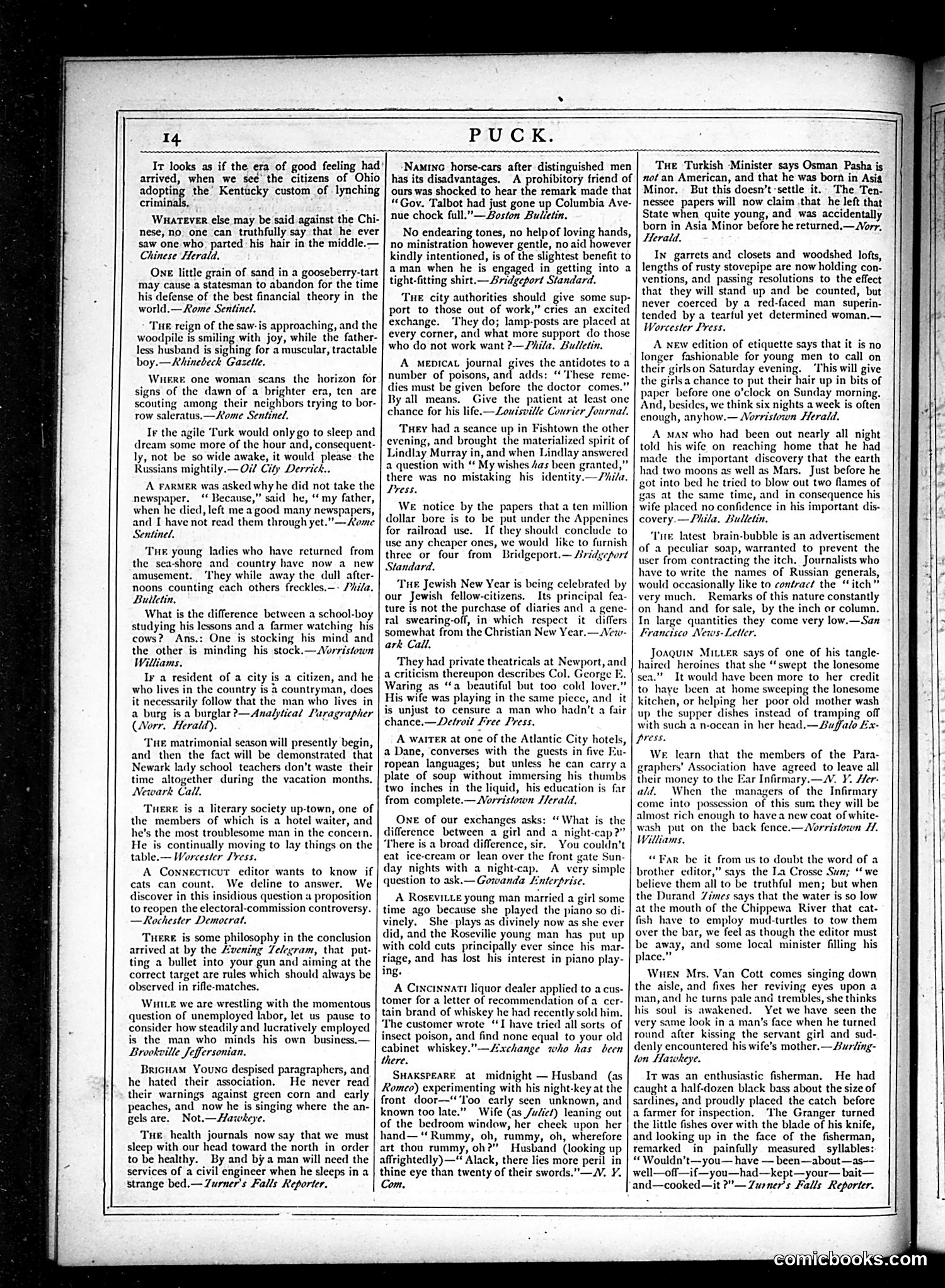
This page is primarily **text content** — a collection of brief satirical commentary items and anecdotes typical of Puck's humor section, rather than illustrated political cartoons. The items mock various contemporary subjects: Ohio's execution methods, Talbot's claims about colonial origins, newspaper exaggeration about poisons, etiquette advice, theatrical reviews, and domestic situations (marital disputes, servants, etc.). **Key satirical targets** include journalistic sensationalism, social pretension, and human folly in everyday situations. The humor relies on wordplay and social observation rather than visual caricature. Without identifying specific illustrations (which appear minimal on this page), the overall effect is **light, gossipy satire** aimed at middle-class readers—critiquing newspapers, manners, and absurd public claims through accumulated anecdotes rather than grand political commentary.
📄 Transcribed text from this page (OCR, searchable)
Machine-transcribed from the original scan — historical spelling and the odd misread are preserved.
PUCK. Ir looks as if the era of good feeling had arrived, when we see’ the citizens of Ohio adopting: the’ Kentucky custom of lynching criminals, Wuatever else may be said against the Chi- nese, no. one can truthfully say that he ever saw one who parted his hair in the middle.— Chinese Herald. One little grain of sand in a gooseberry-tart may cause a statesman to abandon for the time his defense of the best financial theory in the world.—Rome Sentinel. ‘Tue reign of the saw-is approaching, and the woodpile is smiling with joy, while the father- less husband is sighing for a muscular, tractable boy.—Xhinebeck Gazette. Where one woman scans the horizon for signs of the dawn of a brighter era, ten are scouting among their neighbors trying to bor- row saleratus.—Home Sentinel. Ir the agile ‘Turk would only go to sleep and dream some more of the hour and, consequent- ly, not be so wide awake, it would please the Russians mightily.— Oi? City Derrick... A FARMER was asked why he did not take the newspaper. “ Because,” said he, “ my father, when he died, left me a good many newspapers, and I have not read them through yet."—Xome Sentinel, ‘Tue young ladies who have returned from the sea-shore and country have now a new amusement. ‘hey while away the dull after- noons counting each others freckles.—» ila. Bulletin, What is the difference between a school-boy studying his lessons and a farmer watching his cows? Ans.: One is stocking his mind and the other is minding his stock.—Norristown Williams, Ir a resident of a city is a citizen, and he who lives in the country is 4 countryman, does. it necessarily follow that the man who lives in a burg isa burglar?—Analytical Paragrapher (Morr. Herald). ‘THe matrimonial season will presently begin, and then the fact will be demonstrated that Newark lady school teachers don't waste their time altogether during the vacation months. Newark Call. ‘Tuere is a literary society up-town, one of the members of which is a hotel waiter, and he’s the most troublesome man in the concern. He is continually moving to lay things on the table.— Worcester Press. A Connecticut editor wants to know if cats can count. We deline to answer. We discover in this insidious question « proposition to reopen the electoral-commission controversy. —Rochester Democrat. ‘Tuere is some philosophy in the conclusion arrived at by the Evening Zelegram, that put- ting a bullet into your gun and aiming at the correct target are rules which should always be observed in rifle-matches. WHILE we are wrestling with the momentous question of unemployed labor, let us pause to consider how steadily and lucratively employed is the man who minds his own business.— Brookville Jeffersonian. Bricuam Youn despised paragraphers, and he hated their association. He never read their warnings against green corn and_ carly peaches, and’ now he is singing where the an- gels are. Not.—Haivkeye. Tue health journals now say that we must sleep with our head toward the north in order to be healthy. By and by a man will need the services of a civil engineer when he sleeps in a strange bed.— Zurner’s Falls Reporter. Namino horse-cars after distinguished men has its disadvantages. A prohibitory friend of ours was shocked to hear the remark made that “Gov. Talbot had just gone up Columbia Ave- nue chock full.”—Boston Bulietin. No endearing tones, no help of loving hands, no ministration however gentle, no aid however kindly intentioned, is of the slightest benefit to aman when he is engaged in getting into a tight-fitting shirt.— Bridgeport Standard. Tue city authorities should give some sup- port to those out of work,” cries an excited exchange. ‘They do; lamp-posts are placed at every corner, and what more support do those who do not work want ?—Shila. Bulletin. A MEDICAL journal gives the antidotes to a number of poisons, and adds: ‘These reme- dies must be given before the doctor comes.” By all means. Give the patient at least onc chance for his life.—Louisville Courier Journal. Tuey had a seance up in Fishtown the other evening, and brought the materialized spirit of Lindlay Murray in, and when Lindlay answered a question with “ My wishes /as been granted,” there was no mistaking his identity.—/%i/a. Dress. We notice by the papers that a ten million dollar bore is to be put under the Appenines for railroad use. If they should conclude to use any cheaper ones, we would like to furnish three or four from Bridgeport.— Bridgeport Standard. ‘Tue Jewish New Year is being celebrated by our Jewish fellow-citizens. Its principal fe ture is not the purchase of diaries and a gene- ral swearing-off, in which respect it differs somewhat from the Christian New Year.—Aew- ark Call. They had private theatricals at Newport, and a criticism thereupon describes Col. George F Waring as ‘a beautiful but too cold lover.’ His wife was playing in the same piece, and it is unjust to censure a man who hadn't a fair chance.—Detroit Free Press. A waiter at one of the Atlantic City hotels, a Dane, converses with the guests in five Eu- ropean languages; but unless he can carry a plate of soup without immersing his thumbs two inches in the liquid, his education is far from complete.—orristown Herald. One of our exchanges asks: ‘What is the difference between a girl and a night-cap?” ‘There is a broad difference, sir. You couldn't eat ice-cream or lean over the front gate Sun- day nights with a night-cap. A very simple question to ask.— Gowanda Enterprise. A RoseviLte young man married a girl some time ago because she played the piano so di- vinely. She_ plays as divinely now as she ever did, and the Roseville young man has put up with cold cuts principally ever since his mar- riage, and has lost his interest in piano play- ing. A Cincinnati liquor dealer applied to acus- tomer for a letter of recommendation of a cer- tain brand of whiskey he had recently sold him. ‘The customer wrote “TI have tried all sorts of insect poison, and find none equal to your old cabinet whiskey."—Z'xchange who has been there. SwakspearE at midnight — Husband (as Romeo) experimenting with his night-key at the front door—‘‘l'oo carly seen unknown, and known too late.” Wife (as /uéiet) leaning out of the bedroom window, her cheek upon her hand— ‘Rummy, oh, rummy, oh, wherefore art thou rummy, oh?” Husband (looking up affrightedly)—* Alack, there lies more peril in Tue Turkish Minister says Osman Pasha is not an American, and that he was born in Asia Minor. But this doesn’t-settle it. The Ten- nessee papers will now claim that he left that State when quite young, and was accidentally born in Asia Minor before he returned.—Norr, Herald. In garrets and closets and woodshed lofts, lengths of rusty stovepipe are now holding con- ventions, and passing resolutions to the effect that they will stand up and be counted, but never coerced by a red-faced man superin- tended by a tearful yet determined woman,— Worcester Press. A new edition of etiquette says that it is no longer fashionable for young men to call on their girlson Saturday evening. ‘This will give the girlsa chance to put their hair up in bits of paper before one o'clock on Sunday morning. And, besides, we think six nights a week is often enough, anyhow.— Norristown Herald. A man who had been out nearly all night told his wife on reaching home that he had made the important discovery that the earth had two moons as well as Mars, Just before he got into bed he tried to blow out two flames of gas at the same time, and in consequence his wife placed no confidence in his important dis- covery.—Shila. Bulletin. ‘Tie latest brain-bubble is an advertisement of a peculiar soap, warranted to prevent the user from contracting the itch. Journalists who have to write the names of Russian generals, would occasionally like to contract the “itch” very much. Remarks of this nature constantly on hand and forsale, by the inch or column. In large quantities they come very low.—San Francisco News-Letter, Joaquin Mitter says of one of his tangle- haired heroines that she “swept the lonesome sea.” It would have been more to her credit to haye been at home sweeping the lonesome kitchen, or helping her poor old mother wash up the supper dishes instead of tramping off with such a n-ocean in her head.—Buffalo E press. We learn that the members of the Para- graphers’ Association have agreed to leave all their money to the Ear Infirmary.—. Y. Her- ald. When the managers of the Infirmary come into possession of this sum they will be almost rich enough to havea new coat of white- wash put on the back fence.—Norristown H. Williams. “Far be it from us to doubt the word of a brother editor,” says the La Crosse Sun; “we believe them all to be truthful men; but when the Durand Zimes says that the water is so low at the mouth of the Chippewa River that cat- fish have to employ mud-turtles to tow them over the bar, we feel as though the editor must be away, and some local minister filling his place.” Wuen Mrs. Van Cott comes singing down, the aisle, and fixes her reviving eyes upon a man, and he turns pale and trembles, she thinks his soul is awakened. Yet we have seen the very same look in a man’s face when he turned round after kissing the servant girl and sud- denly encountered his wife’s mother.—Burling- ton Hawkeye. It was an enthusiastic fisherman. He had caught a half-dozen black bass about the size of sardines, and proudly placed the catch before a farmer for inspection. ‘The Granger turned the little fishes over with the blade of his knife, and looking up in the face of the fisherman, remarked in painfully measured syllables: “ Wouldn’t—you— have — been—about—as—- well—off—if—you—had—kept—your— bait. thine eye than twenty of their swords.”—J. ¥. Com. and—cooked—it ?”— Zusner’s Falls Reporter.