
Puck, 1877-09-19 · page 12 of 16
Puck — September 19, 1877 — page 12: what you’re looking at
What you’re looking at
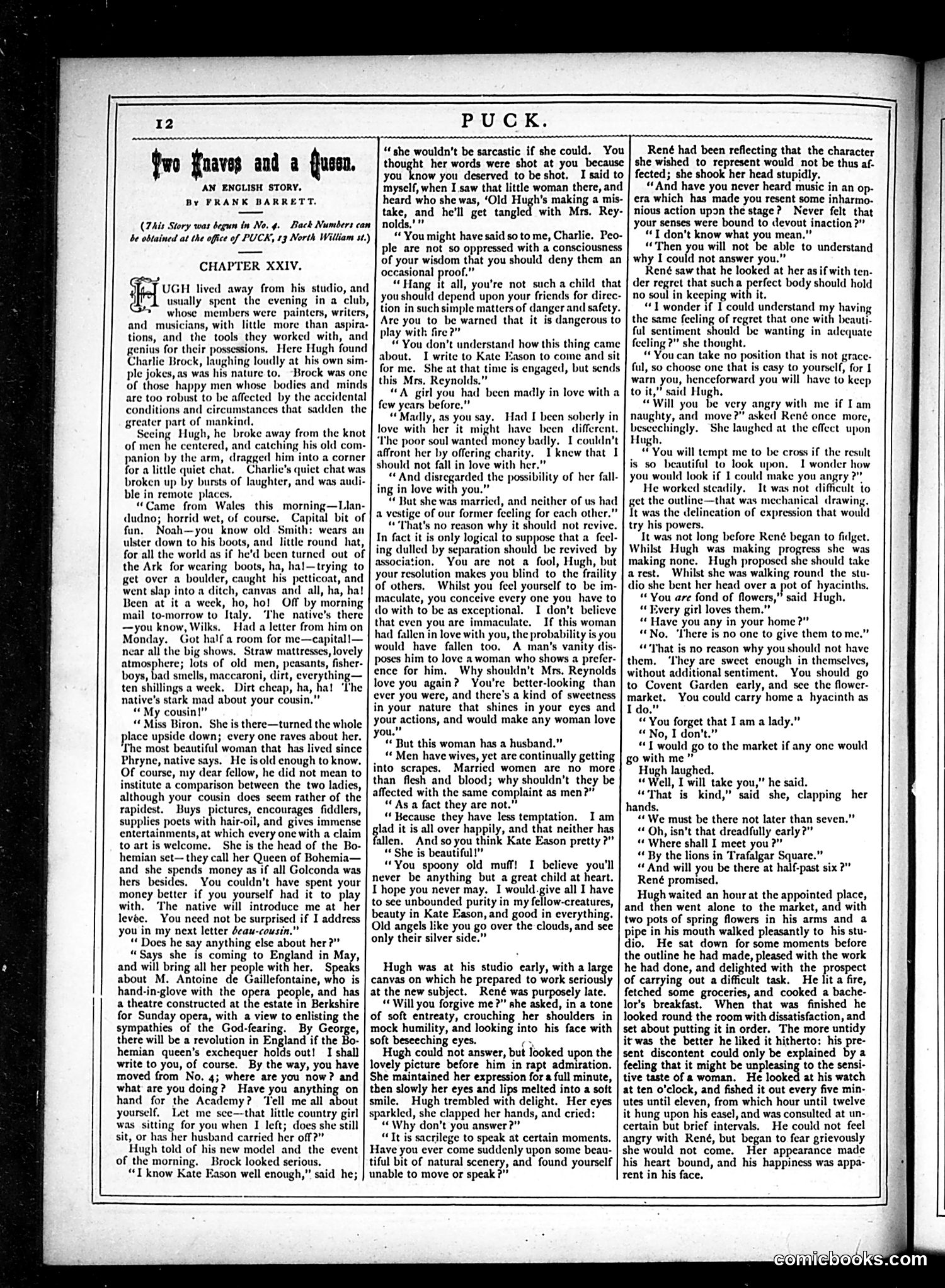
This page contains the continuation of a serialized story titled "Two Knaves and a Queen" by Frank Barrett, labeled Chapter XXIV. It appears to be primarily text rather than a political cartoon—a narrative fiction piece rather than satirical commentary. The story involves romantic drama: Hugh, an artist, receives a visit from a woman named Rene, sparking jealousy and emotional conflict with another character (Kate Eason). The dialogue centers on themes of love, jealousy, artistic life, and social propriety among bohemian artists in what appears to be Victorian-era London. Without visible caricatures or political references in the image itself, this reads as serialized fiction entertainment rather than satire. The "Queen" in the title likely refers to a woman central to the plot rather than actual royalty.
📄 Transcribed text from this page (OCR, searchable)
Machine-transcribed from the original scan — historical spelling and the odd misread are preserved.
12 PUCK. Guo faaves and a fuse, AN ENGLISH STORY. By FRANK BARRETT. (7his Story was begun in No. 4. Back Numbers can be obtained at the office of PUCK, 13 North William st.) CHAPTER XXIV. UGH lived away from his studio, and usually spent the evening in a club, whose members were painters, writers, and musicians, with little more than aspira- tions, and the tools they worked with, and genius for their possessions. Here Hugh found Charlie Brock, laughing loudly at his own si ple jokes, as was his nature to, “Brock was onc of those happy men whose bodies and minds are too robust to be affected by the accidental conditions and circumstances that sadden the greater part of mankind. Seeing Hugh, he broke away from the knot of men he centered, and catching his old com- panion by the arm, ‘dragged him into a corner for a little quiet chat. Charlie's quiet chat was broken up by bursts of laughter, and was audi- ble in remote places, “Came from Wales this morning—Llan- dudno; horrid wet, of course. Capital bit of fun, Noah—you know old ith: wears an ulster down to his boots, and little round hat, for all the world as if he'd been turned out of the Ark for wearing boots, ha, hal—trying to get over a boulder, caught his petticoat, and went slap into a ditch, canvas and all, ha, ha! Been at it a week, ho, ho! Off by morning mail to-morrow to Italy, The native’s there —you know, Wilks, Had a letter from him on Monday. Got half a room for me—capital! near all the big shows. Straw mattresses, lovely atmosphere; lots of old men, peasants, fisher- boys, bad smells, maccaroni, dirt, everything— ten shillings a week. Dirt cheap, ha, ha! ‘The native's stark mad about your cousin.” “ My cousin!” ‘Miss Biron. She is there—turned the whole place upside down; every one raves about her. The most beautiful woman that has lived since Phryne, native says. He is old enough to know. Of course, my dear fellow, he did not mean to institute a comparison between the two ladies, although your cousin does seem rather of the rapidest. Buys pictures, encourages fiddlers, supplies poets with hair-oil, and gives immense entertainments, at which every one with a claim to art is welcome. She is the head of the Bo- hemian set— they call her Queen of Bohemia— and she spends money as if all Golconda was hers besides. You couldn’t have spent your money better if you yourself had it to play with, The native will introduce me at her levoe. You need not be surprised if I address you in my next letter deau-cousin.” “ Does he say anything else about her?” “Says she is coming to England in May, and will bring all her people with her, Speaks about M. Antoine de Gaillefontaine, who is hand-in-glove with the opere people, and has a theatre constructed at the estate in Berkshire for Sunday opera, with a view to enlisting the sympathies of the God-fearing. By George, there will be a revolution in England if the Bo- hemian queen's exchequer holds out! I shall write to you, of course. By the way, you have moved from No. 4; where are you now? and what are you doing? Have you anything on hand for the Academy? ‘Tell me all about yourself, Let me sce—that little country girl was sitting for you when I left; does she still sit, or has her husband carried her off?” Hugh told of his new model and the event of the morning. Brock looked serious. “TI know Kate Eason well enough,” said he; “she wouldn’t be sarcastic if she could. You thought her words were shot at you because you ‘aor you deserved to be shot. I said to myself, when I saw that little woman there, and heard who she was, ‘Old Hugh’s making a mis- take, and he'll get tangled with Mrs. Rey- nolds.’”” “ You might have said so to me, Charlie. Peo- ple are not so oppressed with a consciousness of your wisdom that you should deny them an occasional proof.” “ Hang it all, you're not such a child that you should depend upon your friends for direc- tion in such simple matters of danger and safety. Are you to be warned that it is dangerous to play ‘with fire?” “ You don’t understand how this thing came about. I write to Kate Eason to come and sit for me. She at that time is engaged, but sends this Mrs, Reynolds.” “A girl you had been madly in love with a few ycars before.” “Madly, as you say. Had I been soberly in love with her it might have been different. ‘The poor soul wanted money badly. I couldn't affront her by offering charity. I knew that I should not fall in love with h “And disregarded the possibility of her fall- ing in love with you.” “ But she was married, and neither of us had a vestige of our former feeling for cach other." “ That's no reason why it should not revive. In fact it is only logical to suppose that a feel ing dulled by separation should. be revived by association. You are not a fool, Hugh, but your resolution makes you blind to the fraility of others, Whilst you feel yourself to be im- maculate, you conceive every one you have to do with to be as exceptional. I don’t believe that even you are immaculate. If this woman had fallen in love with you, the probability is you would have fallen too, A man's vanity dis- poses him to love a woman who shows a prefer- ence for him. Why shouldn’t Mrs. Reynolds love you again? You're better-looking than ever you were, and there's a kind of sweetness in your nature that shines in your cycs and your actions, and would make any woman love ou.” “ But this woman has a husband." “ Men have wives, yet are continually getting into scrapes. Married women are no. more than flesh and blood; why shouldn’t they be affected with the same complaint as men?” “As a fact they are not.” “ Because they have less temptation. I am lad it is all over happily, and that neither has n. And so you think Kate Eason pretty ?” She is beautiful!” “You spoony old muff! I believe you'll never be anything but _a great child at heart. I hope you never may, I would.give all I have to see unbounded purity in my fellow-creatures, beauty in Kate Eason, and good in everything. Old angels like you go over the clouds, and see only their silver side.” Hugh was at his studio early, with a large canvas on which he prepared to work seriously at the new subject. René was purposely late. “Will you forgive me?” she xed, ina tone of soft entreaty, crouching her shoulders in mock humility, and looking into his face with soft beseeching eyes. cy Hugh could not answer, but looked upon the lovely picture before him in rapt admiration. She maintained her expression for a full minute, then slowly her eyes and lips melted into a soft smile, Hugh trembled with delight. Her eyes sparkled, she clapped her hands, and cried: “Why don’t you answer?” “Tt is sacrilege to speak at certain moments. Have you ever come suddenly upon some beau- tiful bit of natural scenery, and found yourself unable to move or speak ?” René had been reflecting that the character she wished to represent would not be thus af- fected; she shook her head stupidly. “And have you never heard music in an op- era which has made you resent some inharmo- nious action upon the stage? Never felt that your senses were bound to devout inaction?” “T don’t know what you mean.” “Then you will not be able to understand why I could not answer you.” René saw that he looked at her as if with ten- der regret that sucha perfect body should hold no soul in keeping with it. “1 wonder if I could understand my having the same fecling of regret that one with beauti- ful sentiment should be wanting in adequate feeling ?” she thought. “You can take no position that is not grace- ful, so choose one that is easy to yourself, for I warn you, henceforward you will have to keep to it,” said Hugh, “Will you be very angry with me if Iam naughty, and move?” asked René once more, bescechingly. She laughed at the effect upon Hugh. “You will tempt me to be cross if the result is so beautiful to look upon. I wonder how you would look if I could make you angry ?” He worked steadily, It was not difficult to get the outline—that was mechanical drawing. It was the delineation of expression that would try his powers. It was not long before René began to fidget. Whilst. Hugh was making progress she was making none. Hugh proposed she should take arrest, Whilst she was walking round the stu- dio she bent her head over a pot of hyacinths, “You are fond of flowers,” said Hugh. “ Every girl loves them.” “ Have you any in your home?” “No, ‘There is no one to give them to me.” “That is no reason why you should not have them. ‘I'hey are swect cnough in themselves, without additional sentiment. You should go to Covent Garden early, and see the flower- market. You could carry home a hyacinth as Ido." “You forget that Iam a lady.” “No, I don’t.” “ T would go to the market if any one would go with me” Hugh laughed. “Well, I will take you,” he said. “That is kind,” said she, clapping her hands, “We must be there not later than seven.” “ Oh, isn’t that dreadfully carly?” “ Where shall I meet you ?” « By the lions in Trafalgar Square.” “And will you be there at half-past six?” René promised. Hugh waited an hour at the appointed place, and then went alone to the market, and with two pots of spring flowers in his arms and a pipe in his mouth walked pleasantly to his stu- dio, He sat down for some moments before the outline he had made, pleased with the work he had done, and delighted with the prospect of carrying out a difficult task. He lit a fire, fetched some groceries, and cooked a bache- lor's breakfast. When that was finished he looked round the room with dissatisfaction, and set about putting it in order. The more untidy it was the better he liked it hitherto: his pre- sent discontent could only be explained by a feeling that it might be unpleasing to the sensi- tive taste of a woman. He looked at his watch at ten o'clock, and fished it out every five min- utes until eleven, from which hour until twelve it hung upon his easel, and was consulted at un- certain but brief intervals, He could not feel angry with René, but began to fear grievously she would not come. Her appearance made his heart bound, and his happiness was appa- rent in his face.