
Puck, 1877-05 · page 12 of 16
Puck — May 1877 — page 12: what you’re looking at
What you’re looking at
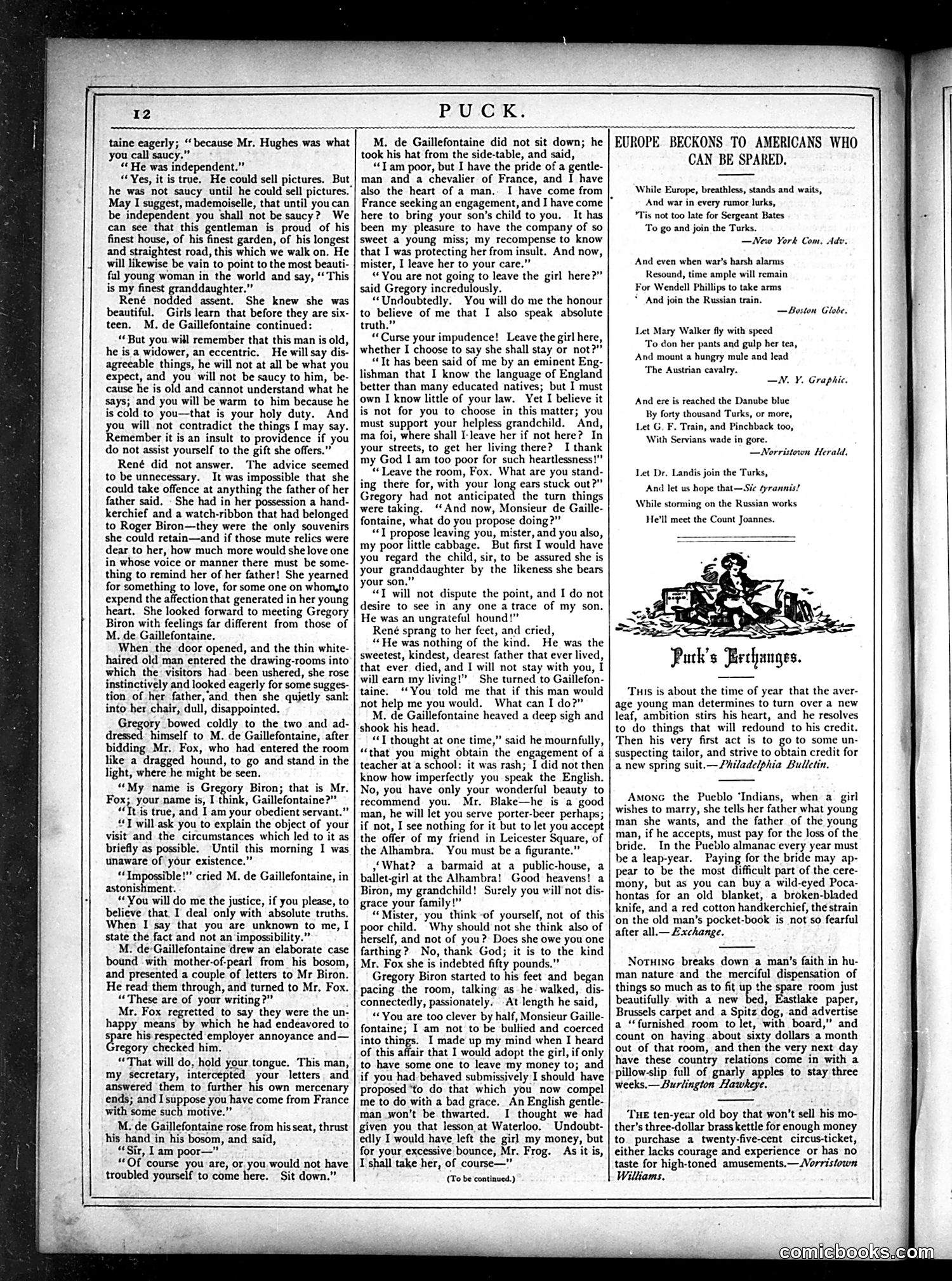
This page contains a serialized story ("To be continued") rather than political cartoons. The narrative involves a conflict between a French aristocrat (M. de Gaillefontaine) and an English gentleman over a young woman and her illegitimate child. The right side features "Puck's Birthings"—brief satirical commentary on contemporary social issues, including observations about young men's life choices, Pueblo Indian marriage customs, and domestic frustrations (a husband's complaint about his wife's housekeeping standards using humor). The page primarily functions as literary content with light social satire rather than political commentary, typical of Puck's mixed editorial approach combining longer fiction with topical humor snippets.
📄 Transcribed text from this page (OCR, searchable)
Machine-transcribed from the original scan — historical spelling and the odd misread are preserved.
PUCK. taine eagerly; “because Mr. Hughes was what you call saucy.” “ He was independent.” “Yes, it is true. He could sell pictures. But he was not saucy until he could sell pictures.” May I suggest, mademoiselle, that until youcan be independent you shall not be saucy? We can see that this gentleman is proud of his finest house, of his finest garden, of his longest and straightest road, this which we walk on. He will likewise be vain to point to the most beauti- fal young woman in the world and say, “This is my finest granddaughter.” René nodded assent. She knew she was beautiful. Girls learn that before they are six- teen. M. de Gaillefontaine continued: “But you widl remember that this man is old, he is a widower, an eccentric. He will say dis- agreeable things, he will not at all be what you expect, and you will not be saucy to him, be- cause he is old and cannot understand what he says; and you will be warm to him because he is cold to you—that is your holy duty. And you will not contradict the things I may say. Remember it is an insult to providence if you do not assist yourself to the gift she offers.” René did not answer. The advice seemed to be unnecessary. It was impossible that she could take offence at anything the father of her father said. - She had in her possession a hand- kerchief and a watch-ribbon that had belonged to Roger Biron—they were the only souvenirs she could retain—and if those mute relics were dear to her, how much more would she love one in whose voice or manner there must be some- thing to remind her of her father! She yearned for something to love, for some one on whom,to expend the affection that generated in her young heart. She looked forward to meeting Gregory Biron with feelings far different from those of M. de Gaillefontaine. When the door opened, and the thin white- haired old man entered the drawing-rooms into which the visitors had been ushered, she rose instinctively and looked eagerly for some sugges- tion of her father,‘and then she quietly sank into her chair, dull, disappointed. Gregory bowed coldly to the two and ad- dre himself to M. de Gaillefontaine, after bidding Mr. Fox, who had entered the room like a dragged hound, to go and stand in the light, where he might be seen. “My name is Gregory Biron; that is Mr. Fox; your name is, I think, Gaillefontaine?” “Ttis true, and I am your obedient servant.” “I will ask you to explain the object of your visit and the circumstances which led to it as briefly as possible. Until this morning I was unaware of your existence.” “Impossible!” cried M. de Gaillefontaine, in astonishment. “You will do me the justice, if you please, to believe that. I deal only with absolute truths. When I say that you are unknown to me, I state the fact and not an impossibility.” M. de:Gaillefontaine drew an elaborate case bound with mother-of-pearl from his bosom, and presented a couple of letters to Mr Biron. He read them through, and turned to Mr. Fox. “These are of your writing?” Mr. Fox regretted to say they were the un- happy means by which he had endeavored to spare his respected employer annoyance and— regory checked him. “That will do, hold your tongue. ‘This man, my secretary, intercepted your letters and answered them to further his own mercenary ends; and ap hee you have come from France with some such motive.” M. de Gaillefontaine rose from his seat, thrust his hand in his bosom, and said, “Sir, I am poor—” “Of course you are, or you, would not have. troubled yourself to come here. Sit down.” M. de Gaillefontaine did not sit down; he took his hat from the side-table, and said, “Tam poor, but I have the pride of a gentle- man and a chevalier of France, and I have also the heart of a man. I have come from France seeking an engagement, and I have come |" here to bring your son’s child to you. It has been my pleasure to have the company of so sweet a young miss; my recompense to know that I was protecting her from insult. And now, mister, I leave her to your care.” “You are not going to leave the girl here?” said Gregory incredulously. “Undoubtedly. You will do me the honour to believe of me that I also speak absolute truth.” “Curse your impudence! Leave the girl here, whether I choose to say she shall stay or not?” “Tt has been said of me by an eminent Eng- lishman that I know the language of England better than many educated natives; but I must own I know little of your law. Yet I believe it is not for you to choose in this matter; you must support your helpless grandchild. And, ma foi, where shall I-leave her if not here? In your streets, to get her living there? I thank my God | am too poor for such heartlessness!"” “Leave the room, Fox. What are you stand- ing thete for, with your long ears stuck out?” Gregory had not anticipated the turn things were taking. ‘And now, Monsieur de Gaille- fontaine, what do you propose doing?” “1 propose leaving you, mister, and you also, my poor little cabbage. But first I would have you regard the child, sir, to be assured she is your granddaughter by the likeness she bears your $ eh , “1 will not dispute the point, and I do not desire to see in any one atrace of my son. He was an ungrateful hound!” René sprang to her feet, and cried, “He was nothing of the kind. He was the sweetest, kindest, dearest father that ever lived, that ever died, and I will not stay with you, I will earn my living!” She turned to Gaillefon- taine. ‘You told me that if this man would not help me you would. What can I do?” M. de Gaillefontaine heaved a deep sigh and shook his head. “T thought at one time,” said he mournfully, “that you might obtain the engagement of a teacher at a school: it was rash; I did not then know how imperfectly you speak the English. No, you have only your wonderful beauty to recommend you. Mr. Blake—he is a good man, he will iet you serve porter-beer perhaps; if not, I see nothing for it but to let you accept the offer of my friend in Leicester Square, of the Alhambra. You must be a figurante.”” ;{What? a barmaid at a public-house, a ballet-girl at the Alhambra! Good heavens! a Biron, my grandchild! Surely you will not dis- grace your family!” “Mister, you think -of yourself, not of this poor child. Why should not she think also of herself, and not of you? Does she owe you one farthing? No, thank God; it is to the kind Mr. Fox she is indebted fifty pounds.” Gregory Biron started to his feet and began pacing the room, talking as he. walked, dis- connectedly, passionately. At length he said, “You are too clever by half, Monsieur Gaille- fontaine; I am not to be bullied and coerced into things. I made up my mind when I heard of this affair that 1 would adopt the girl, if only to have some one to leave my money to; and if you had behaved submissively I should have proposed *to do that which you now compel me to do with a bad grace. An English gentle- man won't be thwarted. I thought we had given you that lesson at Waterloo. Undoubt- edly I would have left the girl my money, but for your excessive bounce, Mr. Frog. As it is, I shall take her, of course—"”” (To be continued.) EUROPE BECKONS TO AMERICANS WHO CAN BE SPARED. While Europe, breathless, stands and waits, And war in every rumor lurks, "Tis not too late for Sergeant Bates To go and join the Turks. —New York Com, Adv. And even when war's harsh alarms Resound, time ample will remain For Wendell Phillips to take arms * And join the Russian train. —Boston Globe. Let Mary Walker fly with speed ‘To don her pants and gulp her tea, And mount a hungry mule and lead ‘The Austrian cavalry. —M. ¥. Graphic. And ere is reached the Danube blue By forty thousand Turks, or more, Let G, F. Train, and Pinchback too, With Servians wade in gore. —Norristown Herald. Let Dr. Landis join the Turks, And let us hope that—Sie tyrannis! While storming on the Russian works He'll meet the Count Joannes. Park's Bechanges. ‘Tuis is about the time of year that the aver- age young man determines to turn over a new leaf, ambition stirs his heart, and he resolves to do things that will redound to his credit. Then his very first act is to go to some un- suspecting tailor, and strive to obtain credit for a new spring suit.— Philadelphia Bulletin. AmonG the Pueblo ‘Indians, when a girl wishes to marry, she tells her father what young man she wants, and the father of the young man, if he accepts, must pay for the loss of the bride. In the Pueblo almanac every year must bea leap-year. Paying for the bride may ap- pear to be the most difficult part of the cere- mony, but as you can buy a wild-eyed Poca- hontas for an old blanket, a broken-bladed knife, and a red cotton handkerchief, the strain ‘on the old man’s pocket-book is not so fearful after all.— Exchange. Nortuinc breaks down a man’s faith in hu- man nature and the merciful dispensation of things so much as to fit up the spare room just beautifully with a new bed, Eastlake paper, Brussels carpet and a Spitz dog, and advertise a ‘furnished room to let, with board,” and count on having about sixty dollars a month out of that room, and then the very next day have these country relations come in with a pillow-slip full of gnarly apples to stay three weeks.— Burlington Hawkeye. ‘THE ten-year old boy that won't sell his mo- ther’s three-dollar brass kettle for enough money to. purchase a twenty-five-cent circus-ticket, either lacks courage and experience or has no taste for high-toned amusements.— Norristown Williams,