
Puck, 1877-05 · page 10 of 16
Puck — May 1877 — page 10: what you’re looking at
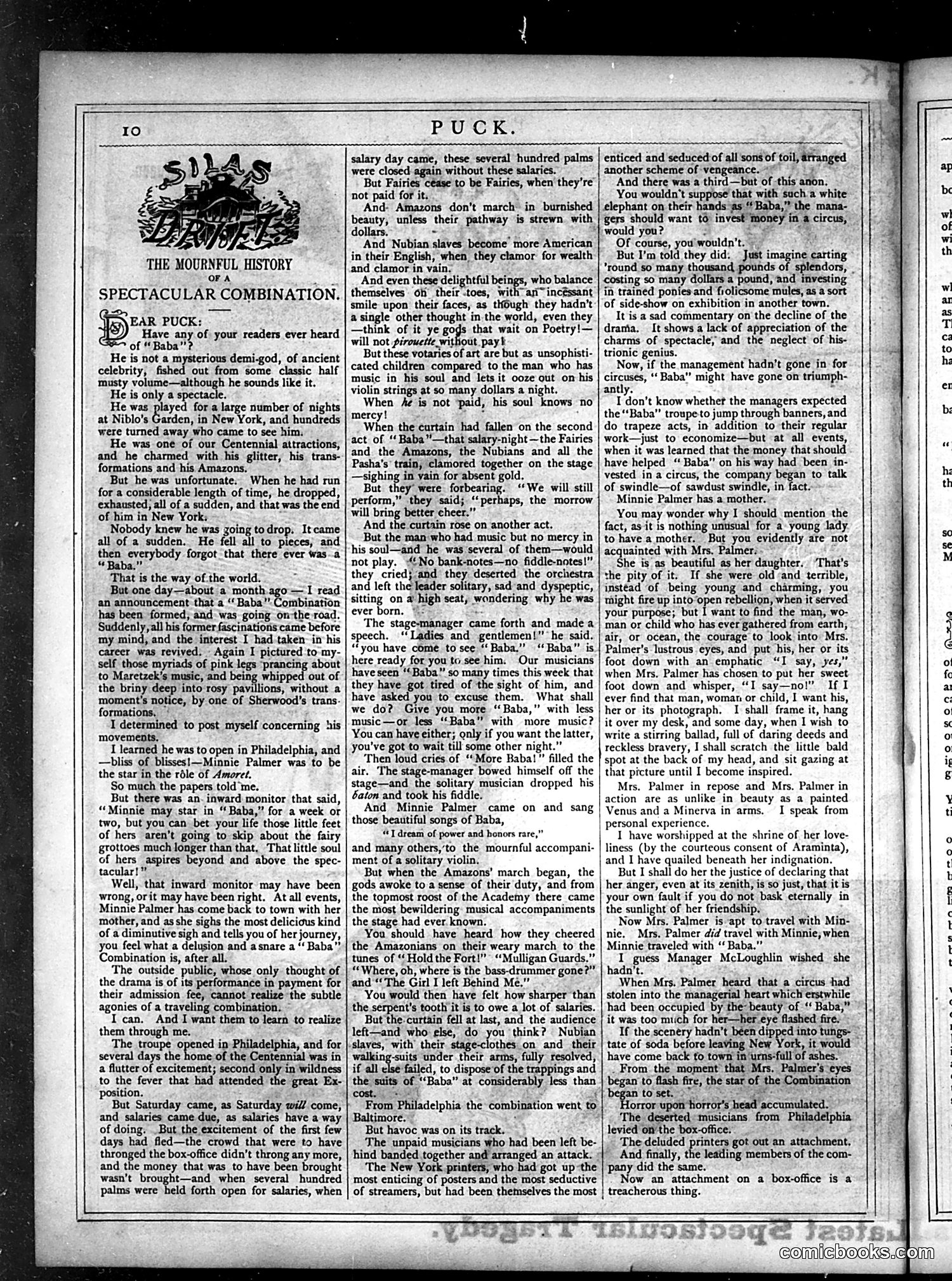
What you’re looking at
This page contains a lengthy article titled "The Mournful History of a Spectacular Combination," discussing a theatrical production called "Baba." The piece critiques the show's management and financial troubles. The article describes how "Baba"—featuring elaborate scenery, music, and performers including the "Amazons"—initially generated excitement but ultimately failed financially. The author blames poor management decisions, including excessive salary demands and inefficient spending, for the production's collapse. The satire targets theatrical mismanagement of the era: managers overspending on spectacle while neglecting practical economics, musicians and performers exploiting the system through wage demands, and the disconnect between artistic ambition and business reality. It's a morality tale about American theatrical excess and financial irresponsibility circa the 1880s-90s.
📄 Transcribed text from this page (OCR, searchable)
Machine-transcribed from the original scan — historical spelling and the odd misread are preserved.
PUCK. THE MOURNFUL HISTORY OFA SPECTACULAR COMBINATION. EAR PUCK: Have any of your readers ever heard of “Baba”? He is not a mysterious demi-god, of ancient celebrity, fished out from some classic half musty volume—although he sounds like it. He is only a spectacle. He was Raye for a large number of nights at Niblo’s Garden, in New York, and hundreds were turned away who came to see him. He was one of our Centennial attractions, and he charmed with his glitter, his trans- formations and his Amazons. But he was unfortunate. When he had run for a considerable length of time, he dropped, exhausted; all of a sudden, and that was the end of him in New York: Nobody knew he was ein todrop. Itcame all of a sudden. He fell to pieces; and then everybody forgot that there ever was.a “Baba.” That is the way of.the world. But one day—about a’ month.ago—I read an announcement that a ‘Baba’: Combination has been formed; and “was going on-the road. Suddenly,all his former fascinations came before my mind, and the interest I had taken- in his career was revived. - Again I pictured to-my- self those myriads of pink legs ‘prancing about to Maretzek’s music, and bein; Phipped ‘out of the briny deep’ into rosy pavillions, without a moment's notice, by one of Sherwood’s trans- formations, I determined to post myself concerning his movements, I learned he was to open in Philadelphia, and —bliss of blisses!—Minnie Palmer was to be the star in the réle of Amoret. So much the papers told‘me. But there was an. inward monitor that said, “Minnie may star in “Baba,” for a week or two, but you can bet your life those little feet of hers aren't going to skip about the fairy grottoes much longer than that, That little soul of hers aspires beyond and above the spec- tacular!” Well, that inward monitor may have been wrong, orit may have been right. At all events, Minnie Palmer has come back to town with her mother, and as she sighs the most delicious kind of a diminutive sigh and tells you of her journey, you feel what a delusion and asnare a“ Baba” Combination is, after all. The outside public, whose only thought of the drama is of its performance in payment for their admission fee, cannot realize the subtle agonies of a traveling combination: Ican. And I want them to learn to realize them through me. The troupe opened in Philadelphia, and for several days the home of the Centennial was in a flutter of excitement; second only in'wildness to the fever that had attended great Ex- ition. But Saturday came, as Saturday wii/ come, and salaries came due, as salaries have a way of doing. But the excitement of the first few days had fled—the crowd that were to have thronged the box-office didn’t throng any more, and the money that was to have been brought wasn’t brought—and when several hundred palms were held forth open for salaries, when [pi i salary day came, these several hundred palms were closed again without these salaries. But Fairies céase to be Fairies, when'they’re not paid for it. eae And- Amazons don’t march: in burnished beauty, unless their pathway ‘is strewn. with d lollars. x And Nubian slaves become’ more American in their English, when, they clamor for wealth and clamor in vain: And even these ‘delightful beings, who balance themselves: oh’ their .toes, with an~ incessant smile upon their faces, as thOugh they hadn’t a single other thought in.the world, even they —think of it ye 509s that wait on Poetry!— will not pirouette without pay But these votaries of art are but as unsophisti- cated children compared to the man who has music in his soul and lets it ooze out on his violin strings at so many dollars a night. When Ae is not ‘paid, his soul knows no mercy! 3 1 When the curtain had fallen on the second act of ‘ Baba”—that salary-night —the Fairies and the Amazons, the Nubians and all the Pasha’s’ trainy ‘clamored together on the stage —sighing in vain for absent gold. But they’ were forbearing. ‘We will still perform,” they said; “perhaps, the morrow will bring better cheer.” And the curtain rose on another act. But the man‘who had music but no mercy in his soul—and he was ‘several of them—would not play. “No bank-notes—no fiddle-notes!” they cried}‘and they deserted the orchestra and left the leader solitary, sad'and dyspeptic, sitting on a high seat, wondering why he was ever born. “> + The stage-manager came forth and made a speech. ‘Ladies and gentlemen!” “he said. “‘you have come to see “Baba,” “Baba” is. here ready for you to. see him. Our musicians have seen ‘*Baba” so many times this week that they have got tired of the sight of him, and have asked you to excuse them. What shall we do? Give you more “Baba,” with less music —or less ‘‘Baba” with more music? You can have either; gnly if you want the latter, you've got to wait till some other night.” Then loud cries.of ‘More Baba!” filled the air, ‘The stage-manager bowed himself off the stage—and the solitary musician dropped his baton and took his fiddle. And Minnie Palmer came on and sang those beautiful songs of Baba, 41 dream of power and honors rare,” and many others,’to the mournful accompani- ment of a solitary violin. But when the Amazons’ march began, the | gods awoke to a sense of their duty, and from the topmost roost of the Academy there came the most bewildering: musical accompaniments the stage had ever. known. You should have heard how they cheered the Amazonians on their weary march to the tunes of “Hold the Fort!” “Mulligan Guards.” “Where, oh, where is the bass-drummer gone?” and ‘The Girl I left Behind Me.” You would then have felt how sharper than the serpents tooth’ it is to owe a lot of salaries. But'the*curtain fell at last, and the audience left—and who else, do you think? Nubian slaves, with’ their stage-clothes.on and_ their walking-suits under their arms, fully resolved, if all ae failed, to dispose’of the trappings and the suits of “Baba” at considerably less than cost. +s | ¢ From Philadelphia the combination went to Baltimore. : But havoc was on its track. The unpaid musicians who had been left be- hind banded together and arranged an attack. ‘The New York printers, who had got up-the most enticing of posters and the most seductive of streamers, but had been themselves the most | Venus and a Minerva in arms. enticed and seduced of all sons of toil, atranged another scheme of vengeance. ~ i And there was a third—but of this anon. You wouldn't suppose’ that with sucha white elephant on their hands ‘as Baba,” the mana- gers should want t6) invest’ money in a circus, 4-would you? : Of course, you'wouldn’t. = ‘ But I’m told they did: — Just imagine carting ‘round so many thousand pounds of costing so many dollars a pound, and investing in trained ponies and fiolicsome mules, as a sort of side-show on exhibition in another town. It is a sad commentary on the decline of the drama. It shows a lack of appreciation of the charms of spectacle; and the neglect of his- trionic genius. Now, if the management hadn't gone in for circuses, “ Baba” might have gone on triumph- antly. & I don’t know whethet the managers expected the “Baba” troupe-to jump through banners, and do trapeze acts, in addition to their regular work—just to economize—but at all events, when it was learned that the money that should have helped “ Baba” on his way had been in- vested in a circus, the compan; an to talk of swindle—of sawdust swindle, Minnie Palmer has a mother. You may wonder why I should mention the fact, as it is nothing unusual’ for a young Jady. to have a mother. But you evidently are not acquainted with Mrs. Palmer: She is as beautiful as her daughter. ‘That's the pity of it. If she were old and terrible, instéad of being young and charming, you thight fire up into“open rebellion, when it served your purpose; but I want to find the man, wo- man or child who has ever gathered from earth, air, or ocean, the courage to look: into: Mrs. Palmer's lustrous eyes, and put his, her or its foot down with an emphatic “I say, yes,” when Mrs. Palmer has chosen to put her sweet foot down and whisper, “I say—no!” If I ever find that man, woman or child, I want his, her or its photograph, I shall frame it, hang it over my desk, and some day, when I wish to write a stirring ballad, full of daring deeds and reckless bravery, I shall scratch the little bald spot at the back of my head, and sit gazing at that picture until I become inspired. Mrs. Palmer in repose and Mrs. Palmer in action are as unlike in beauty as a painted I speak from personal experience. I have worshipped at the shrine of her love- liness (by the courteous consent of Araminta), and I have quailed beneath her indignation. But I shall do her the justice of declaring that her anger, even at its zenith, is so just, that it is your own fault if you do not bask eternally in the sunlight of her friendship. Now Mrs. Palmer is apt to travel with Min- nie. Mrs. Palmer did travel with Minnie, when Minnie traveled with ‘ Baba.” I guess Manager McLoughlin wished she hadn't. When Mrs. Palmer heard that a circus had stolen into the managerial heart which erstwhile had been eerie by the- beauty"of ‘‘ Baba,” it was too mich for her—her eye flashed fire: If the scenery hadn’t béen dipped into tungs- tate of soda before leaving New York, it would” have come back to town in‘urns*full of ashes.” . From. the moment that Mrs. Palmier’s eyes began to flash fire, the star of the Combination an to set. 27 a b lorror upon ‘horror’s head accumulated. ‘The desertedmusicians from Philadelphia levied on’ the box-office: : The deluded printers got out an attachment, And finally, the leading members of the com- pany did the same. Now an attachment on a box-office is a | treacherous thing. lendors, comicbooks.dom wee a i: eto aly ots: